

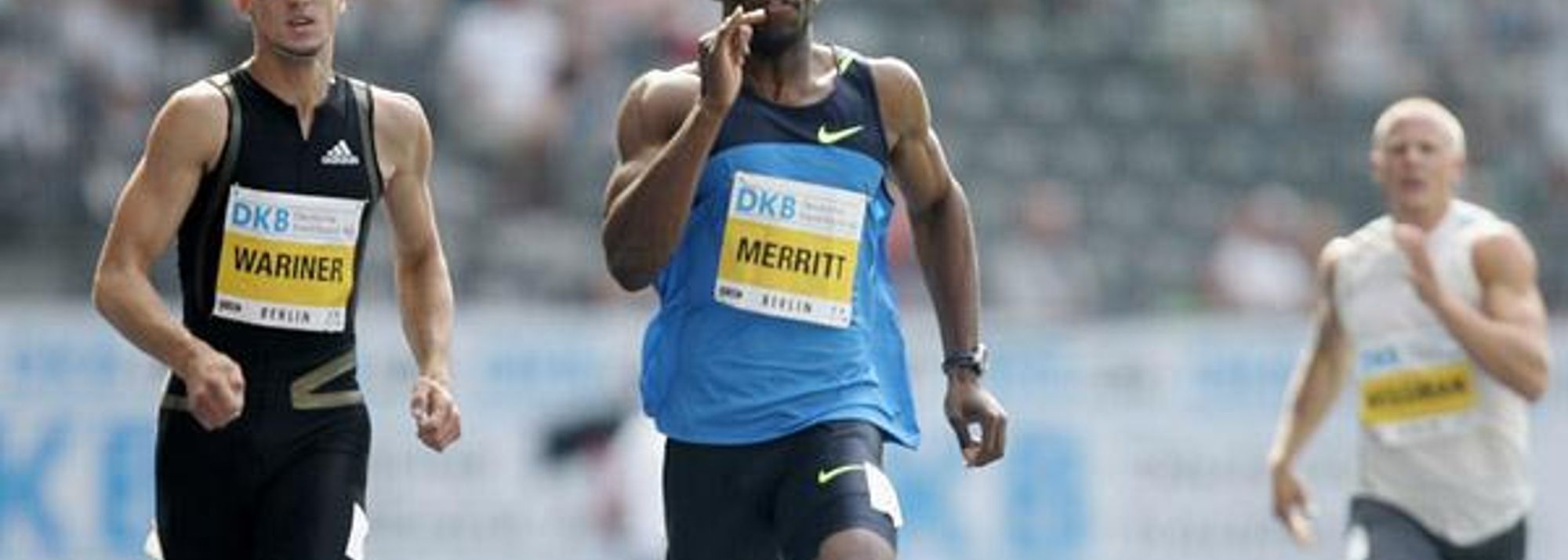


LaShawn Merritt beats Jeremy Wariner over 400m in Berlin (© Getty Images)
The U.S. Olympic Trials begin here today, and to steal a phrase from Baron de Coubertin, the important thing is not winning, but finishing in the top three.
It’s that simple: it doesn’t matter if you’re the World record holder, or the 2004
Olympic champion or the 2007 World champion, or have won 10 consecutive U.S. national championships, unless you finish first, second or third in your event here, you won’t be going to Beijing.
Of course, the winner of each event is the 2008 U.S. national champion, which usually involves bonus money from shoe sponsors, and of course we’re talking about very competitive athletes who hate to lose in any competition – but almost every runner, jumper or thrower competing here would gladly settle for a third place right now.
Since the schedule mimics the Olympics, the athletes will be going through four rounds of the 100 and 200 and the 100/110 hurdles, and three rounds of the 400/400 hurdles, the 800 and the 1500. This should result in a fire-hardened group for Beijing, although wear and tear, injuries and accidents may be expected in the process.
Sprints - Gay hot favourite, closest call in women’s 100
With that lengthy preface, what can you expect from the next 10 days?
There really isn’t much of a form chart – many athletes have competed sparingly indoors and during the short outdoor season – so we’ll try to highlight some of the events where fireworks may be expected (a full-scale event-by-event preview would be as long as some novels are).
First, and not surprisingly, the keenest competition will come in the speed events – the sprints and hurdles – where Americans have traditionally excelled. 2007 Osaka World champion Tyson Gay is favoured to win the men’s 100 and 200 metres, and his former University of Arkansas team-mate Wallace Spearmon figures to be close behind him in both races, along with Xavier Carter and Walter Dix.
In the women’s 100 - well, you saw the Osaka finish, where it took the judges five minutes to decide if the winner was Veronica Campbell, Lauryn Williams or Carmelita Jeter. Williams and Jeter are here, along with Osaka fourth-placer Torri Edwards, but there’s also Allyson Felix, the 200 champion at Osaka, who wants to add the 100 to her repertoire, and has run 10.93 this year.
And there are several others - especially Marshevet Hooker, Muna Lee and Lisa Barber - who could make the top three without surprising anyone. Keep your eyes on the rounds results.
Half Lap – Felix in a class of her own
In the 200, Felix, the only currently active sub-22 runner, should win easily. Closely watched will be 19-year-old Bianca Knight, who set a World indoor record at the indoor NCAAs, and then promptly turned professional.
Wariner V Merritt rematch in 400
The men’s 400 metres became more interesting when LaShawn Merritt beat Olympic and World champion Jeremy Waringer in Berlin earlier this month. These two are favoured, but the third spot is wide open. Two of the possibilities are Xavier Carter – yes, he’s entered in the 100 and 200, too – and Angelo Taylor, the 2000 Olympic gold medallist in the 400-metre hurdles (he’s also entered in the 400 hurdles here).
Redemtion time for Richards
The women’s 400 will be a real test for Sanya Richards. This charming and gracious young woman has been the world’s No. 1 for the past three years, but a bout with the rare Behcet’s disease last year robbed her of the ability to run a strong final when rounds were involved. Her workout sessions and medications this year have been designed to overcome the problem, but this will be the acid test.
Sprint hurdles wide open
Both men’s and women’s straightaway hurdles are loaded with talent. Five women here have run 12.56 or faster for the 100-metre hurdles – including 2004 Olympic champion Joanna Hayes, 2007 World champion Michelle Perry and 2008 World indoor champion Lolo Jones. Check out the IAAF world list, and take your pick.
The men’s 110 hurdles field is just as crowded, with six entrants having PBs of 13.02 or better. Two-time Olympic silver medallist Terrence Trammell and 1996 gold medallist Allen Johnson are in the mix, but Anwar Moore (whose best time is a wind-aided 13.00, but who wins a lot of races) and this year’s Doha winner at 12.95, David Oliver, will be hard to keep off the U.S. team.
World champs Clement and Jackson face off in 400 Hurdles
The 400-metre hurdles are less complicated. 2000 gold medallist Angelo Taylor, as noted above, hopes to double, but he’ll have to contend with 2007 and 2005 World champions Kerron Clement and Bershawn Jackson. Breaking into that top three will be tough, and the final could produce some very fast times.
In the women’s 400 hurdles, LaShinda Demus would seem to be in a class by herself. She was No.1 in the world in 2006 before taking 2007 off (to produce twins) and has returned full force.
Lagat heads middle distance fields
The men’s middle distances will be dominated by 33-year-old Bernard Lagat, who’d like to repeat his 1500/5000 Osaka double in Beijing. In the 1500, he’ll be up against youngsters Alan Webb, Lopez Lomong (a former “Lost Boy” of Sudan), and Leonel Manzano. All but Webb are naturalized American citizens. Shannon Rowbury has emerged this year as the best American woman 1500 runner, posting a 4:01.61.
Circling back to the men’s 800 metres, the two likeliest winners are front-running Khadevis Robinson, a familiar on the world scene for years, and fast-finishing Nick Symmonds. Behind those two, it’s anybody’s guess. The women’s 800 is even more of a toss-up - from Hazel Clark-Riley, whose family tradition of world class in the 800 goes back more than 20 years (sister Joetta, sister-in-law Jearl Miles Clark), to recent high school graduate Chanelle Price, who has run 2:01.61.
In the men’s 5000, the presence of Bernard Lagat and Matt Tegenkamp (1-4 in Osaka), leaves only one place, and that one is wide open. Shalane Flanagan, who set a new American record for 10,000 metres (30:34.49) this spring to go with her 5000 record of 14:44.80 of last year is entered in both distances. The 10,000 final here is scheduled for today (27th) and the 5000 for 4 July, so a double is possible. In the 5000 her chief competitors are Lauren Fleshman and Jen Rhines, and in the 10,000 she’ll be up against the redoubtable Kara Goucher, surprise third in the Osaka 10,000, who has remarkable range –from a 4:05.14 1500 to a 1:06:57 half-marathon!
A record for Barringer?
A focus of interest in the men’s 10,000 will be whether 2004 Olympic marathon silver medalist Mebratom Keflezighi, 33, who finished eighth in this year’s marathon Trials, can make the team in the event in which he holds the national record at 27:13.98.
America’s current steeplechasers, male and female, are more than 20 seconds off the World records (the exception is American record holder Daniel Lincoln, at 8:08.82, who is injured). The biggest news likely to come out of the Trials is a new national record in the women’s race; favourite Jennifer Barringer ran a solo 9:29.20 two weeks ago, and record holder Lisa Galaviz (at 9:28.75) is also in the race.
In the men’s 20,000-metres race walk, only Kevin Eastler and Tim Seaman have made the “B” standard, and both are coming off injuries. In the women’s walk, perennials Teresa Vaill, 45, and Joanne Dow, 44, will probably fight it out for the lone place on the women’s team.
No rivals for Walker and Stuckzynski?
Turning to the field events, it would appear that there are four men high jumpers in good form right now, all with PBs of 2.33 or better; they are 2004 Olympian Tora Harris, 2008 World indoor bronze medalist Andra Manson, NCAA indoor champion Dusty Jonas, and Jesse Williams. Someone won’t make the U.S. team. The only two American women who have cleared 2 meters (both at 2.01) are Amy Acuff, fourth at Athens in 2004, and Chauntee Howard, second in the Helsinki Worlds in 2005.
The pole vault fields should be headed by Brad Walker, who has jumped 6.04 this year, and Jenn Stuckzynski, second on the year list at 4.90. Both are consistent, but behind them there’ll be a scramble for the other spots; Stacy Dragila, the first women’s Olympic gold medallist in the vault (in 2000), is attempting to make her third Olympic team.
21-year-old long jumper Brittney Reese heads the U.S. women’s list this year with 6.93m, and if she can fix a few technique problems could be an Olympic medallist. The only other jumper close to her is Funmi Jimoh, at 6.91. 2004 men’s gold medalist Dwight Phillips was shunted to third at Osaka by the superb Irving Saladino and Tony Hunt, but he should finish in the top three here, either ahead of or just behind Brian Johnson, who leads the U.S. list with 8.33m.
Both triple jumps should be exciting. Four men, Kenta Bell, Rafeeq Curry, 2005 World champion Walter Davis and Aarik Wilson, have jumped past 17.20. But Davis hasn’t competed this year at all. Who will be the odd man out? The women’s TJ (which may well produce a new national record) is similar: national record holder (at 14.45) Tiombe Hurd, 34, will be challenged by Shani Marks (14.30), Erica McLain (14.20w), and Shakeema Welch (14.15). Who will be the odd woman out?
World class men’s Shot Put
The men’s and women’s shot puts provide a huge contrast. The top three men - Christian Cantwell, Reese Hoffa, and Adam Nelson, all with PBs between 22.43 and 22.54 – can justifiably be considered to be the top three in the world. It would be a major upset if they do not finish 1-2-3 here. In the women’s shot, the top-ranked thrower, Jessica Pressley has a best of 18.79, nearly four metres off the World record.
Since many American discus throwers’ PBs are distorted by marks set in such windy spots as Salinas, California and Maui, Hawaii, it’s hard to know who will do well in a closed arena like Eugene’s Hayward Field. Jarred Rome and Ian Waltz have been America’s two leading throwers for several years, often finishing within a few centimetres of each other when they compete. An interesting challenge will come from 36-year-old John Godina, who has given up the shot to concentrate on the discus. The women’s discus looks to be a tight four-way battle between 2004 Olympians Aretha Thurmond and Stephanie Trafton (nee Brown), 1996 and 2000 Olympian Suzy Powell, and brash newcomer Becky Breisch – and once again only three can make it.
The men’s hammer throw has only one “A” qualifier, A.G.Kruger, and the best mark by an American woman this year, Amber Campbell’s 70.19m, is more than eight metres short of the world record. The hammer competition here will be close and exciting, but it won’t affect the Olympic Games.
Greer and Clay heading towards national titles
Breaux Greer, who holds the American record for the javelin throw at 91.29, should win here and be a medal contender in Beijing. Leigh Smith and Mike Hazle have also bettered the “A” standard, and considered likely to make the team. In the women’s speerwurf, national record holder Kim Kreiner (at 64.19) is recovering from elbow surgery.
Finally, the multi-events. The heptathlon shapes up as a battle between two-time national champion Hyleas Fountain and recent NCAA winner Jacquelyn Johnson, with Diana Pickler and Gi-Gi Miller-Johnson in a close con test for the third spot.
The decathlon looks likely to produce a strong three-man entry for Beijing. Start with Bryan Clay, (PB 8,820), 2004 Olympic silver medallist and 2005 World champion, often-injured but now in excellent health. Next, Tom Pappas (PB 8,784), five times U.S. champion, often injured but now in excellent health. Complete the trio with collegiate record holder Trey Hardee, (PB 8,465) who came off 20 months of injury and re-hab this spring to score 8,371 points at less than full effort, and looks ready for much more.
That’s a look at some who might make the 2008 U.S Olympic team. To see who actually does make it, stay tuned for the next 10 days.
Jim Dunaway for the IAAF


