

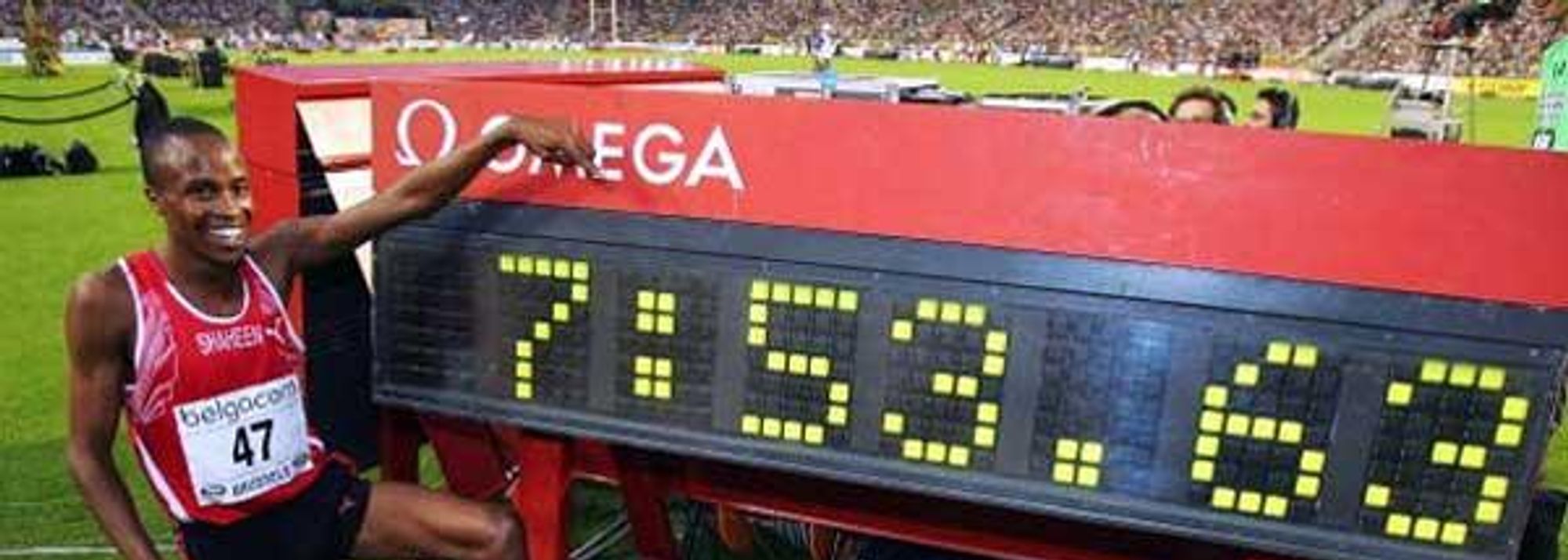


Shaheen sits by his World record clock in Brussels (© Getty Images)
MEL WATMAN of “Athletics International” reviews the highlights of the six TDK Golden League meetings in 2004.
11 June, Bergen, Norway
The 2004 TDK Golden League series got away to a rip-roaring start when Elvan Abeylegesse (21), the Ethiopian-born Turk, smashed the World record for the women’s 5000m at the Bislett Games in Bergen’s Fana Stadium, deputising this year for the traditional venue of Oslo’s Bislett while that stadium was being rebuilt.
Although it had stood to the credit of China’s Jiang Bo at 14:28.09 since 1997, the record had long been regarded as vulnerable and Abeylegesse, the European junior 3000m and 5000m champion of 2001 and winner of the 5000m at the 2003 World Athletics Final, seized the opportunity. The first two kilometres were covered unevenly in 2:49.56 and 2:57.80 but when Abeylegesse raced ahead on the sixth lap the tempo became more regular. She reached 3000m in 8:37.84 (2:50.48 kilometre) and followed with 2:52.59 and 2:54.25 for a final time of 14:24.68 … Turkey’s first world record. Behind her, World champion Tirunesh Dibaba smashed her own World Junior record with 14:30.88, while her elder sister Ejegayehu Dibaba was third in 14:32.74.
With other Ethiopian runners filling the next three places the race was a triumph for that nation, but Ethiopia had to settle for second, third and fourth in the men’s 5000m as John Kibowen of Kenya outkicked Gebre Gebremariam in 13:01.94. In a race of impressive depth (ten men inside 13:09) the Ethiopian junior Mulugeta Wondimu ran 13:02.42 for third, while his even younger compatriot Tariku Bekele, aged 17 and younger brother of the new World record holder, clocked an amazing 13:12.49 in his first attempt at the distance! Another precocious junior, Boniface Kiprop, set a Ugandan senior record of 13:07.56. Meanwhile, Australia’s Craig Mottram with an Oceania record of 13:03.37 and Marius Bakken with a Norwegian record of 13:08.27 proved that non-Africans could still be competitive at the longer distances.
Of the 15 events staged in Bergen, 12 qualified for TDK Golden League status and thus each of the winners was able at least to dream of remaining undefeated in the five ensuing meetings and earning a share of the million dollar jackpot. In addition to Abeylegesse, they were Shawn Crawford (20.31 200m), Yuriy Borzakovskiy (1:44.41 800m), Bernard Lagat (3:34.08 1500m), Felix Sánchez (48.54 400m Hurdles), Christian Olsson (17.58m Triple Jump), Virgilijus Alekna (69.21m Discus Throw), Torri Edwards (11.21 100m), Tonique Williams (49.78 400m), Iryna Lishchinska (4:03.76 1500m), Gail Devers (12.56 100m Hurdles) and Hestrie Cloete (1.98m High Jump).
Among the competitors were nine athletes who would be crowned Olympic champions two months later. Of those, six won their events in Bergen: Crawford, Borzakovskiy, Sánchez, Olsson, Alekna and Williams. Justin Gatlin, the 100m champion in waiting, finished second in the 200m and local star Andreas Thorkildsen placed third in the javelin (won by Breaux Greer with a North American record of 87.39m), but Meseret Defar could hardly have been viewed as a golden Olympic prospect as she trailed half a lap behind the winner in the 5000m, finishing sixth in 14:58.79.
2 July, Rome, Italy
Of the dozen athletes who won their TDK Golden League events in Bergen, only seven showed up for the second leg at the Golden Gala three weeks later as Shawn Crawford, Torri Edwards, Iryna Lishchinska, Elvan Abeylegesse and Gail Devers decided to prepare for the Olympics in other ways.
Two others - Yuriy Borzakovskiy and Bernard Lagat - fell by the wayside in Rome. Borzakovskiy’s even-pace running in the 800m often pays off handsomely, as Athens would demonstrate, but on this occasion he left himself with too much ground to make up in the final straight. Out in lane five at one stage as he overtook a cluster of rivals, he clocked the decent time of 1:44.19 but fell short of catching World record holder Wilson Kipketer, who ran a magisterial 1:43.88 in his first race of the year, and Hezekiél Sepeng (1:43.94).
Lagat (3:30.81) and Mehdi Baala (3:31.25) were engaged in a spirited battle along the finishing straight in the 1500m when the little known Rashid Ramzi burst between them just before the line to claim victory in the Asian record time of 3:30.25. The former Moroccan, now representing Bahrain, had never run faster than 3:39.30 until making an astonishing breakthrough with 3:31.87 in Algiers the previous week, although he had attracted attention with his silver medal at 800m in the World Indoor Championships. Yet, exciting as the finish was, many incredulous eyes were fixed instead on Hicham El Guerrouj. Rome has been a happy hunting ground for him, scene of his World 1500m (3:26.00) and Mile (3:43.13) records, but this race was one to forget. Weakened by a chest infection, he crashed to his worst ever defeat as he gave up before the finish to jog over the line in ninth place in 3:32.68. It was his first loss at the distance since the Sydney Olympics.
Another long invincible athlete who came to grief was Ana Guevara in the 400m. Her near-three year win streak came to an end when she found that even a time of 49.74 left her four metres adrift of Tonique Williams, whose 49.25 was a Bahamian record and over half a second quicker than her previous best time in Bergen. Williams thus kept alive her jackpot hopes, along with Felix Sánchez (48.43), Christian Olsson (17.50m), Virgilijus Alekna (68.42m in windless conditions) and Hestrie Cloete who cleared 2.03m to win by virtue of fewer failures against her future nemesis Yelena Slesarenko.
Other top action included an incredibly close finish to the 110m Hurdles with the verdict, initially called as a dead heat, going to Allen Johnson over Liu Xiang as both clocked 13.11. Paul K Koech ran 7:59.65 in the steeplechase, Tatyana Lebedeva long jumped beyond 7 metres for the first time (7.01m) and a superb 5000m, in which the first five broke 13 minutes and another seven streamed in under 13:09, won by Eliud Kipchoge in 12:46.53.
23 July, Saint-Denis (Paris), France
Performing before the largest crowd (63,851) ever assembled for a Golden League fixture, all five jackpot contenders kept themselves in the running at the Gaz de France meeting.
Felix Sánchez and Christian Olsson added to their long win streaks. Sánchez notched up his 38th consecutive 400m Hurdles victory (heats included) in 47.99 ahead of a much improved Naman Keita, down from 48.82 to 48.17, while Olsson extended his Triple Jump sequence to 29 with a leap of 17.41m…and was not that far short of 18 metres with his two narrow fouls. In the absence of his arch-rival Róbert Fazekas, Virgilijus Alekna won the discus by well over four metres with a great throw of 70.21m, his second longest mark of the year.
Hestrie Cloete high jumped 1.99m, but so too did Vita Styopina and Blanka Vlasic. The Croatian was placed third on count-back but Cloete and Styopina had identical records - all first time clearances up to and including 1.99m followed by three failures at 2.01m - and consequently a jump-off was required. Growing increasingly fatigued, both failed at 1.99m and 1.97m but the South African World champion prevailed when she made 1.95m and her opponent didn’t. By contrast, Tonique Williams-Darling as she now wished to be known (husband Dennis Darling is a sub-46 400m performer) proved to be in a class of her own at 400m. Ionela Tirlea-Manolache narrowly edged Christine Amertil for second place in 50.48, all of ten metres behind the winner whose time of 49.15 was another improvement on her Bahamian record.
With the notable exceptions of Allen Johnson (13.07 110m Hurdles) and Muna Lee (22.49 200m), many of the American competitors were understandably below the form they had displayed in their Olympic Trials which had ended just five days earlier. For example, hoping to celebrate his 30th birthday in style Maurice Greene (10.14) was no match in the 100m for Francis Obikwelu (10.06), who returned to set a Portuguese 200m record of 20.12.
Christine Arron (11.10) maintained her season’s unbeaten record at 100m, just, but the best moment for the big crowd came in the men’s 400m where former 8m long jumper Leslie Djhone came from nowhere in the closing stages to snatch victory from the seemingly certain winner Alleyne Francique in 44.99.
Both 1500m races were notable affairs. In the men’s event Bernard Lagat, second to Hicham El Guerrouj on the World all-time list, went ahead soon after the bell, passed 1200m in 2:47.93 and won in 3:29.21, which at the time was the year’s fastest mark. Fellow Kenyans, led by Timothy Kiptanui in 3:30.04, occupied the next four places. On the women’s side Judit Varga’s winning time of 4:03.92 was relatively ordinary but what a mass finish as ten runners flocked across the line within a second of her! Isabella Ochichi, a 68:38 half marathoner, revealed previously unsuspected speed to boost her Olympic 5000m prospects by running away with the 3000m in 8:31.32, a time which would survive as the fastest of the year.
6 August, Zürich, Switzerland
And then there were four. After a momentous discus contest Virgilijus Alekna dropped out of contention for the jackpot. A fourth round throw by the Lithuanian of 69.21m to edge ahead of 69.13m and 68.93m by the Hungarian duo of Róbert Fazekas and Zoltán Kövágó would normally have ensured victory…but Fazekas produced an immediate fourth round response of 69.77m. A disappointing postscript was that Fazekas would subsequently be stripped of the Olympic title for a doping offence.
Meanwhile the other four in line for the big prize continued on their merry way. Felix Sánchez did not have a good race by his exalted standards and was lagging behind James Carter and Bershawn Jackson at the penultimate hurdle, but he kept his cool, dug in and surged to victory in 47.92. Christian Olsson also had to work hard for his victory. A third round leap of 17.40m kept him a precarious 2cm ahead of Kenta Bell until the Swede climaxed his series with a jump of 17.46m.
Blanka Vlasic gave Hestrie Cloete stiff competition in the High Jump as both were faultless up to and including two metres. However, Vlasic was unable to make 2.04m, a height cleared by Cloete at her first attempt, equal to what was at the time the world’s highest mark of the year. As for Tonique Williams-Darling, whose best 400m time before 2004 was 50.24, her dream season continued when, as in Rome, she drew away from Ana Guevara in the closing stages to score in 49.73 against the Mexican’s 50.18.
The race of the meeting was the 1500m. Hicham El Guerrouj sustained his second defeat of the season but was happy enough with his form for by running 3:27.64 he proved he was back on course for his third and final attempt to become Olympic champion. A furious pace was laid on by Arthémon Hatungimana with 52.87 at 400m and 1:50.13 at 800m, and El Guerrouj was in front at 1200m in 2:46.34, a mere hundredth of a second slower than when he established the World record of 3:26.00. However, Bernard Lagat clung to him with tremendous determination and edged ahead in the final few strides for a great win in the year’s fastest time of 3:27.40. Only he (once), El Guerrouj (seven times!) and Noureddine Morceli (once) had ever run quicker.
As always at the Weltklasse meeting practically every event featured fabulous competition and depth. Take the 800m as an example. The ‘B’ race, in which three men broke 1:44, produced what was briefly the World’s fastest time of the year when Youssef Saad Kamel of Bahrain set an Asian record of 1:43.11. The former Gregory Konchellah of Kenya thus fell just 5/100ths of a second short of his father’s best time (double World champion Billy Konchellah)…although the family record remains 1:42.98 by his uncle, former Commonwealth champion Patrick Konchellah!
Later, in the main race, four men bettered 1:44 with Wilfred Bungei the winner in 1:43.06. The women’s 800m was not so dusty either as Maria Mutola extended her winning sequence in Zürich to a staggering 12 years running. She had to run fast (1:57.47) to contain Jearl Miles Clark (1:58.03) who just short of her 38th birthday ran her best time for five years.
3 September, Brussels, Belgium
Held only five days after the Olympic closing ceremony, the Ivo Van Damme Memorial provided an ideal opportunity for many of the newly crowned champions to begin a new and exciting phase of their careers while those who missed out in Athens had an early chance to prove their true worth. Consequently, the capacity crowd of over 47,000 were treated to a brilliant evening of athletics at its best and were thrilled to witness two World records.
The first, in the steeplechase, involved one of the few athletes present who had not competed in Athens. Ezekiel Kemboi may have led a Kenyan 1-2-3 at the Olympics but the world’s no 1, Saif Saaeed Shaheen (the former Stephen Cherono of Kenya), was unable to represent Qatar at the Games because the land of his birth would not give its consent. That goal denied him, Shaheen would concentrate on becoming World record holder. He succeeded, in the process destroying a field which included the Olympic silver and bronze medallists. His time of 7:53.63 - which prior to 1956 would have been a World record for 3000m on the flat - broke Brahim Boulami’s ratified mark by 1.65. Ahead of the Moroccan’s schedule at 1000m (2:36.13 as against 2:39.66) and 2000m (5:18.09 to 5:19.45), Shaheen strode out alone for the entire final kilometre which he covered in an outstanding 2:35.54 to win by over 50m from Paul K Koech (8:02.07). A close third in 8:02.66 was Boulami in his first race since failing a drugs test and serving a two year suspension.
The other World record fell to someone who has made a lucrative practice, Bubka-like, of improving a centimetre at a time in the Pole Vault. Having cleared 4.87m in Gateshead, 4.89m in Birmingham (recapturing the record from Svetlana Feofanova at 4.88m), 4.90m in London and 4.91m winning the Olympic title, Yelena Isinbayeva this time sailed over 4.92m at the third attempt. With Feofanova unable to go higher than 4.62m, second place was shared at the personal best height of 4.72m by Tatyana Polnova and Monika Pyrek, the latter setting her 68th Polish record!
On the jackpot front, it proved a disastrous evening for Felix Sánchez and Hestrie Cloete. Still on a high after his Olympic triumph in the year’s quickest time of 47.63, Sánchez seemed a near certainty to ring up his 44th consecutive hurdles win (heats included), but alas he pulled up injured midway through a race won by Bayano Kamani in 48.30. As for Cloete, she jumped 1.96m but - as in Athens - Yelena Slesarenko (2.00m) had the measure of her.
Thus, with one meeting remaining, just two athletes were still in the contest for the million dollar prize. Christian Olsson’s opening jump of 17.44m was never threatened, while in the women’s 400m Tonique Williams-Darling again dominated Ana Guevara, 49.59-49.95.
Among other highlights: Asafa Powell speedily put his Olympic disappointment behind him by taking the 100m in a Jamaican record time of 9.87, Eliud Kipchoge posted the world’s fastest 3000m time of the year with 7:27.72 and a World Junior 10,000m record of 27:04.00 was set by Boniface Kiprop of Uganda for fifth place in a race won in 26:59.54 by Qatar’s Abdullah Ahmed Hassan, the former Albert Chepkurui of Kenya.
12 September, Berlin, Germany
The magnificently rebuilt Olympic Stadium was the setting for the final act of the TDK Golden League jackpot drama. The burning question was whether Christian Olsson and Tonique Williams-Darling could each earn a cheque for half a million dollars, for that would be their reward for a sixth consecutive victory. If one succeeded and the other faltered, the prize would be the full million. If both were beaten neither would win a cent and they would have to console themselves with the other golden prize they had landed that summer…an Olympic title.
First to be tested was Olsson, and he passed with flying colours. He landed a good jump of 17.45m in the second round and no one seriously threatened that distance, Walter Davis coming closest with 17.21m. Now the pressure was on Williams-Darling. She was up against Ana Guevara, whom she had deposed as world’s no 1 and who was thirsting for revenge, but as in their four previous encounters this year the Bahamian was just too strong for the Mexican. Guevara produced her fastest time of the season with 49.53 but still found herself nearly half a second behind as her opponent crossed the line in yet another national record of 49.07, quickest in the world in 2004.
Of the other Olympic champions on display before the 61,150 crowd, Tim Mack won the Pole Vault at 5.80m, Joanna Hayes the 100m Hurdles in 12.46, Yelena Slesarenko the High Jump at 2.00m (on countback against Amy Acuff with Hestrie Cloete third at 1.97m), Tatyana Lebedeva the Long Jump with 6.89m and Osleidys Menéndez the javelin with 65.98m. Kelly Holmes, her feet not yet quite back to earth after her astounding double in Athens and the resulting celebrations, was not at all disappointed to lose to Olympic runner-up Tatyana Tomashova in the 1500m (4:04.41 to 4:04.49), just relieved she was still so competitive. Faní Halkiá, the toast of Greece after her sensational showing in the 400m Hurdles, exhibited impressive flat speed as she placed fourth in the 400m in 50.56 to smash the national record. Her fastest before this year stood at 53.46!
The most emotional aspect of this 63rd ISTAF meeting was the final competitive appearance on home soil of one of Germany’s all-time greats, 39 year-old Heike Drechsler. The woman who won the inaugural World long jump title 21 years earlier, was twice Olympic champion and who jumped over seven metres more than 400 times, may have finished last with less than six metres but the fans didn’t mind and showed their appreciation of an astounding career.
As for the future, a glimpse was provided in the men’s 5000m. Mulugeta Wondimu (aged 19 and still a junior), the Ethiopian 1500m record holder at 3:31.13, smashed his personal best with a brilliant 12:57.05…and yet he was narrowly outsprinted by Kenya’s World junior 5000m champion Augustine Choge, whose 55.44 last lap carried him to victory in 12:57.01. That was a world youths record for he is only 17!

