

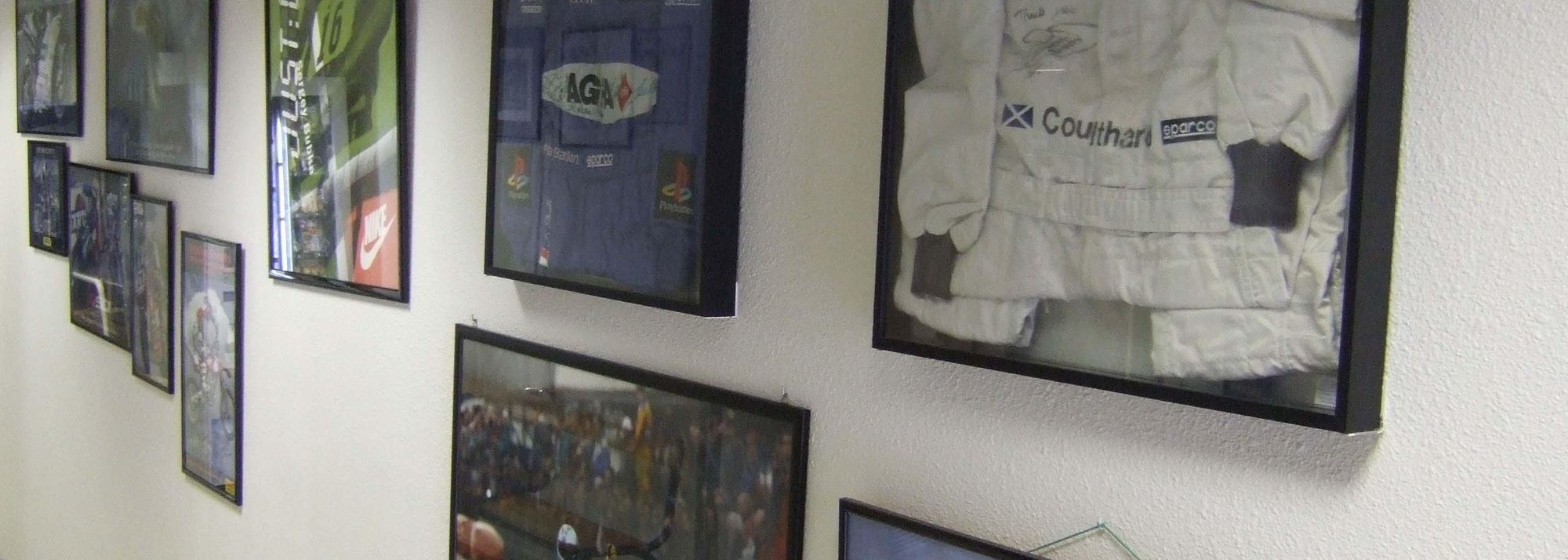


'Thank you's' adorn the wall of Monaco's Salle de Musculation (© Chris Turner)
Modern gym culture can be intimidating. The prospect of wafer thin women glowing with exertion as they manically peddle away on a line of static bikes, or bicep bulging would-be Mr. Universes effortlessly jerking 100s of kilos of weights up above their heads, can challenge the self esteem of even the most self assured would be athletes.
Not so Monaco’s 'Salle de Musculation'!
The gym is located at the Stade Louis II in Monaco’s Fontvieille district which is home to numerous sports associations including the Principality’s French premier league’s football club. It is the venue which of course hosts the annual Herculis athletics meeting, which is a Super Grand Prix status meet as part of the IAAF World Athletics Tour, the 2008 edition of which takes place next Tuesday (29).
Over the decades Monaco has done its level best to warmly welcome the elite of world sport, from athletics’ more famous Grand Prix cousin, the F1 Motor Race, to the even longer established Monte-Carlo Rally, the ATP Tennis Masters, and a multiplicity of other annual international sporting festivals.
Along with Monaco’s Royal Family, Monte-Carlo’s Casinos, its banking and yachting businesses, elite sport is one of the main pillars on which this tiny Mediterranean Principality’s fame has been based and its fortune’s prospered.
Monaco has gone out of its way to attract the best of world sport and one of the principal results of that policy’s lure was that the IAAF moved its HQ from London to this tax-free haven in 1994.
The sports facilities on offer are world class and along with the recently opened Institute of Sports Medicine and the Côte d'Azur’s well known and exceptionally attractive climate, boasting over 300 days of sunshine per year, Monaco is one of the planet’s most attractive training destinations.
The nation’s sport and fitness policy is embedded in the government’s social vision, a dual approach of elite and community involvement and it is into this specialised raison d'etat that the Salle de Musculation and the ethos of the man who is responsible for it, former Polish National Swimming Head Coach Jacques Choynowski, so effortlessly jigsaws.
For those who discard their gym culture fears, undertake the obligatory health check in the stadium’s medical centre, and then enter into this sanctum of fitness a warm greeting awaits.
In a large mirrored rectangular room that burgeons with fitness equipment, you’ll find experienced qualified instructors and the friendliest of clientele that anyone could wish. And to relieve the muscle aches there is a sauna in both the men’s and women’s changing areas.
The Principality of Monaco has managed to blend an elite fitness establishment with the atmosphere of a local social club. As one lies down to do some muscle-taxing sit-ups, you are as likely to be exercising next to an Olympic champion as you are to a ‘girl from accounts’ from a nearby yacht chartering firm or a podgy banker working off an over indulgent lunch.
Track and field athletes of legend such as Sergey Bubka, Merlene Ottey and Frank Fredericks have all trained in this room, as have numerous World and Olympic Champions from sports as diverse as alpine skiing, cycling, formula 1, football, ju-jitsu, motor biking, sailing, triathlon etc….
The statistics of success are unarguable. In 20 years the gym has seen over 400,000 visits by over 3800 people, which isn’t bad for a training area of 260sqm.
Recognition or the lack of it
Coaches are generally the unsung heroes of world sport. With the occasional exception the world’s sports stars usually receive their trophies, top-out podiums, and enthusiastically spray champagne, with seldom a mention in the press or TV of the men or women who have refined the talents and techniques which have taken those sports personalities to success.
If trainers do get a mention then it is the technical coaches that grab the limelight but for general fitness trainers the usual realm is one of anonymity.
One man who contentedly basks in this position is Choynowski, who gets his reward from the dozens of world class athletes he has had the fortune to work with over the years, their success is his reward.
No words are necessary to recognise the gratitude and respect so many owe to this Polish ex-pat. As one enters the gym both walls of the corridor leading from the reception area to the changing rooms are lined with framed and autographed photographs, posters and sports clothing which have been donated to Choynowski and his staff in recognition of their assistance in physically honing some of the world’s champions.
Choynowski arrived in Monaco in 1987 at the invitation of Madame Lambin-Berti, who is now General Commissioner for National Sport and Education in Monaco, but at the time was the first director of the new stadium. The idea was to open a fitness centre which could help to prepare the football squad, the bobsledders…all the national teams of Monaco, and at the same time serve the community’s fitness too.
The Monegasque sport scene was a buzz at the time. 1987 was the same year in which Arsene Wenger was contracted to be Monaco’s football coach, and its basketball team under the team leadership of Bill Sweek became affiliated to FIBA. Many of the stars from those teams such as Enzo Scifo, Emmanuel "Manu" Petit, Mickael Madar, Robert Leroy Smith etc…have found their physical fitness perfected within the walls of Monaco’s gym.
State communism blocks the way
In 1981, Choynowski had left his native Poland to settle in France after an illustrious period of four years as coach to the country’s National Women’s Swimming Team. This was a period highlighted by the Moscow Olympics bronze medal of Agnieszka Czopek in the 400m Individual Medley, which was Poland’s first ever Olympic aquatic podium.
The youngest ever national level swimming coach, Choynowski was voted in 1978, 79, and 80 as the best swimming coach in Poland and in 1979 as the best trainer across all sports in the country.
A patriot though not a ‘party man’ in what was then an iron curtained Poland, Choynowski battled against all the political odds to rise in national sports circles with his greatest achievement being the foundation in 1978 of the National Olympic School of Swimming in his native Krakow.
Coaching swimmers who between them won 684 medals at national championship level was an inspiring achievement which gained Choynowski’s Krakow club, 6 times national club champions and 15 times vice-champions, recognition which even communist party administrators could not afford to ignore.
A journey to Warsaw to discuss his plans for a centre of swimming excellence with the comparatively open minded Mr.Kuberski, the then Minister of National Education who had spent some time in the west, saw Choynowski’s dream of the creation of the National Olympic School of Swimming become unstoppable.
Yet even after official acceptance of the project it was a hand to mouth struggle as the authorities did no more than supply the building materials while the club members themselves, including the parent’s of the swimmers, did the physical build of the centre themselves!
The Pride and the Passion
Choynowski comes from a Polish family with an illustrious documented 800 year history. One of his great, great grandfathers was a Grand Marshal of the Royal Polish Army, and his sabre nowadays hangs on Choynowsk’s sitting room wall in Monaco.
Like his forbears Choynowski is a fighter and a proud man in all the right senses of the word. He is prepared to make sacrifices to get things done, and, though he would be too modest to admit it, it is largely his stubbornness, resolve, pride and the inspirational atmosphere that his self-will generates in all those around him which gets things achieved.
Choynowski in one word is a man of passion, and it’s infectious!
Choynowski never turned his back on his homeland, he was simply frustrated by communism’s stranglehold on all elements of social and economic interaction. It was abundantly clear to him that even with the National Olympic School of Swimming established that his personal long term development in Poland would always face obstacles under communism. Therefore, after experiencing glimpses of the freedom and dynamic economies that the west had to offer via his travel with the Polish swimming team, Choynowski made his decision to leave Poland.
Choynowski’s entry to the west and his future life came initially via the French Olympic altitude training centre in Font Romeu in France which the Polish National Olympic Committee used in conjunction with their French counterparts as part of a sporting exchange, having visited the centre with the Polish squad ahead of the 1981 European Swimming Championships. The team came home with three medals, and three months later their coach left Poland for good.
Coaching colleagues at the centre sent him word of a vacant position as Chief Coach at the AS Building in Nice, France, which after three years (1981 – 84) led to posts as a Coordinator at the Aquatic Centre of CACEL in Nice, and a Municipal Swimming Pool in St. Andre, Nice.
During the period (1982 to 87) Choynowski also lectured in Sport Medicine at the Academy of Nice.
A flurry of national titles and records followed in these years for Choynowski’s new swimming charges in Nice, the Pole’s magic was working again. It was his fast growing reputation in these years for methodically structuring the competitive and training activities of swimmers which caught the eye of Monaco in 1987.
A blend of speed and strength
Choynowski’s minutely personally crafted fitness programmes are based upon one of the fundamentals of modern sport fitness – ‘cross training’.
Choynowski’s own sporting experience - swimming , ice hockey, basketball - as a youth laid out the initial map to follow, and from his boxing days and the ethos of his coach Mr. Winklewski, Choynowski gained his moral and physical background, and his will to win.
On the other hand, in dabbling with the Decathlon (approximate pbs follow - 100 metres, 11.1sec, Long Jump, 6.90m; Shot, 13.00m; High Jump, 1.82m; 400 metres, 49.79 sec; 110 m Hurdles, 14.90, Discus, 48m; Pole Vault, 4.80m; Javelin, 46m; usually 1500 metres but he ran 1000m, 2:29:00; best total = 6430) brought him the benefits of the combination of speed and strength.
The predominant requirements of the decathlete are mobility, skill, speed and explosive strength, a combination of abilities which Choynowski has brought with great effect to a number of other sports. As Choynowski is quick to point out 40% of the preparation of an Olympic champion swimmer needs to take place out of the water.
In most recent years Choynowski has helped transform the fitness preparations of a number of the world’s top Alpine Skiers including global champions Pernilla Wiberg, Kjetl Aamoolt, Anja Paerson, Bode Miller (consulted), Kalle Pallander etc….
The current wonder girl of the US team Lindsey Vonn-Kildow, who won the overall World Cup title 2007/08, joining men's overall champion Miller as the first Americans to win both competitions since the 1983 season, has currently been under Choynowski’s fitness wing for the last three years during which she turned professional.
So unexpectedly but quite naturally in the last two decades sunny Monaco has found itself to be an increasingly popular training base for the downhill and slalom set!
Was any of this planned when Choynowski arrived in Monaco in 1987?
No, Choynowski was employed simply to look after the Salle de Musculation.
A team effort
But Choynowski is one piece in a large jigsaw which has achieved such outstanding international sporting success in tiny Monaco. From the understanding and support of Madame Lambin-Berti to the guidance and enthusiasm of HSH Prince Albert II of Monaco who Choynowski coached ahead of the Albertville Olympic Games, this has been a team effort.
That Monaco’s community gym has seen a procession of world beaters pass through its doors is the result of one thing, and that is passion. The passion for the concept of total fitness, and globally acknowledged training regimes which have made this Principality and its gym an increasingly strong magnet for many of the world’s best sports professionals.
Chris Turner
IAAF Editorial Senior Manager

