

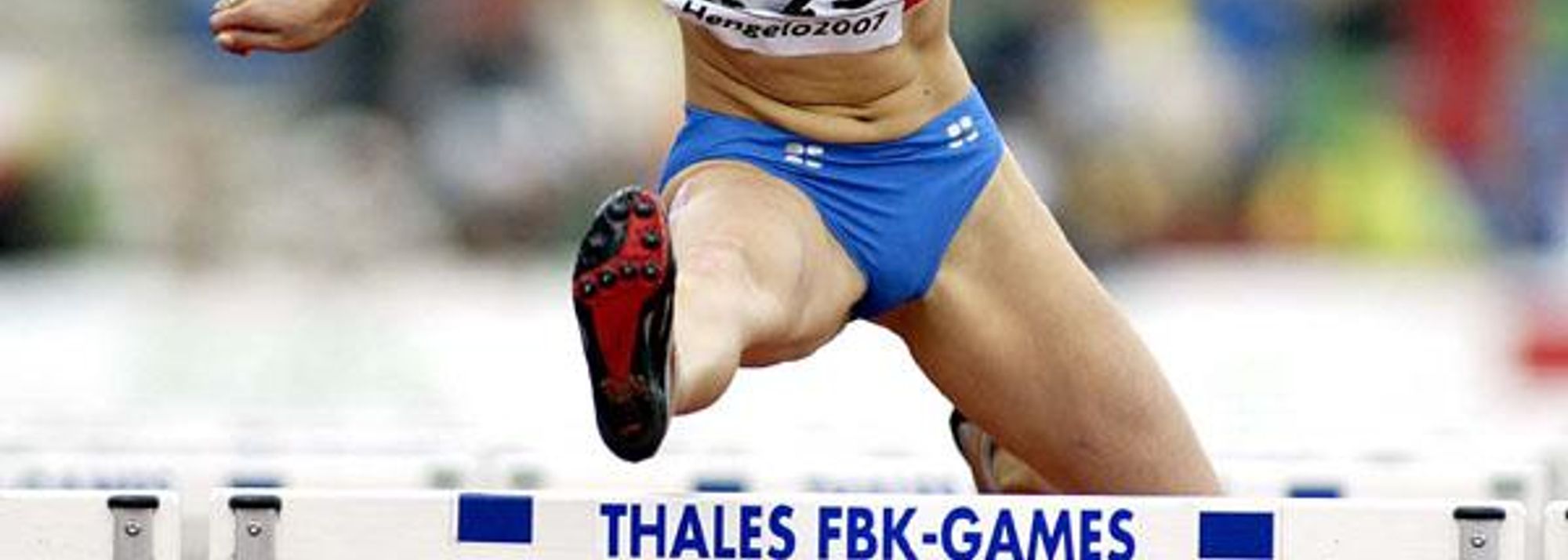


Aleksandra Fedoriva (RUS) en route to a national junior record in Hengelo (© Mark Shearman)
At the end of day three (18) at the European U23 Championships, Russia had amassed 16 medals (eight of them gold), while Britain had 13 (five gold), two more than they had ever won before and there was still a day to go. In third on the medals table was Poland with 10 in total, two of them gold.
Sandeman surprises; Fedoriva beats off Polish challenge
German’s Platini Alex Menga was supposed to win the 200m, but no one told Britain’s Toby Sandeman. Despite having a far inferior time to the German coming into these championships - 20.72sec to 20.52 - Sandeman was buoyed by the success of his team this last two days. Though Menga in lane three had Sandeman in his sights in lane six, he never managed to make contact as the Briton ran as though there were no one else in the race.
Ignoring times and reputations, Sandeman entered the straight well up and rammed home his advantage with aplomb to blast apart his PB, reducing it to a more than respectable 20.37. Menga found the going hard in the straight and only just managed to hold off the Ukraine’s Igor Bodrov by the slenderest of margins. “My biggest rival was Menga,” said Sandeman. “He was very fast and he had more experience.”
Russia’s Aleksandra Fedoriva, already an Olympic sprint relay gold medallist, pocketed gold, crossing the line a tenth of a second clear in a season’s best of 22.97. Poland’s Ewelina Ptak clinched silver while team-mate, Marika Popowicz, fought her way past Belarus’s Alena Kievich in the final metres to snatch bronze.
Quality 800s... Polish 1-2; Kofanova - 1:58
In a high quality 800m, Poland clinched a worthy one-two as Adam Kszcot in 1:45.81 and defending champion, Marcin Lewandowski, took gold and silver with Germany’s Robin Schembera, a possible aspirant to the title, in third. It was German Soren Ludolph who led as they came off the stagger, but as the field came into the straight, France’s Jeff Lastennet took over, passing the bell in 52.85. At 600m it was still Lastennet in 1:20.67, but that was when the Polish duo made their move. They still had to negotiate Schembera, the tall German, however, but Ksczot injected a ferocious sprint with 150m to go and with Schembera struggling to hold on and tying up, that was when Lewandopwski made his move.
In the women’s 800m, Yelena Kofanova made class tell to win in the first championship record of the seventh U23 championships. Leading from gun to tape she ran the field into the ground, crossing the line in 1:58.94 to supplant German Claudia Gesell’s time from ten years ago in Gothenburg.
Passing the bell in 59.32 with the Ukraine’s Natalya Lupu and Moldova’s Olga Cristea in single file, the Russian opened up a gap and extended it to the finish. With 200m to go Poland’s Agnieszka Leszczynska moved past Cristea but could make no inroads against Lupu or Kofanova who powered on towards the line, extending her lead with every step.
Sprint hurdles title for Noga and Vukicevic
Britain had been enjoying a highly successful afternoon, so it was almost no surprise when Gianni Frankis and Callum Priestley got explosive starts in the 110m Hurdles, leaving favourite, Artur Noga of Poland, trailing. Rising to the fifth hurdle it was still a British one-two, but at this stage Noga dug in and gradually hauled in the Britons. By the line, reached in 13.47, Noga had clear water between him and the minor medals and it was a tribute to his determination and technique that he was able to pull it off because Frankis and Priestley both shaved time off their lifetime bests.
Christina Vukivevic had an imperfect start, but still rose first to the first hurdle and ran away from her rivals with an impeccable display of crisp hurdling, breaking the beam in 12.99. “The start was not good at all, so I have to work on that,” the Norwegian admitted. “But I was smiling from the beginning till the finish line.”
British sweep in the 400m Hurdles
Lloyds Gumbs of Britain was third fastest on paper in the one-lap hurdles coming into Kaunas behind the Ukraine’s Stanislav Melnykov and Germany’s Silvio Schirrmeister. When the lane draw was published, with Gumbs in lane eight, it appeared to give him little chance. For Gumbs, however, it seems to have been an advantage. Disregarding the problem entirely, the Briton simply ran his own race and ran away with the race in a lifetime best 49.62. Silver went to the season leader until today, Melnikov while Vincent Vanrycheghem came through for bronze.
Britons Perri-Shakes Drayton and Eilidh Child did they were always threatened to do since they arrived in Kaunas and duly took gold and silver in the women’s 400m Hurdles. Both responded to the gun aggressively, but not so aggressively as Denmark’s Sara Petersen, bronze in the World Student Games. Down the back straight she flew past Shakes-Drayton. But given her form in the rounds, it looked as though it were more wishful thinking than a tactic. As they passed the eighth hurdle, reality descended and the British number one made her bid. Quickly dispensing with Peteresen she entered the straight in the lead and won in 55.26 with Child (55.32) half a metre in arrears and the Russian Dora Korableva (56.08) third.
Shamsutdiniva gets it on count-back; Ryzih 4.55m over Finns
Both Aleksandra Shamsutdiniva of Russia and Germany’s Melanie Bauschke cleared the same height, 1.89, but it was the Russian’s perfect card up to that moment that gave her High Jump gold.
There was a stutter at her opening height of 4.15 which she needed two looks at, but eventually Germany’s Elizaveta Ryzih settled into the task and clinched Pole Vault gold with a PB-equalling 4.50. By the time they reached 4.35, the medals were effectively decided as the Finnish pairing of Minna Nikkanen (4.45m) and Vanessa Vandy (4.35m) were the only other competitors capable of handling the height.
Final round Finnish javelin heroics for Mannio
It was a cliffhanger and maybe it will come as no surprise to hear that it involved a Finn and a Czech. In an uncanny throw-back to any of the legendary Jan Zelezny’s exploits against any number of Finns, Petr Frydrich had the audacity to attempt to steal gold from under the nose of Ari Mannio who had spent the afternoon watching everyone fall short of his first-round 80.47. But with a final throw of the dice – and a javelin – Frydrich pulled out a corker to shunt Mannio into silver with the second 80m-effort of the day.
Mannio stared in disbelief, but calmly gathered himself, calling on his country’s javelin Gods and his undoubted talent to deliver a throw worthy of gold. As the spear disappeared into the blue sky, hitting a perfect arc, it was evident it was a winner. Arms akimbo, Mannio coolly stood still, awaiting the distance. As the digital display showed 84.57, not only was Frydrich (80.53m) beaten, but so was the championship record.
It will come as no surprise to hear that it once belonged to another Finn, Harry Haatainen, set in Gothenburg ten years ago. As if to complete the event’s symmetry, taking it back to its ancient roots, the third actor in the drama was Greece’s Spiridon Lebesis, who had three out of five valid throws that would have won bronze.
Sedyuk and Marghieva wrap up other day 3 throws
Nikolay Sedyuk of Russia collected men's Discus Throw gold by dint of being the only finalist to come close to his season’s best (60.61). His winning throw of 60.80 came in the fifth round and was enough for gold despite having 63.90-performer, Martin Wierig of Germany to contend with. Wierig had come through the qualifiers untroubled, needing only one throw, but could not improve on his second effort of 59.12.
Season leader, Zalina Marghieva of Moldova, wrapped the Hammer Throw title up in the first round with 66.20m before consolidating in the final round with 67.67m. The Czech Republic’s Katerina Safrankova clinched silver with 63.01m and Britain’s Sarah Holt pocketed bronze with 62.55m.
Miguel Angel Lopez added to the considerable Spanish Walking legacy when he collected the 20km gold in 1:22.43. Second was Dzianis Simanovich (1:22:57) of Belarus while bronze went to Italy’s Matteo Giupponi (1:23:00).
“The temperature (21C) was perfect,” commented the winner. “In Spain now it is 40C. The course was a bit difficult, but all in all everything was good.”
Kurban in lead
The final event of day one of the Heptathlon was won by Russia’s Olga Kurban in 24.57, Latvian Aiga Grabuste’s 24.73 relegating her to second overall while Kurban took over at the top. It is tight at the top, though, Kurban’s 3714 only giving her a slender three-point lead. Sergeyeva ended the day in third overall after she could finish no higher than ninth in 25.50.
Michael Butcher for the IAAF
Click here for RESULTS

