

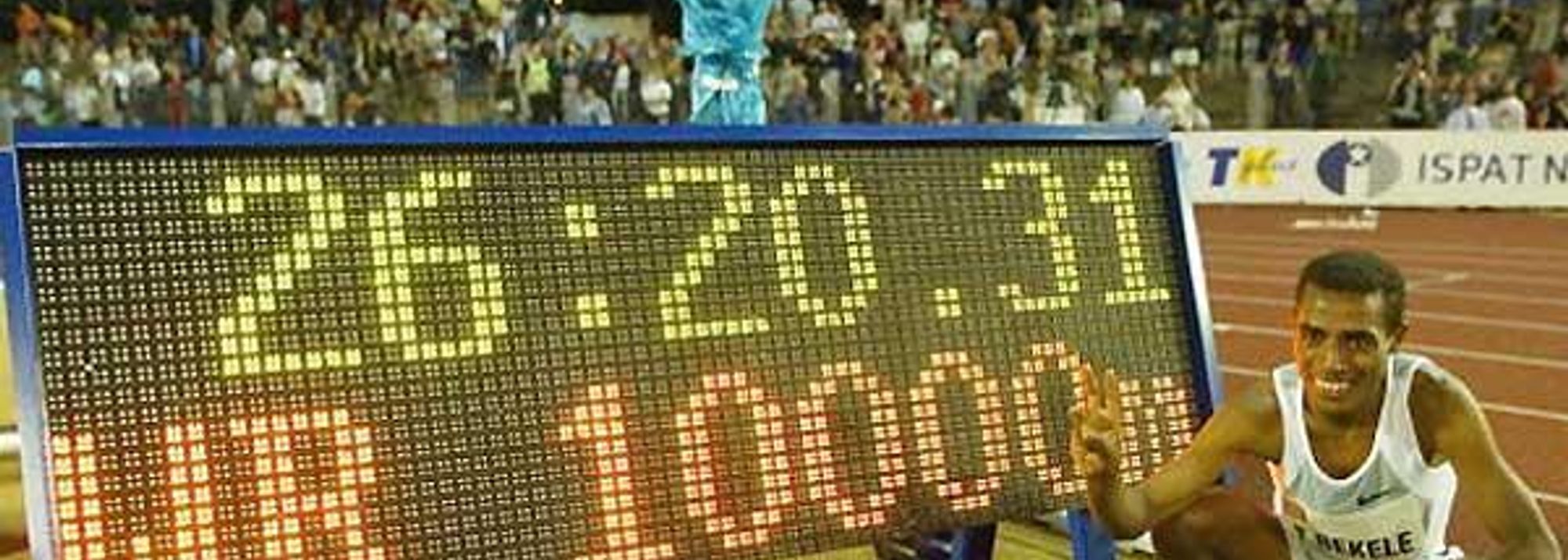


Bekele poses next to his 10,000m World record clock in Ostrava (© Getty Images)
The most significant moments from last year’s 28 IAAF Grand Prix meetings are recalled by Mel Watman of “Athletics International”.
We now present Part One - February to June 2004.
12 February, Melbourne, Australia
(Grand Prix II)
Benita Johnson’s winning 5000m time of 15:23.68 was fairly ordinary, but it set her up nicely for her challenge at the IAAF World Cross Country Championships in Brussels the following month where she scored a runaway victory over formidable African opposition in the eight kilometres race. The men’s 5000m went in 13:25.97 to Craig Mottram, who in London in July would run Haile Gebrselassie close with an Oceania record of 12:55.76.
24 April, Fort-de-France, Martinique
(Grand Prix II)
The two fastest 100m runners in history encountered mixed fortunes. World record holder Tim Montgomery won the final in the sharp early-season time of 10.08 whereas an injured Maurice Greene withdrew after taking his heat in 10.18. World 100m champion Torri Edwards completed a neat sprint double with times of 11.12 and 22.66 but subsequently was banned for two years after providing a positive drugs sample at this meeting.
8 May, Osaka, Japan
(Grand Prix)
From the moment that Liu Xiang defeated Allen Johnson by 7/100ths of a second with an Asian 110m Hurdles record of 13.06 it became evident that the 20 year-old would stand a great chance of becoming the first Chinese man to win an Olympic athletics title. “I’m not in good shape,” he remarked. “If I had been a bit faster to clear the first three hurdles, my time would have been much faster. If I can keep believing in myself, I can do very well in the Olympics.” Just how well the world was to discover on August 27. Two other Olympic champions in waiting won their events: Tim Mack vaulted a modest 5.60m and ever consistent Koji Murofushi threw the hammer 82.18m. Recovered from his injury in Martinique, Maurice Greene took the 100m in 10.04.
14 May, Doha, Qatar
(Super Grand Prix)
Helped by a strong following wind although probably hindered by the accompanying sandstorm, the sprinters produced some spectacular 100m times. Shawn Crawford established himself among the favourites for the Olympic crown by clocking 9.90w in his heat and 9.86w in the final, which he won by a full metre from Justin Gatlin (9.95w after a 9.92w heat). Three others broke 10 seconds. The other highlight was the 3000m in which world 5000m champion Eliud Kipchoge outkicked his former compatriot Saif Saaeed Shaheen in 7:33.37. The World Steeplechase champion’s consolation prize was an Asian record of 7:34.67. Elvan Abeylegesse, destined to smash the World 5000m record the following month, won the women’s race by a 100m margin in 8:35.83.
16 May, Rio de Janeiro, Brazil
(Grand Prix II)
Brazilian fans had much to enthuse over as the gigantic (2.01m, 92kg) Jadel Gregório triple jumped what was at the time a legal outdoor personal best of 17.22m, and among other home winners were Vicente de Lima (20.45 200m) and Redelen dos Santos (13.49 110m Hurdles). Gregório would improve massively to 17.72m in the Brazilian Championships three weeks later.
23 May, Belém, Brazil
(Grand Prix)
Brazil’s athletes shone again in the hot and humid conditions. Jadel Gregório added another 3cm to his outdoor best with 17.25m, Redelen dos Santos set a South American sprint hurdles record of 13.33 despite a sluggish start and a headwind, and Vicente de Lima took the 200m in his fastest time of 20.39. No sign at this stage that Yumileidi Cumbá was destined to be crowned Olympic Shot Put champion as she placed third with a modest 18.70m behind Nadezhda Ostapchuk (18.90m) and a Trinidadian record of 18.78m by Cleopatra Borel.
31 May, Hengelo, Netherlands
(Grand Prix)
The Fanny Blankers-Koen Stadium has long been Haile Gebrselassie’s favourite, having set world records there at 5000m and 10,000m (twice), but this time the spotlight was seized by his young compatriot Kenenisa Bekele as he demolished his hero’s World 5000m record by over two seconds with 12:37.35 for a stunning average of 60.59 per lap. Paced through opening kilometres of 2:33.24 and 5:05.47, the 21 year-old Ethiopian went ahead just after halfway to pass 3000m in 7:37.34 and 4000m in 10:07.93. He covered the last lap in 57.9 to win by nearly 24 sec from the remarkable Ethiopian junior, Mulugeta Wondimu (13:01.28). Gebrselassie was happy enough to see his record pass into good hands but was less enchanted later in the evening when he was outkicked in the 10,000m by yet another brilliant young Ethiopian, Sileshi Sihine, whose time of 26:39.69 represented an improvement of nearly 20 seconds.
31 May, Palo Alto, USA
(Grand Prix II)
Now recovered from the knee injury which had held him back for the past two seasons and with his old confidence restored, Maurice Greene was timed at a spectacular 9.78 for 100m. True, he had a 3.7m/sec tailwind but it still ranked as the equal second quickest time ever registered under any conditions. In second place Justin Gatlin, who would time his season’s peak to perfection in Athens, clocked 9.91. Top women’s mark came from pole vaulter Stacy Dragila (4.70m), who took three unavailing attempts at a World outdoor best of 4.83m.
2 June, Milan, Italy
(Grand Prix II)
Although she fell well short of her target, Jiang Bo’s World 5000m record of 14:28.09, Berhane Adere expressed satisfaction with her time of 14:36.92. She had led through 3000m in 8:40.72, just inside Jiang’s corresponding time, and was over three seconds ahead of the Chinese runner’s pace at 4000m (11:37.22), but she ran out of steam in the closing stages. “I am not disappointed,” she said. “It was a very good test for the 10,000m in Athens.” Unhappily for her, she would be controversially dropped from the Ethiopian Olympic team.
4 June, Turin, Italy
(Grand Prix II)
Four days after Kenenisa Bekele smashed the World 5000m record in Hengelo came an indication that he might in years to come find his closest rival is his younger brother! Tariku Bekele (17), silver medallist at 3000m in the 2003 IAAF World Youth Championships, was timed at 7:45.23 for the distance in placing second to Kenya’s David Nyaga (7:44.37), way ahead of Kenenisa’s fastest at that age of 8:09.89. Later in the summer Tariku would run 5000m in 13:11.97 whereas his brother was 21 before he ran that fast. Star of the Memorial Primo Nebiolo was Christian Olsson whose Triple Jump of 17.61m ranked fleetingly as the world’s top outdoor mark of the year.
5 June, Seville, Spain
(Grand Prix)
The relentless rise in women’s Hammer Throw standards was underlined when, for the first time, four throwers exceeded 70m in the same competition. World champion Yipsi Moreno consolidated her position as Olympic favourite by throwing 73.81m for a decisive victory over Manuela Montebrun (70.90m) and Yunaika Crawford (70.44m) … but it was fourth placed Olga Kuzenkova (70.14m) who would win the contest which really mattered two months later. Another Russian who peaked at the right time was Yuriy Borzakovskiy. Racing for the first time this season he was unable to catch Wilfred Bungei in the 800m, 1:44.69 against 1:44.79.
5 June, Gresham (Portland), USA
(Grand Prix II)
Having already thrown a world-leading 22.35m in Carson two weeks earlier, World Indoor Shot Put champion Christian Cantwell improved to 22.54m for eighth place on the world all-time list. That came in the first round and he followed up with 22.16m and 22.33m. On such form he was clearly favourite for the Olympic title … but he never even got to Athens as the following month he could place only fourth in the US Trials. In what proved to be the classiest shot contest of the year, Adam Nelson overtook John Godina (21.67m) for second place in Gresham with his final effort of 21.68m.
8 June, Ostrava, Czech Republic
(Super Grand Prix)
Just ten days after his momentous 5000m in Hengelo, Kenenisa Bekele relieved Haile Gebrselassie of another of his great World records, this time at 10,000m. The pacemakers fell short of expectations, so that at 4000m Bekele was over six seconds down on Gebrselassie’s corresponding time en route to his 1998 figures of 26:22.75. In front from just before 4000m, Bekele reached halfway in 13:14.42 (Gebrselassie’s time had been 13:11.7) and by 6000m he was ahead of schedule. A determined last lap of 57.2 carried him over the line in 26:20.31 with Gebre Gebremariam (his runner-up in both World Cross Country Championship races in March) second in 26:53.73. Among those present to congratulate him was 81 year-old Dana Zátopková, whose husband Emil Zátopek had himself set world 10,000m records in Ostrava with 29:28.2 and 29:21.2 in 1949. Among other notable performances, Stacy Dragila vaulted 4.83m for what was at first claimed to be a new world record. However, as the IAAF had reintroduced a rule that allows indoor marks in that event to be recognised as the World record (Yelena Isinbayeva having cleared 4.86m) Dragila had to settle for an American record and the best ever outdoor mark in the world.
19 June, Eugene, USA
(Grand Prix)
The big 100m showdown lived up to its billing. On a hot day with a friendly 1.8m/sec tailwind making the conditions ideal for quick sprinting, Shawn Crawford finished strongly for victory in a legal personal best of 9.88 – fastest ever by an American in the USA – over Maurice Greene (9.93). A good three metres behind Crawford, Justin Gatlin finished eighth and last in 10.19. Another Olympic champion-to-be to suffer an off-day was Tim Mack, ninth in the Pole Vault with 5.50m. Conversely, Stacy Dragila – destined for a huge disappointment in Athens – maintained her fine form, vaulting 4.70m and attempting the World record height of 4.88m, the classic 16 feet. Alan Webb thrilled the crowd with a 3:50.85 mile, supplanting Jim Ryun’s then World record of 3:51.1 in 1967 as the fastest by an American on home soil. Among the visitors, Perdita Felicien set a Canadian 100m Hurdles record of 12.46 and former Eugene resident Maria Mutola ran a 1:57.78 800m for a record (in any event) 12th Prefontaine Classic victory.
26 June, Villeneuve d’Ascq (Lille), France
(Grand Prix)
It was a good meeting for the French. Christine Arron, who didn’t put a foot wrong until her Olympic debacle, scored a fine sprint double against the wind in 11.18 and 22.60, and Romain Mesnil cleared 5.80m to win the pole vault. Two of the winners were former Kenyans representing Bahrain. Gregory Konchellah, son of the 1987 and 1991 world 800m champion Billy Konchellah but now known as Youssef Saad Kamel, took the two lap event in 1:45.78 (he would run 1:43.11 in Zürich) while Mushir Salem Jawher (né Leonard Mucheru) won the 5000m in a national record of 13:05.21.
27 June, Gateshead, United Kingdom
(Super Grand Prix)
Despite the blustery conditions and the fact that it was her first outdoor competition of the year, Yelena Isinbayeva sailed over 4.87m to end any confusion as to what constituted the women’s World Pole Vault record. After making 4.40m at the second attempt, 4.60m at the first, 4.72m at the second and 4.80m at the first, the 22 year-old Russian succeeded on her final attempt at 4.87m to add a centimetre to the height she cleared when winning the world indoor title in Budapest in March and surpass Stacy Dragila’s “world oudoor best” by 4cm. Isinbayeva later revealed she had cleared the magical five metre mark in training three weeks earlier! The meeting’s other stunning performance came from Paula Radcliffe. Running 10,000m on a British track for the first time, she set a UK all-comers record of 30:17.15 and in less windy conditions she would surely have broken her European record and dipped under 30 minutes. On her own after 2000m, she reached halfway in 15:00.67 and lapped the entire field, including former Olympic and world champion Fernanda Ribeiro. The weather was such that even Kenenisa Bekele was reduced to a relatively pedestrian 3000m time of 7:41.31, far short of Brendan Foster’s stadium (and former world) record of 7:35.2 from 30 years ago.
28 June, Prague, Czech Republic
(Grand Prix II)
Two athletes destined to strike gold in Athens showed off their paces to good effect. Hammer thrower Koji Murofushi had four efforts beyond 81 metres with a best of 81.92m, while world indoor champion Yelena Slesarenko high jumped 2.01m at the first attempt before failing three times with the bar at the Russian record equaling height of 2.05m.
29 June, Zagreb, Croatia
(Grand Prix)
As in Prague the previous day, the women’s High Jump yielded one of the top performances. This time the star was Hestrie Cloete, who cleared 2.00m with local heroine Blanka Vlasic pressing hard with 1.97m in second place. Another advance in hammer throwing evolution: for the first time three women exceeded 71 metres in the same contest with Olga Kuzenkova (71.91m) getting the better of Zhang Wenxiu (71.50m) and Kamila Skolimowska (71.04m).

