

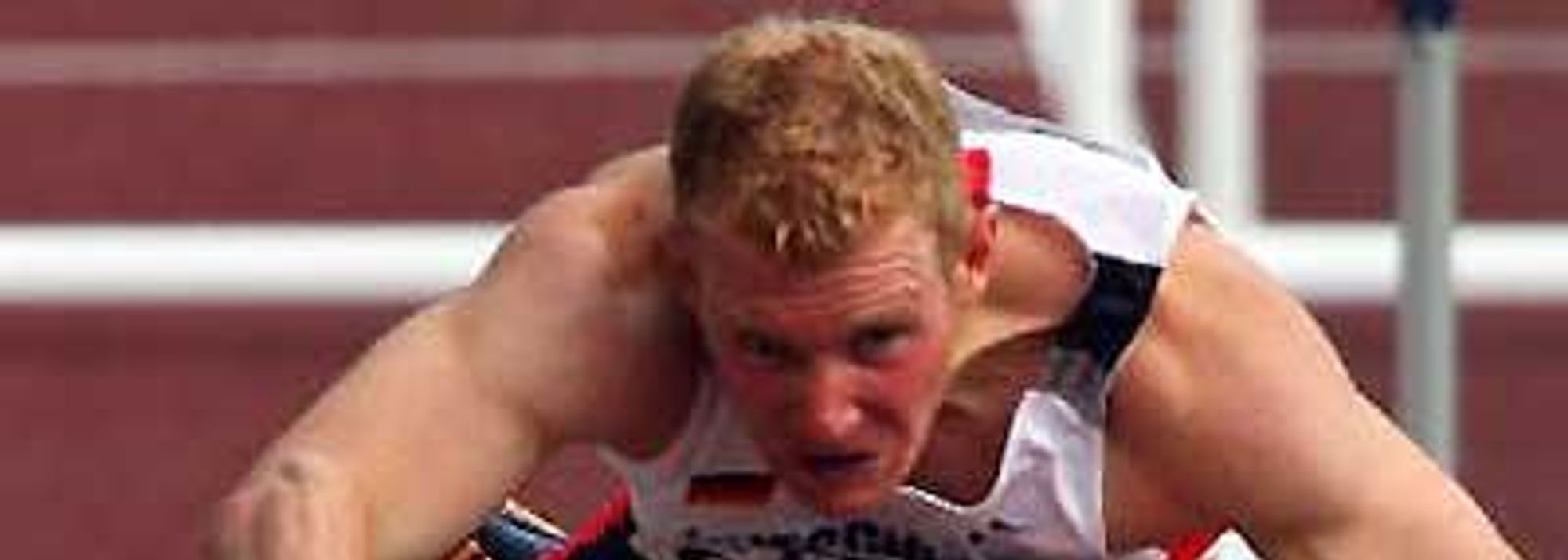


Arthur Abele of Germany hurdling in Osaka (© Getty Images)
Germany’s 21old Arthur Abele is fast establishing himself as a decathlete of the highest stature.
At the 2006 IAAF World Indoor Championships in Moscow, Russia, Germany's André Niklaus produced a major surprise by taking the gold medal in the Heptathlon. Even though hampered by injury the 26-year-old decathlete from Berlin last year backed-up that win with a fifth place finish at the World Championships in Osaka (8371pts PB) and a fifth place finish in Götzis (8340pts) to show he is more than capable of continuing Germany’s great successful decathlon tradition.
Germany is currently awash with Combined Event prospects and two 22-year-old talents Norman Müller (8255 Gotzis 2007) and Pascal Behrenbruch (8239pts PB silver Euro U23 in Debrecen) seemed the obvious candidates for the number two spot in Germany behind Niklaus. Yet by the end of last year it was the even younger Arthur Abele, 21, who had surprisingly established himself in that role.
Ratingen breakthrough victory at 20
Arthur Abele, who lives in the small town of Aalen in Southern Germany and competes for SSV Ulm, was only 20-years-old when he won the Decathlon event of the IAAF’s World Combined Events Challenge in Ratingen in June 2007 with a massive personal best of 8269 points, an improvement of 257 points on his previous highest total. Then at the World Championships in Osaka Abele came very close again to that new best with 8243 for ninth place. A star had been born!
“Arthur has developed amazingly,” confirms Germany’s national coach for the Decathlon Claus Marek. Abele, He points out that one has to take into account where Abele had been two years ago: “At that time for example he had a personal best in the high jump of 1.80 metres – now he jumped 2.04m. This shows his potential. But there is also a danger if you are not prepared very well for competitions.” Marek describes Abele as an athlete with enormous will and with powerful speed.
Together with his personal coach Wolfgang Beck, Marek has agreed that Abele will benefit if he skips the indoor season and fully concentrates on qualifying for Beijing, as although he was Germany’s number two last year this still does not put him in a secure position regarding the Olympic Games.
“There are about eight athletes who are in with a chance of qualifying (for the three team places). In Osaka we had three different athletes competing than we had a year ago at the European Championships in Gothenburg,” Marek explains.
There is no doubt that Abele will give absolutely everything in his fight for a ticket to Beijing. He has had to learn to fight hard early in his life. “I have always been fascinated by sports,” says Abele.
Lucky not to be paralyzed
When he was 6-years-old Abele started doing gymnastics. But at the age of eleven he fell down a drop of five metres from a hayloft.
“My kneecap was broken in four places. Additionally my thigh and a cervical vertebra were fractured as well. I had to have immediate surgery and was very lucky not to end up paralyzed,” Abele recalls.
After recovering it appeared that gymnastics would be a sport too dangerous for him. Instead Abele turned to handball and additionally started athletics a bit later at the age of 13. Doing multiple events (eight disciplines) he quickly became successful, taking the national title of the 14 and 15 year-olds.
However, it was not long before the next setback: At the age of 16 he suffered a slipped disc in his back and since he did not want to give up athletics he looked for an alternative event. “I turned to the 400m Hurdles.” Again it didn’t take long before he was in the winning lane. Abele qualified for the World Juniors in 2004. At the age of 17 he had run 51.71 seconds. But he never competed at this distance in Grosseto, Italy.
In the meantime Abele was able to do the multi-events again. And when he also qualified for the Decathlonfor the World Juniors he opted instead for the multi-event, and finished seventh with 7224 points.
King of disciplines
Since then Abele has concentrated on the Decathlon. “It is the king of athletics’ disciplines,” he explained. A year later he won the silver at the European Junior Championships.
But his path again was not an easy one. A little more than a year ago Abele had to have surgery on his elbow. As a result he could not do any Javelin training for months. Despite that further setback he came back strongly in Ratingen and then went on to achieve his goal of a placing inside the top ten in Osaka.
Abele's achievements are even more remarkable if one takes into account that Abele works full-time doing a three and a half year training as special electrician.
“My company really supports my sport, otherwise it would be impossible to do it.”
Jörg Wenig for the IAAF

