

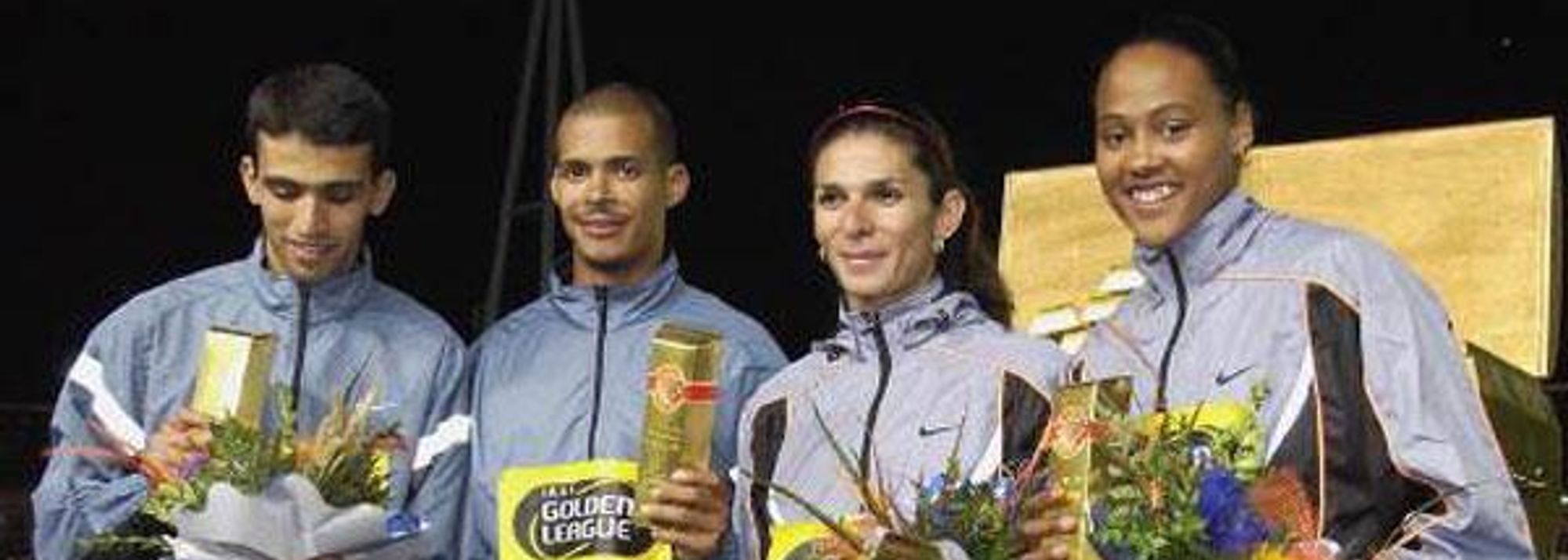


IAAF Golden League Jackpot Winners 2002 (© Getty Images)
MEL WATMAN of “Athletics International” recalls the highlights of the 2002 edition of the IAAF Golden League.
Click here to go to the 2002 Golden League site for full meeting reports
June 28, Exxon Mobil Bislett Games, Oslo
The men’s 100m always promised to be one of the star events of this year’s Golden League series, and after Maurice Greene had beaten Tim Montgomery by just 1/100th of a second in the USA Championships (9.88w-9.89w) six days earlier there was intense speculation about which man would come out on top at Bislett.
In the event Greene (10.06) again got the better of Montgomery (10.10) but victory went to Britain’s Dwain Chambers in 10.05. The times may have been somewhat disappointing, especially when one recalls that Montgomery clocked a spectacular personal best of 9.84 at the same meeting last year, but on that occasion there was a tailwind of 2.0m/s and this time the wind reading on a cool evening was minus 0.1m/s.
Montgomery observed: “Me and Maurice were thinking too much about each other. We were both scared of each other and that opened the way for someone else to win.”
No problems for the USA’s other sprinting superstars. Marion Jones took her 100m race in 10.96 with the headwind registering 1.0m/s and Gail Devers ran a sparkling 12.53 in the 100m Hurdles into a 1.2m/s wind, leaving Bridgette Foster - who would prove to be her closest rival throughout the rest of the summer - almost two and a half metres behind.
Conditions were favourable for distance running and there were excellent in-depth races at 5000m for both men and women. Kenyans filled first five places in the men’s event, all of them inside 13:01. Ben Limo claimed victory in 12:57.50 over Sammy Kipketer and John Kibowen, while 32 year-old Paul Bitok in fourth place broke 13 minutes for the first time in a distinguished career which has included two Olympic silver medals.
In the women’s race barely ten metres covered the top five as Gabriela Szabo’s 60.4 last lap proved just too much for Berhane Adere in 14:46.86.
Of the field events, by far the most notable was the Triple Jump. Walter Davis was over half a metre down on his magnificent 17.59m in the US Championships five days earlier, leaving Jonathan Edwards and Christian Olsson to fight it out for first place. The young Swede held the lead with his first three jumps of 16.80m, 17.24m and 17.35m, but the world record holder reached 17.51m in the fourth round. Olsson went close with his fifth round 17.47m but Edwards, who sat out the last two rounds, was not to be caught.
The other winners of Golden League scoring events were Hicham El Guerrouj in the mile (3:50.12), Felix Sánchez in the 400m Hurdles (48.91), Tim Mack unexpectedly in the pole vault (5.70m), Ana Guevara in the women’s 400m (50.45), Maria Cioncan in the 1500m (4:03.55) and Osleidys Menéndez in the Javelin (63.51m).
But there was a long way to go before anyone could envisage a share of the jackpot of 50 kilograms of gold. Last year an athlete qualified for winning at five of the seven designated meetings; this time victories in all seven were required for the big payout.
July 5, Gaz de France, Paris Saint-Denis
The rain which poured down for most of the evening on the Stade de France (venue for next year’s IAAF World Championships) failed to dampen the spirits of those competing in the second of the seven Golden League meetings.
Six athletes produced world-leading marks for that stage of the season: Hicham El Guerrouj ran 1500m in 3:29.96, Felix Sánchez clocked 47.91 for 400m Hurdles, Jonathan Edwards triple jumped 17.75m, Marion Jones recorded 10.89 for 100m, Ana Guevara 50.00 for 400m and Gabriela Szabo 8:31.88 for 3000m.
All six had also won in Oslo and thus remained in contention for the jackpot, along with Ben Limo (13:02.34 5000m) and Gail Devers, winner in 12.56 of the first ever 100m Hurdles race in which all nine starters finished inside 13 seconds.
Dwain Chambers, the 100m winner in Oslo, elected not to run, while the jackpot dreams of three others were cut short. Tim Mack placed fourth in a pole vault much affected by the wet conditions and won by Romain Mesnil at a modest 5.65m; Maria Cioncan and Osleidys Menéndez were narrowly beaten in the 1500m and Javelin by Nicole Teter (4:05.52-4:05.64 thanks to a 28.8 final 200m) and Tatyana Shikolenko (64.59m-64.29m) respectively.
Maurice Greene enjoyed one of his better races of what would turn out to be a chequered season. He won the 100m in 9.99, commenting: “It was OK. If I had to grade my race I would give it a C”. He defeated Bernard Williams (10.03) and 19 year-old Mark Lewis-Francis who, despite a sluggish start, finished ahead of Tim Montgomery for third place in a legal personal best of 10.04.
In the 1500m, El Guerrouj dipped under 3:30 for the seventh successive year. His long-term consistency has been extraordinary: of 68 races at 1500m or mile since 1996 he has lost just three!
The 5000m epitomised the stranglehold that Africans have on the longer men’s running events. Of the 18 starters in the 5000m, 14 were from that continent while the four Frenchmen competing were all of North African descent.
Africa also fielded two particularly formidable figures in the women’s 3000m in Berhane Adere and Edith Masai, but neither could cope with Szabo’s final 200m of 29.7.
Pick of the field events, as in Oslo, was the Triple Jump which featured another thrilling duel between Edwards and Olsson. Again the Swede made the running, with 17.32m in the second round and 17.60m in the third, but Edwards remains at 36 one of the supreme competitors and bounded out to 17.75m in the fourth round.
July 12, Golden Gala, Rome
After his success in Paris, Maurice Greene told reporters: “You win some and you lose some; it’s the way you come back from the defeat that matters. I’ve won and I’m going to carry on winning.”
In Rome he was as good as his word. Brilliantly away, with a reaction time of 0.115 sec, he finished half a metre clear of Tim Montgomery (9.94) in 9.89, a time which would remain as the fastest of the year until Montgomery’s shock world record two months later. That was Greene’s ninth legal sub-9.90 mark, breaking the record he had shared with Ato Boldon.
In contrast, Marion Jones got a rotten start in her 100m race and did well to clock a season’s best equalling 10.89 after overhauling fast-starting Tayna Lawrence (11.02). “It was my worst start of the year,” she acknowledged, “but I rescued myself in the second half of the race.”
Jones maintained her challenge for the jackpot along with four others, but three winners from Oslo and Paris dropped by the wayside.
Ben Limo may have run his fastest 5000m time of the year with 12:57.24 but he was no match for the 1999 world champion Salah Hissou who broke away almost 800m from home and went on to record what remained as the world’s quickest time of the season (12:55.85).
Also relegated to second place was Jonathan Edwards, who admitted that after the withdrawal from the meeting of Christian Olsson he “never really got the adrenaline going.” Jumping on auto-pilot he managed 17.25m but Walter Davis topped that with 17.33m.
The other casualty was Gabriela Szabo, who wound up third in the 5000m (14:55.48) behind Edith Masai (14:53.77) and Berhane Adere (14:54.46). The slowish pace had appeared tailor-made for her normally deadly kick but on this occasion she was uncharacteristically subdued. Adere made the intitial move at the bell, only for the 35 year-old Kenyan to overtake her some 40m from the line.
Hicham El Guerrouj continued on his undefeated way with a 3:48.28 mile ahead of William Chirchir (3:49.49) in a race which saw Rui Silva set a Portuguese record of 3:49.50, Cornelius Chirchir run the second fastest ever junior mile with 3:50.69 and Hudson de Souza lower the South American record to 3:52.97.
There were world-leading marks also by Felix Sánchez (47.73 400m Hurdles) and Ana Guevara (Mexican 400m record of 49.51), while the other athlete to notch up a third Golden League win was Gail Devers, who was again pushed hard in the 100m Hurdles by Bridgette Foster, 12.51 to 12.55.
But you didn’t need to have the incentive of a jackpot to record classy performances.
Frank Fredericks continued his heart-warming comeback with a 19.99 200m victory, his first sub-20 seconds mark for three years; Mark Boswell equalled his Canadian high jump record of 2.35m after a stirring duel with Stefan Holm (2.33m); five men threw beyond 80m in a hammer contest won in the final round by 39 year-old Igor Astapkovich (80.79m); and Maria Mutola - in her first 1500m race for two years - improved her national record to 4:01.50 in a race which saw 11 runners set personal bests.
July 19, Herculis, Monaco
There were so many brilliant performances in the Stade Louis II, including nine world-leading marks, that it’s difficult to isolate a single highlight but perhaps the palm should go to a fabulous women’s 3000m race in which Edith Masai smashed the African record with 8:23.23 in third place!
Fast times were assured after pacemaker Zoya Kaznovskaya covered the first kilometre in 2:47.39 and Paula Radcliffe led at 2000m in 5:37.01. Radcliffe, in her first race since her glorious London Marathon win in 2:18:56, set such a tempo that even Berhane Adere was dropped completely before the last lap. Displaying a new turn of speed, Radcliffe hacked nearly five seconds from her Commonwealth record with 8:22.20 and even Gabriela Szabo, back in top form after her lapse in Rome, had to pull out all the stops to ensure victory.
Her time of 8:21.42 broke Sonia O’Sullivan’s European record and elevated her to fifth place on the world all-time list behind four Chinese, while Radcliffe now ranks eighth but third non-Chinese.
Maurice Greene ran 9.97 to clinch what proved to be his last 100m victory of the year by a 2/100ths margin over Bernard Williams, but two much longer races provided even closer finisbes.
Brahim Boulami (7:58.09) had just 1/100th to spare in a desperate steeplechase climax against Stephen Cherono with an almost unnoticed Simon Vroemen improving by over six seconds to set a European record of 8:06.91 in third place, while the same margin separated women’s world steeplechase record holder Alesya Turova and 38 year-old Regina Jacobs in a 4:01.02 1500m. Actually that was such a tight finish that initially Jacobs was awarded the verdict.
The men’s 1500m featured a world record attempt by Hicham El Guerrouj, but his chances were weakened by some over-eager pace-making as Bernard Kisilu tore around the first lap in 53.04 and reached 800m in 1:49.82. El Guerrouj was ahead of world record schedule with 2:45.78 at 1200m but slowed to 3:27.34, the sixth fastest of all-time (and his fifth quickest time).
Bernard Lagat was gaining at the finish for his second best time of 3:27.91 and next came Rui Silva with a Portuguese record of 3:30.07 and Cornelius Chirchir with a phenomenal World Junior Record of 3:30.24.
Both the 800m races were superb competitions. Wilson Kipketer (1:43.76) and David Krummenacker (1:43.95) became the first two men to break 1:44 in 2002, while in the women’s race Maria Mutola paid the penalty for following an over-excited hare (54.16!) too closely and covering the first lap in well under 56 seconds.
She lacked her normal strong finish and despite clocking her season’s best time of 1:56.16 was outkicked by Zulia Calatayud, who chopped over two seconds from her previous fastest with 1:56.09.
All five athletes in contention for the jackpot were in terrific form and notched up their fourth win of the series. In addition to El Guerrouj’s victory, Felix Sánchez took the 400m Hurdles in 47.86, Marion Jones the 100m in her fastest time of the year (10.84) with Tayna Lawrence breaking 11 seconds for the first time in second place (10.95), Ana Guevara the 400m in a Central American record of 49.25 (with Lorraine Fenton close behind in a Jamaican record of 49.30), and Gail Devers the 100m Hurdles in 12.42.
Field event action included another unsuccessful bid at the world record height of 4.82m by Svetlana Feofanova after vaulting 4.69m, and a close Triple Jump encounter in which Christian Olsson tied his Swedish record of 17.63m to finish four centimetres ahead of Jonathan Edwards.
August 16, Weltklasse, Zürich
A world record is always a momentous event. The athlete concerned has created a piece of history; the spectators are thrilled to have witnessed something special that they might always remember; the meeting gains in prestige; and media coverage of the sport is enhanced. Thus there was a tremendous buzz of excitement in the packed stadium when it became evident that Brahim Boulami had pulverised his own year-old World Steeplechase Record with the stunning time of 7:53.17. It was a magical moment.
Alas, it turned out to be a performance that literally was too good to be true. An IAAF pre-competition doping control for EPO, conducted the day before the meeting, revealed that Boulami had tested positive and consequently faced a two-year ban while the performance itself would not reach the record books.
Of the five athletes still in jackpot contention, one fell at the fifth hurdle, so to speak. Gail Devers, winner of ten consecutive 100m Hurdles races this season, was relegated to third place behind newly crowned European champion Glory Alozie (12.63) and Bridgette Foster. However, Hicham El Guerrouj, Felix Sánchez, Marion Jones and Ana Guevara continued to dominate their events.
Although he again fell short of his world record target, El Guerrouj authored another superlative 1500m performance, winning by some 30m in 3:26.89, the year’s fastest and a time bettered only by himself on four occasions and once by Bernard Lagat, who in this race wound up only fourth behind junior star Cornelius Chirchir and Rui Silva.
Another world champion, Sánchez, reduced his Central American 400m Hurdles record to 47.35, another best for 2002, as was Guevara’s Central American 400m record of 49.16. Jones was deprived of a super-fast 100m time by an 0.5m/s headwind but still ran 10.88 with Chryste Gaines second in 10.95.
A stronger headwind of 1.3m/s ended any hopes of sensational times in the men’s 100m. The second heat, when there was a 1.6m/s tailwind, had promised something remarkable in the final as Tim Montgomery was timed at 9.93 and Dwain Chambers a personal best of 9.94, but the later conditions resulted in Montgomery’s winning time being slowed to 9.98. Maurice Greene wound up fifth, and he would not win another race all season.
Two men ran inside 1:43.7 for the fastest 800m times of the year and that was only the “B” race! The main race saw Wilson Kipketer run 1:43.59, his best for two years, and yet he was beaten by former World Junior champion Jospeh Mutua in 1:43.33.
The women’s 800m was notable also, with Maria Mutola comfortably defeating Jolanda Ceplak in 1:57.24 for her tenth successive victory at this meeting. Monaco winner Zulia Calatayud could manage only seventh place this time.
Four women dipped under four minutes in the 1500m, with Gabriela Szabo overhauling Suzy Favor Hamilton in what was at the time a world-leading mark of 3:58.78, while Alesya Turova and Yelena Zadorozhnaya broke through the barrier for the first time.
Berhane Adere kicked to her first Golden League victory (8:32.76 3000m), while Kenyans filled first four places in the 5000m, headed by the new Commonwealth champion Sammy Kipketer in 12:56.99, with Salah Hissou fifth.
It was Jonathan Edwards’ turn again to win the Triple Jump, his fourth round 17.63m proving much too good for the likes of Christian Olsson and Walter Davis, but Sweden came up trumps in the High Jump where Stefan Holm cleared a personal best of 2.35m - that’s 54cm above his head - to avenge his Rome defeat by Mark Boswell.
August 30, Memorial Van Damme, Brussels
Celebrating his 25th birthday, Felix Sánchez was the first of the four jackpot challengers to be seen in action in the penultimate Golden League meeting.
The New York-born 400m hurdler, who represents his parents’ native Dominican Republic, had enjoyed a flawless season thus far and he extended his streak in Brussels, although after encountering stride problems he left it late to overtake European champion Stéphane Diagana on the run-in from the final hurdle. Sánchez clocked 47.99, to the Frenchman’s 48.05.
Next on the track was Marion Jones in the 100m, up against her World Championships conqueror Zhanna Pintusevich-Block for the first time in this Golden League series. The American had trounced her opponent in the London Grand Prix meeting (10.97-11.11) one week earlier in their first clash of the year but this time it was much closer as Jones scraped home 2/100ths ahead in 10.88 with fast starting Tayna Lawrence third in a personal best of 10.93 and Chryste Gaines clocking her season’s best of 10.94.
Barely an hour later Jones produced the world’s fastest 200m time of the year with 22.11 into a slight headwind, Pintusevich-Block finishing second in 22.24.
The third contender to keep jackpot hopes alive was Ana Guevara in the 400m. Astonishingly, she had improved her time in every single Golden League race: 50.45 in Oslo, 50.00 in Paris, 49.51 in Rome, 49.25 in Monaco and 49.16 in Zürich. This time the Mexican had to settle for 49.69 for a clearcut win over Lorraine Fenton, runner-up also in Oslo, Paris, Rome and Monaco.
As for Hicham El Guerrouj, he decided to shelve his original world record attack in the 1500m and concentrate just on winning the race, which he did with a 52.64 final 400m for a time of 3:29.95. Bernard Lagat was once more the runner-up in a race which saw nine men better 3:33.
As befits a meeting staged in memory of a brilliant Belgian runner who died so tragically young soon after winning silver medals in the 1976 Olympic 800m and 1500m, the Brussels spectacular has a great tradition in the longer track events and that was upheld.
World leading marks were achieved by Wilson Kipketer at 800m (1:42.74), Maria Mutola at 1000m (2:30.12) and Turkey’s sensational European champion Süreyya Ayhan in only her second 1500m outing of the year (3:57.75). A thrilling women’s 3000m saw Berhane Adere hang on in 8:26.14, 1/100th ahead of Gabriela Szabo, while in the corresponding men’s race Abderrahim Goumri, almost 30m clear at the bell, stayed ahead of a pack of fast closing Kenyans in 7:35.77.
Best of all, though, was a pulsating 10,000m which set new standards of in-depth excellence. No fewer than five men finished inside 26:53, while new world bests for position were established by the runners who placed from third to 12th. The man who came 12th was, in fact, World 3000m Record holder Daniel Komen in his best time of 27:38.32 – and he was only the seventh Kenyan home!
A halfway time of 13:23.58 indicated exceptional times to come and after a great race it was 20 year-old Sammy Kipketer, running 10,000m at sea level for the first time, who prevailed in 26:49.38. That was the world’s quickest time for four years and ranked him as fifth fastest of all time behind Haile Gebrselassie, Paul Tergat, Paul Koech and Salah Hissou. Assefa Mezgebu, hot on his heels, became no.6 with 26:49.90, while world 5000m champion Richard Limo was timed at 26:50.20 in his track debut at the distance and Albert Chepkurui 26:50.67 to rank seventh and eighth all-time.
September 6, ISTAF 2002, Berlin
As the cavernous Olympic Stadium is currently being renovated in preparation for the 2006 soccer World Cup, the Golden League finale was staged instead in the much more intimate Friedrich-Ludwig-Jahn-Sportpark, venue for the former GDR’s “Olympischer Tag” meetings of yesteryear.
None of the “big four” encountered any problems and so Hicham El Guerrouj, Felix Sánchez, Marion Jones and Ana Guevara shared the jackpot of 50 kilograms of gold. Seven wins each from seven races. Indeed, all four athletes went through the entire 2002 season undefeated, El Guerrouj winning 12 races at 1500m or mile, Sánchez nine at 400m Hurdles, Jones 14 at 100m (plus three races at 200m and one at 400m) and Guevara 11 at 400m.
For El Guerrouj this was the third time in the five-year history of the Golden League that he has been a joint beneficiary. On this occasion his time was a relatively modest 3:30.00, a mark he has bettered no fewer than 27 times including a record six times in 2002, but the margin of victory over Bernard Lagat, the second fastest 1500m runner in history, was even more commanding than usual at over 20 metres.
Sánchez cannot rival El Guerrouj’s win streak but his 48.05 constituted his 15th straight hurdles victory since July 2001. Marion Jones (11.01) was chased home yet again by Tayna Lawrence, while there was a sense of déjà vu also in the 400m where Guevara (49.91) was followed in by Lorraine Fenton.
With Tim Montgomery, winner of the 100m in Brussels in 9.91, sitting this one out (to rather good effect in Paris the following weekend) and Maurice Greene finishing sixth as in Brussels, Dwain Chambers (10.02) was able to overcome a dreadful start to notch up his second Golden League success of the summer.
The only other European to win a track event was Süreyya Ayhan who, on her 24th birthday, produced another impressive 1500m (3:58.43). Arguably the most exciting revelation of the year, the normally front running Turk was content to follow a pacemaker for two laps before cutting loose, although Suzy Favor Hamilton finished strongly to take second in 3:59.40.
To his credit, Sergey Lebed made a bold bid around the final bend in the 5000m; Luke Kipkosgei (13:10.41) and Ben Limo eventually got past him but his reward was a Ukrainian record of 13:10.78.
The women’s 5000m resulted in an Ethiopian one-two through Berhane Adere (14:41.43) and Worknesh Kidane but Australia’s Benita Johnson, a bitterly disappointed sixth in the Commonwealth Games, ran out of her skin to place third with an Oceania record of 14:47.60.
In other action, European champion Alex Averbukh only narrowly failed at an Israeli record of 5.92m after winning a hotly contested pole vault at 5.80m on countback against Viktor Chistiakov and Tim Lobinger, Christian Olsson triple jumped 17.40m, Bridgette Foster (12.62) gained her first hurdles victory over Gail Devers in seven Golden League encounters, and at the age of 37 Heike Drechsler - who back in 1985 set a world record of 7.44m in East Berlin - pulled off yet another long jump victory, even if she did reach only 6.45m.

