

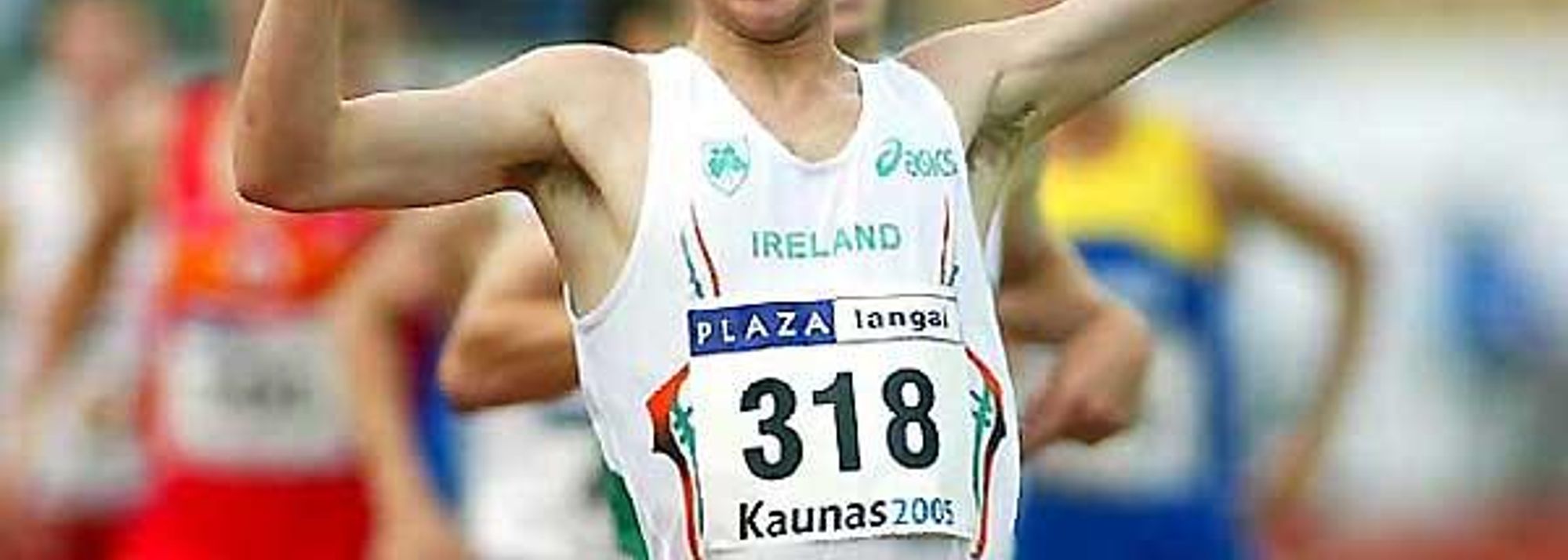


Colin Costello wins the 1500m in Kaunas (© Mark Shearman)
Kaunas, LithuaniaIrish eyes were smiling in Lithuania on the final day of the European Junior Championships as Colin Costello and Danny Darcy claimed a memorable one-two for the Emerald Isle in the men’s 1500m.
Darcy took out the pace from the outset but Costello unleashed a ferocious finishing kick around the final curve to run out a worthy champion in 3:45.25 with Darcy hanging on for second in 3:46.07, sparking jubilant scenes among the Irish contingent in the Darius and Gireno Stadium.
Costello has raced sparingly this season, preferring to spend three weeks in June preparing at altitude in Font Romeu, France - the training camp used by World marathon record-holder Paula Radcliffe. Costello said he has spoken to Radcliffe during the stay and said Radcliffe’s husband, Gary Lough, an Irishman, offered some advice about how to get the best out of altitude training.
An elated Costello, who finished fifth in the 1500m at the 2003 World Youth Championships, said: “I’m ecstatic. I haven’t been racing much this season because my coach thought I would get more out of training at altitude. I suffer hay fever and you don’t get much hay fever at altitude. We didn’t discuss tactics beforehand (with Darcy). It’s brilliant to get an Irish one-two.”
Steeplechase record
Poland’s Marcin Chabowski, a man who set a national junior record of 8:30.40 to climb to No.3 on all-time European junior earlier this year, was always going to be the man to beat in the men’s 3000m steeplechase, and so it proved. Chabowski took the lead from the gun and simply ran away from the field to smash the eight-year-old championship record of 8:40.88 set by Austria’s Gunther Weidlinger.
Chabowski, one of the most exciting junior steeplechase talents in Europe for many years, said: “It was hard because it was windy. I am exhausted but proud to break the record.
Hungary’s tactically won 5000m gold
Barnabas Bene, the European junior cross country champion, was the fastest athlete in the 5000m and 10,000m coming into the championships and opting for the 12-and-a-half lap distance proved the right decision for the Hungarian as he used his superior pace over the last lap to win gold in a tactical race in 14:22.30.
Greek favourite beaten
There was a surprise in the men’s Pole Vault as Dmitri Starodubtsev defeated pre-event favourite Konstadinos Filippidis, of Greece. Filippidis had cleared 5.72m in Athens earlier this season to climb to No.2 on the all-time European junior lists but he found 5.50m a stumbling block. Starodubtsev, the Russian junior champion, took advantage, clearing that height on his third attempt to win gold.
Silver turns to gold in the High Jump
Svetlana Shkolina broke her run of silver medals at major championships to finally win High Jump gold. The 19-year-old Russian, who was joint-second at the 2003 World Youth Championships and second at last year’s World Junior Championships, cleared every height first time including her gold medal-winning clearance of 1.91m. It was only with the gold medal already in her pocket did she blot her scorecard with three unsuccessful attempts at a new personal best of 1.93m.
The Czech Republic collected gold medal number three of the championships with Denisa Scerbova, adding the European junior crown to the world junior title with a first round leap of 6.57m.
National tradition wins through again
Meanwhile, Hungary completed the Hammer Throw double as Kristof Nemeth set a new championship record of 78.85m with a masterly display. Nemeth, 17, the 2003 World Youth Championship silver medallist, produced a sensational series – with five of the six longest throws in the competition. Noemi Nemeth, no relation, had lifted the women’s title earlier in the championship.
In the men’s 4x100m relay, Germany profited from Great Britain’s disqualification in the heats to take gold with 39.90. Poland, anchored by their individual 100m champion Iwona Brzezinska, took the women’s sprint relay by five hundredths of a second from Russia in 44.65.
The Russians predictably retained the women’s 4x400m title to claim gold medal No.8 to top the medal standings and Great Britain moved into second in the overall classification with gold medal No.6 for the championships in the men’s 4x400m.

