

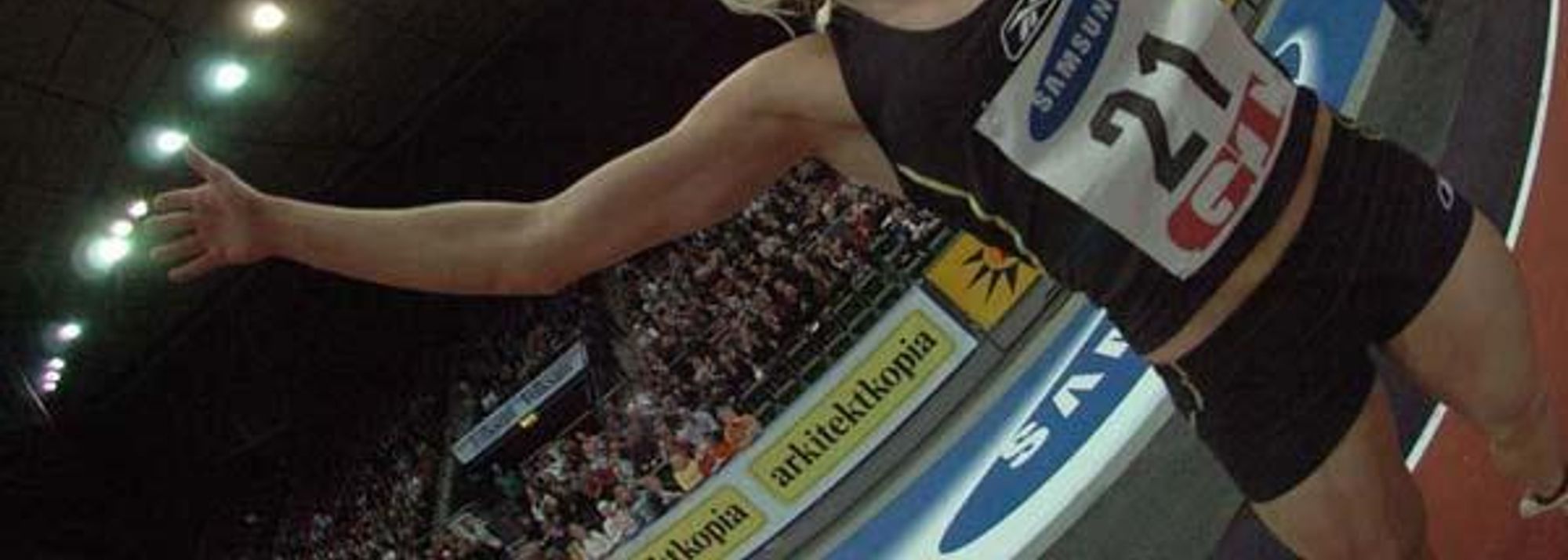


Karolina Kluft in Goteborg (© Deca Text and Bild)
All’s well that ends well, and if that is true the third edition of the “EuroJump” meet in the “Scandinavium” arena in Göteborg was very well indeed.
Because the meet ended with a real big bang as Carolina Klüft – supported not only by the enthusiastic clapping of all the 5.209 spectators but also by a former Eurovision Song Contest winner sung by her favourite artist Carola played on the PA system – improved her own world leading mark in the Long Jump to 6.84! That was a full 21 centimetres further than in Boston last Saturday!
Kluft had dominated the competition right from the start opening with 6.59 and improving to 6.66 in the fourth round. Her main challenge came from Latvian Iveta Radevica who reached 6.57 in the 4th round and 6.58 in the last. Hungarian Tünde Vaszi finished 3rd in 6.53.
But “EuroJump” didn’t just have a great ending. It actually also began very well, as the first event too – the 60m Hurdles for women – challenged the world leading mark (Irina Shevchenko 7.90 in Samara on Wednesday). Despite the presence of Glory Alozie the race was dominated by the Kallur twins and although Susanna lowered her 7.95 from Glasgow by one hundredth she was pressed harder than ever by Jenny who tied her PB of 8.02. Carolina Klüft finished 5th in 8.23, just 0.04 off her PB.
Also the men’s hurdles race produced top marks with four runners under 7.70. The expected duel between American Ron Bramlett and Brazilian Marcio de Souza never materialized but Bramlett still had to do his utmost - a world lead-equalling time of 7.62 - to win the race, as he was challenged all the way by Swede Philip Nossmy who in the end lost to Bramlett by just one single hundredth of a second!
However, the most exciting – and highest quality - duel of the evening was provided by the men’s High Jump. Despite the presence of jumpers like Matt Hemingway, Mark Boswell and Sergey Klyugin it was right from the start obvious that it in the end was to be all about Stefan Holm and Yaroslav Rybakov.
When the bar was raised to 2.31 Holm and Rybakov had perfect records and only Hemingway – who had passed at 2.28 - remained of the others. At 2.31 Rybakov missed his first attempt and Holm took advantage of this slight sign of weakness by making it on first attempt. While Hemingway was eliminated (although he was very close on his 3rd attempt) Rybakov cleared emphatically on his second.
At 2.33 Rybakov was back to his pattern of 1st attempt clearances but as Holm matched him, it was still the Olympic champion in the lead when the bar went to 2.35. Rybakov jumping first made it - thereby setting a new PB and equalling Jaroslav Baba’s world leading mark. Could Holm once more reclaim the lead by also clearing on first attempt?
No, he just brushed the bar off and suddenly it was “advantage Rybakov”. As Holm would need 2.37 to win he decided to save his two remaining attempts for that height which was equal to his own PB set last winter at the “GE Galan” meet in Stockholm.
At 2.37 Rybakov jumped first – and almost made it! Now Holm had the chance to once more get the upper hand. After a very long concentration and with the full support of the crowd he ran up and … almost made it! It was at least as good an attempt as Rybakov’s, but it was not good enough to keep the bar on the supports. Thus the advantage remained with Rybakov who produced two more excellent jumps at 2.37 while Holm flew right into the bar on his second and last attempt.
So although Holm improved his yearly best to 2.33 (BTW the 77th meet at 2.30+ in his career) he had for the second time within less than a week to be content with 2nd place behind a PB improving Russian jumper: In Glasgow it took 2.34 by Dmitrik to win and here Rybakov needed 2.35. But the clearance at 2.33 and so close at 2.37 still shows that it would be very unwise for the High Jump community to think that Holm already is a “has-been”.
The men’s Pole Vault was somewhat disappointing performance wise as Lars Börgeling, Aleksandr Averbukh and Nick Hysong all ended up at 5.45 after failing at 5.65. But the Göteborg fans were still happy as hometown vaulter Alhaji Jeng made 5.55 and thus won the competition.
On an evening when Kajsa Bergqvist (still on the way back to full training after her Achilles operation last summer) had to be content with doing infield interviews with the top athletes the women’s High Jump was a closely fought battle between Tatiana Novoseltsova and Ukrainian teenager Irina Kovalenko. Both made 1.92 with Novoseltsova winning on the countback.
The men’s Triple Jump has been the feature event of the two previous editions of the “EuroJump” meeting, but not this time as local hero Christian Olsson is not competing at all this winter due to a nagging ankle injury which he sustained on his first jump in the Olympic final in Athens. But Christian was of course there and assured the spectators that he expects to be back in full force this summer.
In the men’s 60m final both Morné Nagel (who was fastest in the heats with 6.66) and Roland Nemeth were disqualifed for false starting. When the race finally got away on the 4th time of asking Swede Daniel Persson had the fastest pickup but was in the final stages passed by Finn Markus Pöyhönen and Italian Simone Collio who both finished in 6.69 with Pöyhönen getting the win.
The women’s 60m was mainly a national event, but it was still interesting to see the Kallur twins taking another double victory. Here it was Jenny who had the upper hand and both she and Susanna demonstrated improved flat speed by lowering their PB’s to 7.28 and 7.29 respectively. They are now No 2 and 3 on the Swedish All-time list behind 1970’s star Linda Haglund.
Note: There is no oval track in the “Scandinavium” arena, thus the “EuroJump” meet is limited to jumps and sprints.

