

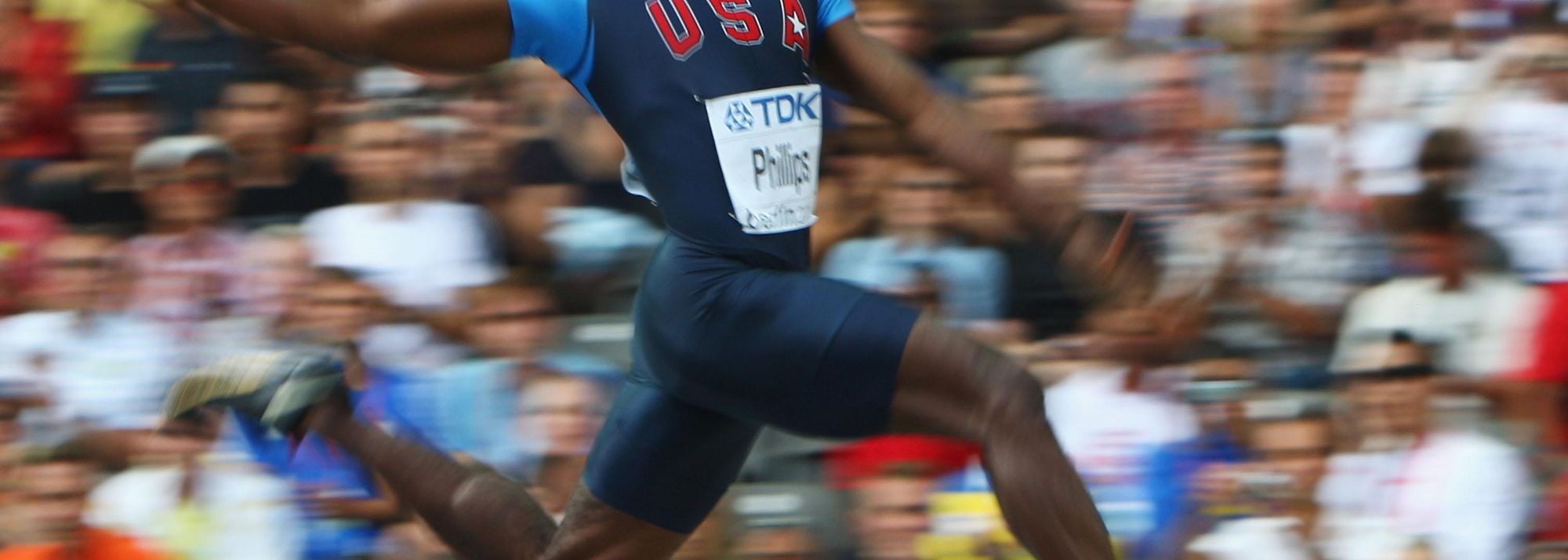


World Leader Dwight Phillips of the United States in flight in the men's Long Jump final at the 12th IAAF World Championships in Athletics in Berlin (© Getty Images)
MonteCarloStatisticians A. Lennart Julin (SWE) and Mirko Jalava (FIN) continue their 2009 review with a survey of the main action in the JUMPS.
MEN -
High Jump
2009 was year No. 1 post-Stefan Holm as the Swedish jumper had retired after a decade as one of the major players in just about every international championship final. A jumper that really experienced that firsthand was Russian Yaroslav Rybakov who met Holm in 15 championship finals with the Swede getting the upper hand on nine of those occasions. No less than four times it was only Holm that separated Rybakov from the gold medal.
In six previous starts in global outdoor championships Rybakov had collected three silver medals, one bronze, one 6th and one 9th place so just like Sanya Richards in the women's 400m the Berlin gold medal was something even their toughest opponents must see as hard earned and well deserved. An extraordinary consistency (Rybakov cleared at least 2.30m in all his 13 competitions indoors and outdoors in 2009) was finally rewarded also in the form of a gold medal.
It probably wasn't a coincidence that the triumph came in a championship final that was exceptionally demanding due to a torrential downpour that wrecked havoc with the warm-up and other preparations and caused such a long delay of the start that it probably was close to being postponed to the next day. Combining that with a truly brutal (even in ideal conditions) chart of heights (2.18m – 2.23m – 2.28m – 2.32m – 2.35m) almost killed the whole competition.
One athlete was eliminated at the second height, all the other 12 failed their first attempts at the third height and eight of them missed all their three chances. But then suddenly the competition caught fire, Rybakov and Kyriakos Ioannou of Cyprus made 2.32m on first attempt and Sylwester Bednarek of Poland and Germany’s Raul Spank on second. It seemed that if you survived the tough first part of the competition you were compensated for the disrupted warm-up.
But another 3 cm was not there for anyone of the four 2.32m-jumpers, so the medals were distributed based on countback with gold for Rybakov, silver for Ioannou and bronzes for Bednarek and Spank. But if the greatest actual height achieved had been decisive the winner would have been the young Bednarek who had a couple of monster jumps that made even the 20-year-old shake his own head in disbelief.
Russian Ivan Ukhov had dominated the indoor season becoming the 11th 2.40m-jumper in history and winning the European Indoor title. Ukhov has always been more successful indoors than outdoors but with five summer meets at 2.34m-2.35m and a 3-0 record versus Rybakov leading up to Berlin that seemed to have changed. However, after 2.30m in the qualification Ukhov in the final had his first failure at 2.23m and was eliminated at 2.28m. So he still has some work to do to manage to make his peak form coincide with the major events.
As for the event in general 2009 was just a quiet year statistically with approximately 25 jumpers clearing 2.30m and 75 making 2.24m.
Pole Vault
Almost certainly the 2009 World Championships will be remembered mostly for Usain Bolt's amazing exploits in the sprint events but to some extent that was a replay of Beijing 2008 and who would bet against Bolt himself doing something similar also in the future? So if you are looking for something really unique – i.e. unlikely to ever be reproduced – that happened in Berlin you should instead focus on the Pole Vault.
Because what Steven Hooker did there was really incredible. After suffering a painful injury some ten days before the championships he was unable not only to train but also to do any kind of warm-up or practice jumping at the meet. Not knowing how many – if any – jumps he could do in the competition his preparation was limited to some easy running, measuring his run-up and waiting for the right moment to take his chance.
In the qualification The Australian waited until 5.65m and then had no room for any hesitating. He had to hope for the run-up to be correct and the technique to function. It did and despite being visibly in pain he had secured his place in the final two days later. But would he be able to jump then? No one knew, not even Hooker himself.
Because he might just have one vault in him in the final the tactic was the same – just wait and wait until the bar was at a height that could be sufficient for at least a medal. This time he waited until 5.85m when just three others still remained in the competition. But the gamble was not successful, Hooker failed while Frenchman Romain Mesnil cleared. Now at least 5.90m was necessary so the Australian decided to try that height. And he succeeded in a magnificent vault that put him high above the bar and that effectively closed the competition.
Just three vaults in about two weeks – not one single practice attempt – and still becoming the World champion! This will go down in the annals of athletics as a truly unique accomplishment and testament of an extraordinary ability to successfully handle a situation that for anyone else would have appeared hopeless. But it was probably not a coincidence that it was achieved by an athlete who one year earlier took the Olympic title after clearing the qualifying height and the last four heights of the final on third and last attempts!
If it hadn't been for Hooker's heroics in Berlin this year of pole vaulting would probably have been remembered as the year when Frenchman Renaud Lavillenie emerged on the international scene. Before 2009 he had been basically a national vaulter with a 10th place at the European U23's in 2007 and going out discretely in the qualification at the World Indoors in 2008 his only international exploits. With his physique (1.77 m, 69 kg) being in sharp contrast to the traditional "Tarzan"-format of leading vaulters probably no expert saw Lavillenie as a future star.
But in 2009 he proved them all completely wrong. Indoors he raised his level about a quarter of a metre and charmed everyone at the European Indoors in Turin by his flawless vaulting towards gold at 5.81m. His speed on the runway was impressive but so also his plant of the pole and his body control over the bar. Lavillenie showed that speed and technique could compensate fully for lack of physical strength and size.
And if there still were any doubters after Turin they were converted into fans after the European Team Championships in Leiria in late June where Lavillenie cleared 6.01mb(new French record) and might even have made 6.10m if the special rules (said to improve the attractiveness of the competition??) of that meet hadn't prevented him from taking more than one attempt at that height.
Apart from Hooker and Lavillenie 2009 Pole Vaulting was a little flat. Top US vaulter (and reigning World Champion) Brad Walker had another year when his injury problems prevented him from performing up to his ability at the main events of the season. And German Raphael Holzdeppe who tied the World Junior Record of 5.80m in 2008 was unable to fulfil the expectations that had created. Also hampered by injuries Holzdeppe competed sparingly and then at the 5.50m/5.60m level.
Worrying is also that the number of vaulters clearing 5.75m or better outdoors in 2009 dropped to 13 which means a loss of over 50% compared to the last previous post-Olympic year 2005!
Long Jump
If there is one event that deserves the descriptor "Event of the Year" it is the Long Jump. Because rather than showing the post-Olympic-blues that characterized most other events the Long Jump was at an all-time high quality-wise.
It doesn't show that clearly in the main year lists counting the number of jumpers over 8.00m or over 8.20m but if one checks the performances rather than the performers list a very different picture emerges. Because quite often the performers list is dominated by one-off marks set under extremely beneficial conditions and not really reflecting the normal level of performance for the athlete.
What was special with 2009 was that most of the top jumpers had very impressive seasons to back-up their top marks. Of the top-8 jumpers only one – Germany's Sebastian Bayer – would loose more than 14 cm if their respective top marks would be exchanged for their second best performance of the season.
When Irving Saladino – the dominant jumper in recent years – after a brilliant start to the summer with two meets at 8.50m+ was hindered by injury problems Dwight Phillips – the dominant jumper in the years before Saladino – unopposed could reclaim his position as the No 1. At age 31 Phillips actually had his best ever season averaging 8.43m for his 12 meets and more than doubling (from 4 to 9) his career total of 8.50m+ competitions!
With Saladino effectively sidelined for the second half of the summer South Africa's Godfrey Mokoena assumed the position as the main challenger to Phillips. Mokoena was a very deserving silver medallist indeed in Berlin as he during his northern hemisphere season of four months and 16 meets averaged 8.22m.
The Berlin bronze went to the 2009 international revelation – Australia's 21-years-old Mitchell Watt. After spending his teenage years playing Australian football and rugby Watt in 2007 decided to return to athletics where he had been quite successful as a kid. And that talent hadn't been lost as illustrated by his extremely steep progress: 7.72 i February 2008, 7.97m in June, 8.04m in January 2009, 8.17m in March and then 8.43m in July! The legitimacy of which he emphatically demonstrated by his 8.37m for the Bronze in the World Championships!
That the Berlin medallists came from three different parts of the World – Phillips from North America, Mokoena from Africa and Watts from Oceania – is another illustration of the fact that the Long Jump is the most global of all athletics events when it comes to the national diversity at the top. No nation or no area is dominant here like you can see in most other events.
Among the top-25 of 2009 no less than 18 different nations spread over all the six Areas of the IAAF are represented. If one widens the scope to all 8.00m+ jumpers the 68 jumpers are coming from 36 different nations!
Triple Jump
Since persistent injuries forced Christian Olsson after 2006 to – at least temporarily – vacate his position as the No 1 triple jumper the event has developed into a two-man battle for supremacy between Portugal's Nelson Evora and Britain's Phillips Idowu. Except for the 2009 European Indoors – which none of them contested – this duo has won all five gold medals as well as three silvers.
In the last four global championships – Worlds 2007, World Indoors 2008, Olympics 2008 and Worlds 2009 – the gold medallists have been Evora 17.74m, Idowu 17.75m, Evora 17.67m and Idowu 17.73m respectively! The most interesting development here is that Idowu after about a decade as an athlete with great potential but lacking the consistency necessary to have success at the global championships now has become a complete world class performer.
In recent years the number of 17.50m+ and 17.00m+ jumpers have varied between 5 and 8 and between 30 and 39 so 2009 with 6 and 35 was very much "average" quality-wise. The only really remarkable thing was that 50% of those over 17.50m were Cubans who achieved their top marks already in the spring on home soil. However, they did prove themselves also in Berlin (3rd and 5th) as well as at the World Athletics Final (Giralt winning over Idowu).
The Triple Jump has always been a strong Cuban event so there it is very much a tradition living on but another consistent TJ power – the USA – seems to have lost it. Only Brandon Roulhac could claim the status of being reasonably consistent at the world elite benchmark of 17 metres, but he still failed to reach the Berlin final. The other two US jumpers at the World championships – Kenta Bell and Walter Davis – were mere shadows of the world class jumpers with those names.
Of course top athletes could loose form for a number of legitimate reasons but the remarkable fact here is that the US didn't have any other athletes to send to Berlin than the visibly below par Bell and Davis, none of which hade jumped better than 16.85m this year. However, there is a distinct glimmer of hope for the future of US triple jumping in Will Claye. On his 18th birthday Claye won the NCAA title with 17.24w (having also the new US junior record 17.19m in the series)!
Claye, who wisely after a long and strenuous collegiate season decided to pass the US Championships (and Berlin Trials), could very well be the best prospect for giving the Triple Jump world another 18m-jumper. Something only two jumpers have done with legal wind and two more with wind-aid. It has now been over 11 years since we last saw someone surpass that illusive barrier.
2009 World Lists - [High Jump][Pole Vault][Long Jump][Triple Jump]
WOMEN -
There was plenty to talk about in the women’s jumping events this season with records broken and win streaks ending. Last season Croatian Blanka Vlasic had seen her magnificent 34-meet win streak come to an end at the Olympics and this season it was Yelena Isinbayeva’s turn to see her 19-meet streak in ruins.
While the Russian star was unable to defend her World title in the pole vault in Berlin, she bounced back nicely notching her 27th world record just days later. Vlasic on the other hand had a very different season with real resistance coming from Germany. Ariane Friedrich came to the same level with the Croatian, but in the end could not really challenge her for the win in Berlin. For long and triple jumps this season was not equally as prolific. 23-year-old American Brittney Reese was the clear number one name in the long jump, the only athlete over seven metres and a World champion as well. The triple jump season was a real low key one with only two athletes over 15 metres.
High Jump
26-year-old Blanka Vlasic recovered well from her Olympic disappointment. She had a really strong start to the indoor season with a 2.03m clearance in the first competition in Rijeka, Croatia, and a 2.04m result less than two weeks later. But the big picture of the 2009 high jumping season was drawn in Karlsruhe, Germany, in the middle of February when Vlasic lost the competition despite jumping 2.05m to equal her national indoor record. 25-year-old Ariane Friedrich had jumped a 2.03m personal best in 2008, her first season over 2 metres and had started the 2009 indoor season impressively. But the 2.05m personal best and win over Vlasic still was a surprise.
Friedrich didn’t stop there as she decisively won the European Indoor Championships in Turin with Vlasic failing to compete at her best level only reaching an equal fifth place in the competition. Vlasic however wasn’t troubled with the indoor disappointment but immediately hit a 2.05m winning mark in Doha, Qatar, in her first outdoor meet. Following a very consistent outdoor season with only two losses Vlasic came to Berlin as a co-favourite with Friedrich who had jumped a 2.06m national record and world leader at the same stadium in June. But at the World Championships the German did not find the same rhythm as in the best meets of the season and in the end Vlasic was a comfortable winner with a 2.04m clearance. 27-year-old Russian Anna Chicherova surprised a bit and grabbed her second consecutive silver medal at World Champs jumping a season’s best 2.02m, the same result with Friedrich who got the bronze, her first worldwide major championships medal.
Vlasic didn’t stop at her second straight World title but attacked the World record once more in Zagreb at the end of August making a first time clearance at 2.08m, a national record and second place in the world all-time list behind Bulgarian Stefka Kostadinova’s 22¬-year-old world record 2.09m.
Pole Vault
Yelena Isinbayeva started her season brightly with a World indoor record 5.00m in the first competition in Donetsk, Ukraine. It was the 26th World record for the 27-year-old Russian who was unbeaten outdoors in 2008 also winning her second consecutive Olympic title. In 2009 she seemed to be in even better form and things went smoothly until the middle of July. But then Isinbayeva seemed to lose some of her touch apparently because of an injury and finally lost to Pole Anna Rogowska in London on countback with both athletes clearing 4.68m, after having won 19 competitions in a row.
The Russian star didn’t compete any more before Berlin, and at the World championships, famously no-heighted out of the competition. She would later admit that she had simply become complacent. With her elimination, it was the 28-year-old Rogowska who therefore grabbed her first major gold medal with a relatively modest 4.75m result with countrywoman Monika Pyrek and American Chelsea Johnson tied for the silver with 4.65m.
But the pole vault season wasn’t over for Isinbayeva. She bounced back quickly setting a 5.06m world record in Zürich just 11 days after the disappointing World Championships final. The Russian furthermore added four more wins including the last World Athletics Final for five straight wins to the end of the season.
Jenn Stuczynski of USA, the second best vaulter in the world in 2008, had been injured after an impressive indoor season and couldn’t compete outdoors after June. 28-year-old Brazilian Fabiana Murer set a 4.82m South American record in June, but missed her opportunity in Berlin only clearing 4.55m for the fifth place.
The United States has 30 athletes in the world top 100, Germany has 15 for second place and Russia eight for third.
Long Jump
23-year-old American Brittney Reese continued her run to the world elite in the Long Jump. The former NCAA champion was eighth in Osaka 2007 as a 20-year-old and reached 6.95m winning the US Olympic Trials in 2008 before rising to fifth place in Beijing.
Her 2009 season was opened in style and she was the early world leader with a 6.99m personal best jump in Doha in May. The young American then progressed to another PB in Belém, Brazil, reaching 7.06m later the same month and won the US Championships with a wind aided 7.09m result in June. Reese was the only athlete during this season to jump over 7 metres and she did it in Berlin as well winning comfortably with a 7.10m PB and 2009 world leading mark.
Portuguese Naide Gomes was badly disappointed in Beijing when she didn’t make the Olympic final although she had jumped a 7.12m national record earlier. In 2009 Gomes didn’t jump 7 metres, but was as close as possible with a 6.99m season’s best and winning result in London in July. But Berlin proved to be another disappointment for the former heptathlete who missed the bronze by a mere three centimetres jumping 6.77m in the World Championships final. Former South African Karen Melis Mey of Turkey was the surprise bronze medallist with 6.80m result. The reigning World champion from Osaka, 33-year-old Russian Tatyana Lebedeva, only competed three times prior to Berlin, but still found her stride when it mattered jumping a 6.97m season’s best for the silver.
Russia has 16 athletes in the world top 100 just edging United States with 14. Germany is third with ten.
Triple Jump
In the women’s triple jump results went down quickly during the 2009 season. Only two athletes jumped over 15 metres for the first time in four years (since 2005) and the depth in the event was even worse with the third athlete in the world list only reaching 14.72m. The last time this result was third best in the world was in 2001.
31-year-old Nadezhda Alekhina was the big surprise of the season setting a 15.14m personal best for the win at the Russian championships in July. She added a massive 54 centimetres to her 8-year-old best 14.60m from 2001, but could not back this result up later. Alekhina’s second best mark of the season was only 14.61m and she wasn’t even close to making the final in Berlin.
At the World Championships reigning champion Yargelis Savigne of Cuba was the only one rising to her own level. The 25-year-old retained her title with a 14.95m result, just five centimetres less than the 15.00m season’s best she jumped in July. Fellow Cuban Mabel Gay was the silver medallist with 14.61m and Anna Pyatykh of Russia took the bronze with 14.58m, the worst results for the lesser medals since 2001. Savigne has risen to the number one athlete in this event and holds a 13-strong win streak and was unbeaten in 2009.
Russia has 11 athletes in the world top 100 with eight for Ukraine and seven for China.
2009 World Lists - [High Jump][Pole Vault][Long Jump][Triple Jump]
MEN -
High Jump
2009 was year No. 1 post-Stefan Holm as the Swedish jumper had retired after a decade as one of the major players in just about every international championship final. A jumper that really experienced that firsthand was Russian Yaroslav Rybakov who met Holm in 15 championship finals with the Swede getting the upper hand on nine of those occasions. No less than four times it was only Holm that separated Rybakov from the gold medal.
In six previous starts in global outdoor championships Rybakov had collected three silver medals, one bronze, one 6th and one 9th place so just like Sanya Richards in the women's 400m the Berlin gold medal was something even their toughest opponents must see as hard earned and well deserved. An extraordinary consistency (Rybakov cleared at least 2.30m in all his 13 competitions indoors and outdoors in 2009) was finally rewarded also in the form of a gold medal.
It probably wasn't a coincidence that the triumph came in a championship final that was exceptionally demanding due to a torrential downpour that wrecked havoc with the warm-up and other preparations and caused such a long delay of the start that it probably was close to being postponed to the next day. Combining that with a truly brutal (even in ideal conditions) chart of heights (2.18m – 2.23m – 2.28m – 2.32m – 2.35m) almost killed the whole competition.
One athlete was eliminated at the second height, all the other 12 failed their first attempts at the third height and eight of them missed all their three chances. But then suddenly the competition caught fire, Rybakov and Kyriakos Ioannou of Cyprus made 2.32m on first attempt and Sylwester Bednarek of Poland and Germany’s Raul Spank on second. It seemed that if you survived the tough first part of the competition you were compensated for the disrupted warm-up.
But another 3 cm was not there for anyone of the four 2.32m-jumpers, so the medals were distributed based on countback with gold for Rybakov, silver for Ioannou and bronzes for Bednarek and Spank. But if the greatest actual height achieved had been decisive the winner would have been the young Bednarek who had a couple of monster jumps that made even the 20-year-old shake his own head in disbelief.
Russian Ivan Ukhov had dominated the indoor season becoming the 11th 2.40m-jumper in history and winning the European Indoor title. Ukhov has always been more successful indoors than outdoors but with five summer meets at 2.34m-2.35m and a 3-0 record versus Rybakov leading up to Berlin that seemed to have changed. However, after 2.30m in the qualification Ukhov in the final had his first failure at 2.23m and was eliminated at 2.28m. So he still has some work to do to manage to make his peak form coincide with the major events.
As for the event in general 2009 was just a quiet year statistically with approximately 25 jumpers clearing 2.30m and 75 making 2.24m.
Pole Vault
Almost certainly the 2009 World Championships will be remembered mostly for Usain Bolt's amazing exploits in the sprint events but to some extent that was a replay of Beijing 2008 and who would bet against Bolt himself doing something similar also in the future? So if you are looking for something really unique – i.e. unlikely to ever be reproduced – that happened in Berlin you should instead focus on the Pole Vault.
Because what Steven Hooker did there was really incredible. After suffering a painful injury some ten days before the championships he was unable not only to train but also to do any kind of warm-up or practice jumping at the meet. Not knowing how many – if any – jumps he could do in the competition his preparation was limited to some easy running, measuring his run-up and waiting for the right moment to take his chance.
In the qualification The Australian waited until 5.65m and then had no room for any hesitating. He had to hope for the run-up to be correct and the technique to function. It did and despite being visibly in pain he had secured his place in the final two days later. But would he be able to jump then? No one knew, not even Hooker himself.
Because he might just have one vault in him in the final the tactic was the same – just wait and wait until the bar was at a height that could be sufficient for at least a medal. This time he waited until 5.85m when just three others still remained in the competition. But the gamble was not successful, Hooker failed while Frenchman Romain Mesnil cleared. Now at least 5.90m was necessary so the Australian decided to try that height. And he succeeded in a magnificent vault that put him high above the bar and that effectively closed the competition.
Just three vaults in about two weeks – not one single practice attempt – and still becoming the World champion! This will go down in the annals of athletics as a truly unique accomplishment and testament of an extraordinary ability to successfully handle a situation that for anyone else would have appeared hopeless. But it was probably not a coincidence that it was achieved by an athlete who one year earlier took the Olympic title after clearing the qualifying height and the last four heights of the final on third and last attempts!
If it hadn't been for Hooker's heroics in Berlin this year of pole vaulting would probably have been remembered as the year when Frenchman Renaud Lavillenie emerged on the international scene. Before 2009 he had been basically a national vaulter with a 10th place at the European U23's in 2007 and going out discretely in the qualification at the World Indoors in 2008 his only international exploits. With his physique (1.77 m, 69 kg) being in sharp contrast to the traditional "Tarzan"-format of leading vaulters probably no expert saw Lavillenie as a future star.
But in 2009 he proved them all completely wrong. Indoors he raised his level about a quarter of a metre and charmed everyone at the European Indoors in Turin by his flawless vaulting towards gold at 5.81m. His speed on the runway was impressive but so also his plant of the pole and his body control over the bar. Lavillenie showed that speed and technique could compensate fully for lack of physical strength and size.
And if there still were any doubters after Turin they were converted into fans after the European Team Championships in Leiria in late June where Lavillenie cleared 6.01mb(new French record) and might even have made 6.10m if the special rules (said to improve the attractiveness of the competition??) of that meet hadn't prevented him from taking more than one attempt at that height.
Apart from Hooker and Lavillenie 2009 Pole Vaulting was a little flat. Top US vaulter (and reigning World Champion) Brad Walker had another year when his injury problems prevented him from performing up to his ability at the main events of the season. And German Raphael Holzdeppe who tied the World Junior Record of 5.80m in 2008 was unable to fulfil the expectations that had created. Also hampered by injuries Holzdeppe competed sparingly and then at the 5.50m/5.60m level.
Worrying is also that the number of vaulters clearing 5.75m or better outdoors in 2009 dropped to 13 which means a loss of over 50% compared to the last previous post-Olympic year 2005!
Long Jump
If there is one event that deserves the descriptor "Event of the Year" it is the Long Jump. Because rather than showing the post-Olympic-blues that characterized most other events the Long Jump was at an all-time high quality-wise.
It doesn't show that clearly in the main year lists counting the number of jumpers over 8.00m or over 8.20m but if one checks the performances rather than the performers list a very different picture emerges. Because quite often the performers list is dominated by one-off marks set under extremely beneficial conditions and not really reflecting the normal level of performance for the athlete.
What was special with 2009 was that most of the top jumpers had very impressive seasons to back-up their top marks. Of the top-8 jumpers only one – Germany's Sebastian Bayer – would loose more than 14 cm if their respective top marks would be exchanged for their second best performance of the season.
When Irving Saladino – the dominant jumper in recent years – after a brilliant start to the summer with two meets at 8.50m+ was hindered by injury problems Dwight Phillips – the dominant jumper in the years before Saladino – unopposed could reclaim his position as the No 1. At age 31 Phillips actually had his best ever season averaging 8.43m for his 12 meets and more than doubling (from 4 to 9) his career total of 8.50m+ competitions!
With Saladino effectively sidelined for the second half of the summer South Africa's Godfrey Mokoena assumed the position as the main challenger to Phillips. Mokoena was a very deserving silver medallist indeed in Berlin as he during his northern hemisphere season of four months and 16 meets averaged 8.22m.
The Berlin bronze went to the 2009 international revelation – Australia's 21-years-old Mitchell Watt. After spending his teenage years playing Australian football and rugby Watt in 2007 decided to return to athletics where he had been quite successful as a kid. And that talent hadn't been lost as illustrated by his extremely steep progress: 7.72 i February 2008, 7.97m in June, 8.04m in January 2009, 8.17m in March and then 8.43m in July! The legitimacy of which he emphatically demonstrated by his 8.37m for the Bronze in the World Championships!
That the Berlin medallists came from three different parts of the World – Phillips from North America, Mokoena from Africa and Watts from Oceania – is another illustration of the fact that the Long Jump is the most global of all athletics events when it comes to the national diversity at the top. No nation or no area is dominant here like you can see in most other events.
Among the top-25 of 2009 no less than 18 different nations spread over all the six Areas of the IAAF are represented. If one widens the scope to all 8.00m+ jumpers the 68 jumpers are coming from 36 different nations!
Triple Jump
Since persistent injuries forced Christian Olsson after 2006 to – at least temporarily – vacate his position as the No 1 triple jumper the event has developed into a two-man battle for supremacy between Portugal's Nelson Evora and Britain's Phillips Idowu. Except for the 2009 European Indoors – which none of them contested – this duo has won all five gold medals as well as three silvers.
In the last four global championships – Worlds 2007, World Indoors 2008, Olympics 2008 and Worlds 2009 – the gold medallists have been Evora 17.74m, Idowu 17.75m, Evora 17.67m and Idowu 17.73m respectively! The most interesting development here is that Idowu after about a decade as an athlete with great potential but lacking the consistency necessary to have success at the global championships now has become a complete world class performer.
In recent years the number of 17.50m+ and 17.00m+ jumpers have varied between 5 and 8 and between 30 and 39 so 2009 with 6 and 35 was very much "average" quality-wise. The only really remarkable thing was that 50% of those over 17.50m were Cubans who achieved their top marks already in the spring on home soil. However, they did prove themselves also in Berlin (3rd and 5th) as well as at the World Athletics Final (Giralt winning over Idowu).
The Triple Jump has always been a strong Cuban event so there it is very much a tradition living on but another consistent TJ power – the USA – seems to have lost it. Only Brandon Roulhac could claim the status of being reasonably consistent at the world elite benchmark of 17 metres, but he still failed to reach the Berlin final. The other two US jumpers at the World championships – Kenta Bell and Walter Davis – were mere shadows of the world class jumpers with those names.
Of course top athletes could loose form for a number of legitimate reasons but the remarkable fact here is that the US didn't have any other athletes to send to Berlin than the visibly below par Bell and Davis, none of which hade jumped better than 16.85m this year. However, there is a distinct glimmer of hope for the future of US triple jumping in Will Claye. On his 18th birthday Claye won the NCAA title with 17.24w (having also the new US junior record 17.19m in the series)!
Claye, who wisely after a long and strenuous collegiate season decided to pass the US Championships (and Berlin Trials), could very well be the best prospect for giving the Triple Jump world another 18m-jumper. Something only two jumpers have done with legal wind and two more with wind-aid. It has now been over 11 years since we last saw someone surpass that illusive barrier.
2009 World Lists - [High Jump][Pole Vault][Long Jump][Triple Jump]
WOMEN -
There was plenty to talk about in the women’s jumping events this season with records broken and win streaks ending. Last season Croatian Blanka Vlasic had seen her magnificent 34-meet win streak come to an end at the Olympics and this season it was Yelena Isinbayeva’s turn to see her 19-meet streak in ruins.
While the Russian star was unable to defend her World title in the pole vault in Berlin, she bounced back nicely notching her 27th world record just days later. Vlasic on the other hand had a very different season with real resistance coming from Germany. Ariane Friedrich came to the same level with the Croatian, but in the end could not really challenge her for the win in Berlin. For long and triple jumps this season was not equally as prolific. 23-year-old American Brittney Reese was the clear number one name in the long jump, the only athlete over seven metres and a World champion as well. The triple jump season was a real low key one with only two athletes over 15 metres.
High Jump
26-year-old Blanka Vlasic recovered well from her Olympic disappointment. She had a really strong start to the indoor season with a 2.03m clearance in the first competition in Rijeka, Croatia, and a 2.04m result less than two weeks later. But the big picture of the 2009 high jumping season was drawn in Karlsruhe, Germany, in the middle of February when Vlasic lost the competition despite jumping 2.05m to equal her national indoor record. 25-year-old Ariane Friedrich had jumped a 2.03m personal best in 2008, her first season over 2 metres and had started the 2009 indoor season impressively. But the 2.05m personal best and win over Vlasic still was a surprise.
Friedrich didn’t stop there as she decisively won the European Indoor Championships in Turin with Vlasic failing to compete at her best level only reaching an equal fifth place in the competition. Vlasic however wasn’t troubled with the indoor disappointment but immediately hit a 2.05m winning mark in Doha, Qatar, in her first outdoor meet. Following a very consistent outdoor season with only two losses Vlasic came to Berlin as a co-favourite with Friedrich who had jumped a 2.06m national record and world leader at the same stadium in June. But at the World Championships the German did not find the same rhythm as in the best meets of the season and in the end Vlasic was a comfortable winner with a 2.04m clearance. 27-year-old Russian Anna Chicherova surprised a bit and grabbed her second consecutive silver medal at World Champs jumping a season’s best 2.02m, the same result with Friedrich who got the bronze, her first worldwide major championships medal.
Vlasic didn’t stop at her second straight World title but attacked the World record once more in Zagreb at the end of August making a first time clearance at 2.08m, a national record and second place in the world all-time list behind Bulgarian Stefka Kostadinova’s 22¬-year-old world record 2.09m.
Pole Vault
Yelena Isinbayeva started her season brightly with a World indoor record 5.00m in the first competition in Donetsk, Ukraine. It was the 26th World record for the 27-year-old Russian who was unbeaten outdoors in 2008 also winning her second consecutive Olympic title. In 2009 she seemed to be in even better form and things went smoothly until the middle of July. But then Isinbayeva seemed to lose some of her touch apparently because of an injury and finally lost to Pole Anna Rogowska in London on countback with both athletes clearing 4.68m, after having won 19 competitions in a row.
The Russian star didn’t compete any more before Berlin, and at the World championships, famously no-heighted out of the competition. She would later admit that she had simply become complacent. With her elimination, it was the 28-year-old Rogowska who therefore grabbed her first major gold medal with a relatively modest 4.75m result with countrywoman Monika Pyrek and American Chelsea Johnson tied for the silver with 4.65m.
But the pole vault season wasn’t over for Isinbayeva. She bounced back quickly setting a 5.06m world record in Zürich just 11 days after the disappointing World Championships final. The Russian furthermore added four more wins including the last World Athletics Final for five straight wins to the end of the season.
Jenn Stuczynski of USA, the second best vaulter in the world in 2008, had been injured after an impressive indoor season and couldn’t compete outdoors after June. 28-year-old Brazilian Fabiana Murer set a 4.82m South American record in June, but missed her opportunity in Berlin only clearing 4.55m for the fifth place.
The United States has 30 athletes in the world top 100, Germany has 15 for second place and Russia eight for third.
Long Jump
23-year-old American Brittney Reese continued her run to the world elite in the Long Jump. The former NCAA champion was eighth in Osaka 2007 as a 20-year-old and reached 6.95m winning the US Olympic Trials in 2008 before rising to fifth place in Beijing.
Her 2009 season was opened in style and she was the early world leader with a 6.99m personal best jump in Doha in May. The young American then progressed to another PB in Belém, Brazil, reaching 7.06m later the same month and won the US Championships with a wind aided 7.09m result in June. Reese was the only athlete during this season to jump over 7 metres and she did it in Berlin as well winning comfortably with a 7.10m PB and 2009 world leading mark.
Portuguese Naide Gomes was badly disappointed in Beijing when she didn’t make the Olympic final although she had jumped a 7.12m national record earlier. In 2009 Gomes didn’t jump 7 metres, but was as close as possible with a 6.99m season’s best and winning result in London in July. But Berlin proved to be another disappointment for the former heptathlete who missed the bronze by a mere three centimetres jumping 6.77m in the World Championships final. Former South African Karen Melis Mey of Turkey was the surprise bronze medallist with 6.80m result. The reigning World champion from Osaka, 33-year-old Russian Tatyana Lebedeva, only competed three times prior to Berlin, but still found her stride when it mattered jumping a 6.97m season’s best for the silver.
Russia has 16 athletes in the world top 100 just edging United States with 14. Germany is third with ten.
Triple Jump
In the women’s triple jump results went down quickly during the 2009 season. Only two athletes jumped over 15 metres for the first time in four years (since 2005) and the depth in the event was even worse with the third athlete in the world list only reaching 14.72m. The last time this result was third best in the world was in 2001.
31-year-old Nadezhda Alekhina was the big surprise of the season setting a 15.14m personal best for the win at the Russian championships in July. She added a massive 54 centimetres to her 8-year-old best 14.60m from 2001, but could not back this result up later. Alekhina’s second best mark of the season was only 14.61m and she wasn’t even close to making the final in Berlin.
At the World Championships reigning champion Yargelis Savigne of Cuba was the only one rising to her own level. The 25-year-old retained her title with a 14.95m result, just five centimetres less than the 15.00m season’s best she jumped in July. Fellow Cuban Mabel Gay was the silver medallist with 14.61m and Anna Pyatykh of Russia took the bronze with 14.58m, the worst results for the lesser medals since 2001. Savigne has risen to the number one athlete in this event and holds a 13-strong win streak and was unbeaten in 2009.
Russia has 11 athletes in the world top 100 with eight for Ukraine and seven for China.
2009 World Lists - [High Jump][Pole Vault][Long Jump][Triple Jump]

