

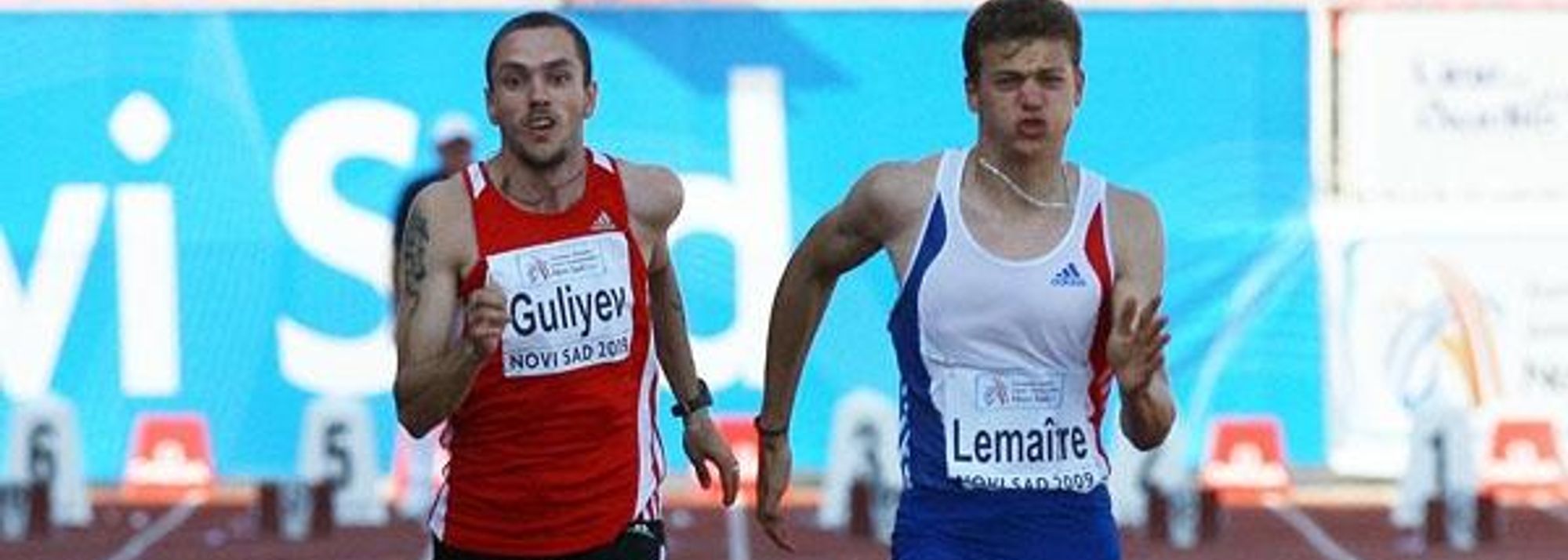


Christophe Lemaître on his way to 2009 European Junior gold (© AFP / Getty Images)
“Does European athletics now have an answer to Usain Bolt in the making?” was the question being asked after France's Christophe Lemaître set European junior 100m record on the second day (24) of the 20th European Athletics Junior Championships.
Lemaître ran 10.04, the second best officially ratified time by an Under-20 sprinter, with only the World junior record of 10.01 by Trinidad's Darrel Brown being faster.
Lemaître “I can run even faster”
The long-legged 1.89m-tall Frenchman from Aix-les-Bains blazed out of his blocks in the men's 100m final, with a stunningly quick reaction time of 0.120, and was straight into his running.
By 40m the race was as good as over but, unlike Bolt, there were no celebrations until he was past the line.
His time took two-hundredths off the previous European junior record of 10.06, set by Britain's Dwain Chambers at the 1997 European Juniors.
“I was only focused getting to the top of the podium. Of course, I was motivated to make a good time but in a championship it is always at the bottom of the list of priorities,” commented Lemaître.
“I thought that the junior record of France might come, but the European record, I did not expect me at all. I am a bit speechless. Now, I'm going to rest and give my best so that, with my friends, we can also go back with a relay medal. Now I'm looking forward to Berlin next month. I think that I can do something great there, I can run even faster,” he added.
Azerbaijan's Ramil Guliyev, who had run 10.08 this year, had a good run himself but could not contain the flying Frenchman. He started to close on Lemaître during the final 20m but had to settle for the silver medal in 10.16.
Four more championship records
Lemaître's feat was the highlight of an outstanding second day at the Championships but there were four other championship records.
Romania's Bianca Perie, a Hammer Throw gold medallist at two World Youth and two World Junior Championships, completed her outstanding junior championship career by defending her European title with a throw of 68.59m, an improvement of nearly two metres.
After a rather modest 61.15m first round effort, by her own high standards, Perie then executed a perfect second throw and sent the Hammer out to 68.59m. The throw as good as clinched the gold medal as nobody else in the field had ever thrown within four metres of that mark.
Another record came in the women's Long Jump when Russia's Darya Klishina broke many hearts among the Serbian supporters by jumping 6.80m.
Klishina's massive jump broke the 24-year-old record of 6.68m that had belonged to Bulgaria's Sofia Bozhanova since 1985.
The enthralling competition started in earnest when Spanovic, who won the World Junior crown last year and the World University Games title two weeks ago, jumped 6.64m in the first round, a mark that kept the lead until Klishina produced her winning jump in the third round.
Spanovic then responded with an absolute national record 6.71m later in that third round but couldn't go any further while Klishina, after a fourth round foul, emphasised her superiority by going out to 6.72m with both of her last two attempts.
“I expected a good result but I didn't think I was going to jump so far, despite coming here in good shape. Ivana is a friend of mine but I have a feeling that this is just the beginning of a life-long struggle as we both make progress in the future,” commented Klishina.
Nesterenko turns the tables
The Ukrainian Discus thrower Mykyta Nesterenko completed the trio of championship records in the field events by twice improving the previous mark, opening with 65.59m and then finishing off proceedings with 65.73m in the final round.
Nesterenko, the European junior record holder with the 1.75kg Discus at 70.13m, went to the World Junior Championships in Bydgoszcz 12 months ago as the favourite but only ended up finishing a disappointed third behind Germany's Gordon Wolf.
This time the tables were turned as Wolf, who had thrown 66.45m earlier this summer, could only reach 63.02m and took the silver medal.
The Ukrainian gold reserves were also increased by Yulia Baraley, who ran a well-controlled race to win in 52.80. She added the European 400m junior title to the one she won at the World Youth Championships gold medal two years ago.
Chris Clarke added his name to a long list of illustrious British names who have won the men's 400m, winning in a personal best of 45.59, the eighth fastest time by a European junior over one lap of the track.
Clarke was marginally in front at the halfway point in the race but accelerated between 250 and 350 metres to leave everyone else trailing in his wake by at least 10 metres and win by more than a second from Hungary's silver medallist Andrzej Jaros, who clocked a personal best of 46.75.
Favourites to the fore
Russia's Alexsey Fydorov the 2007 World Youth Championships silver medallist, was almost half-a-metre better than any other man in the Triple Jump in Novi Sad and proved his ability by bounding out to 16.67m in the opening round, albeit helped by a 2.7mps wind,
Germany's Yasmin Kwadwo was not quite such an overwhelming favourite as Fydorov but she had been the fastest women during the previous two rounds of the women's 100m and held her nerve under pressure to win in 11.42.
“I have to confess, after running the fastest heat and semi, I knew that I could win the race but my legs were shaking before the start,” admitted Kwadwo.
Nevertheless, when the gun went Kwadwo was the fastest out of her blocks and had a clear advantage at the halfway point although Norway's Folake Akinyemi started to claw back the deficit in the final 40m to take the silver medal in 11.47.
Belgian bounty
Belgium's Thomas van der Plaetsen made a little bit of history when he became his country's first European junior Decathlon champion after finishing the 10 events with a tally of 7769 points.
He made a massive improvement in his previous best of 7366 by getting personal bests in seven events, including all five on the first day.
Van der Plaetsen lead overnight with 4137 points and then sped to a 110m Hurdles best of 14.27 but, after only being able to launch the Discus out to 36.44m, his lead over Sweden's Peter Olson was reduced from 88 points to just two.
Olson then took over in pole position by 128 points after an excellent 4.90m Pole Vault. However, van der Plaetsen responded in the Javelin Throw with 58.42m and regained the lead by 104 points as Olson could do no better than 42.74m.
The computer science student from the west Belgian town of Deinze then pushed his tired body to a 1500m personal best of 4:44.17 and held off Olson, who ran strongly to finish in 4:33.27 but could not quite do enough in the final event and was second with 7734 points.
The fourth championship record came in the men's 110m Hurdles semi-finals as Russia's Sergey Shubenkov ran a personal best of 13.35, although the event has only been contested over the smaller 99cm hurdles for the last two editions of the European Junior Championships.
Phil Minshull for the IAAF
Click here for RESULTS

