

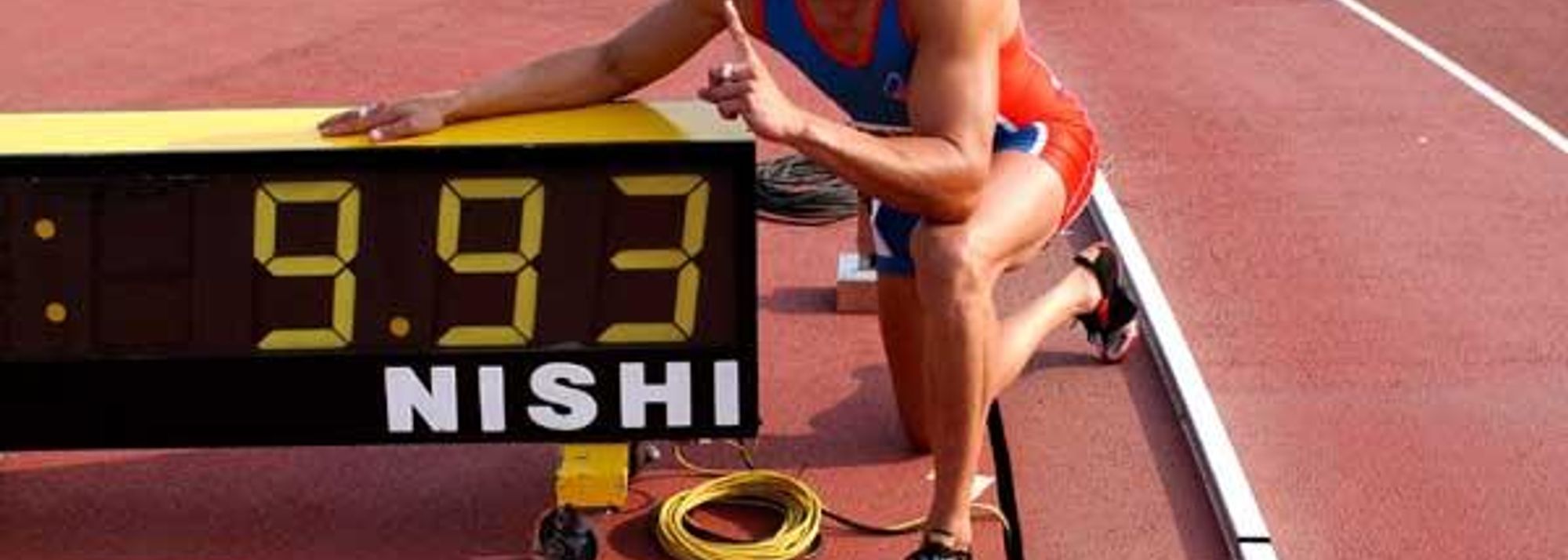


Patrick Johnson with his Australian record time in Mito (© Rikujyou Kyougi Magazine)
The highlight of the Japanese spring track season was of course the men’s 100m at the Mito meeting on 5 May, where Patrick Johnson of Australia ran 9.93 for a national 100m record. It was also a meet record, but not an all-comers record, as that was set (9.86) by Carl Lewis at the 1991 IAAF World Championships in Tokyo.
Earlier at the Shizuoka meet on 3 May, Johnson’s 200m time of 20.42, disguised under heavily wind assisted conditions (3.6m/s) gave no indication of what was to come two days later in Mito.
Johnson is next scheduled to run at this weekend’s Osaka IAAF GP (Saturday 10 May), where among others he will meet Americans Tim Montgomery and Bernard Williams.
Behind Johnson, Japan’s Shingo Suetsugu also recorded a personal best of 10.03. It was the fastest time by Japanese on the native soil, surpassing the 10.05 that he recorded last year on the same track.
“I thought I did it (sub 10 seconds),” said Suetsugu. “However, it was not a good run for me. I was not relaxed during the final 20-30m. I was lucky to get a personal best today. But I feel that if the race condition is right I can run close to 10 seconds anytime, and if I run it right I can go sub 10.”
Unlike last year when Suetsugu had to be shape for collegiate season, now that he has graduated, he is planning to peak in late August, with the goal to make the World Championships final in Paris.
The shot putter Chinatsu Mori is on a early roll this season. Mori who set her fifth national record of 17.39m in November 2002 was already hot during the indoor season. In Tenjing, China on February 17, she improved her national indoor record to 16.87m (from the 16.80m she recorded the previous year also in Tenjing). Four days later in Yokohama, Mori recorded the first indoor 17m Shot Put by a Japanese woman, 17.35m.
Therefore, much was expected of her in this outdoor season, and she has already delivered. On April 20 in the Hyogo Relays in Kobe, Mori recorded 17.53m, a 14cm improvement of her national record. Two weeks later on 3 May in Shizuoka, Mori again recorded 17.53m to tie her national record. On both occasions Mori recorded two other 17m throws to show that her record was not a fluke. During the last three years, Mori has improved the national record by 1.31m. She credits this improvement to Chinese thrower Sui Xinmei (21.66m best in 1988), who has been working with Mori from time to time since March 1999, when Mori visited a junior athletes’ training camp in Shanghai, China, for the first time.
Last year, Hammer thrower Koji Murofushi had somewhat less than a stellar year compared to 2001, partially because of an injury he sustained to his little finger during the winter of 2002. However, this year Murofushi’s winter training has gone well, and in his first competition of the year at his home track in Toyota on April 26, he threw 82.36m. For the first time in his career, all six throws were over 80m (80.29, 80.69, 82.36, 81.06, 81.49, 81.66).
Originally, Murofushi was entered to compete in Shizuoka meet, but citied fatigue and pulled out. In his absence, Balazs Kiss of Hungary won the competition with a throw of 76.15m. Murofushi’s next competition is expected to be in Osaka GP, which will take place on May 10 in Nagai stadium, the future (2007) site of the World Championships in Athletics.
Historically, the Hyogo Relays in Kobe, which take place annually at the (1985) World University Games stadium, is well known for fabulous distance races, and recently, the men’s 10,000m has been dominated by Kenyans running for Japanese corporate teams.
Once again it was almost an all Kenyan affair again this year. With one lap to go Julius Maina and Martin Mathathi both from Kenya broke a part the leading pack of three Kenyans and one Japanese - Julius Maina, Martin Mathathi, Simon Maina and Takayuki Matsumiya (30Km world record holder). At the end, it was Julius Maina who prevailed (27:48:22) over the 17 years-old Mathathi (27:48.86).
Another 10,000m race was held in Shizuoka on May 3, and Mathathi was outkicked in the final straight again, this time by Toshinari Takaoka, a triple (5000m, 10000m and marathon) Asian record holder. Takaoka, 28:03.62 – Mathathi, 28:05.31.
Because Japanese women are truly world class at 10,000m, the Hyogo Relays 10,000m was awaited with much anticipation, but this year’s race was quite slow. Covering the final 400m in 67.6 seconds, Yoshiko Ichikawa outkicked Takako Kotorida, another renowned kicker and won in 32:26.60.
Having missed the Nagoya International Women’s Marathon in March due to injury to back of her knee, Yoko Shibui, a national 10,000m record holder and a 2:21 marathon runner, failed to make the marathon team for the 'Worlds' in Paris.
Undaunted, Shibui announced that she will try to make the 10,000m squad instead, and chose the 5000m in Oda meet as her comeback race. Shibui who was aiming for 15:30 grew impatient with the early pace (2:27 for 800m by Esther Wanjiru) and took over the lead at 900m; she towed Kazue Ogoshi, Hiromi Fujii and Takako Kotorida with her, and kept her lead until 4500m except for a brief moment when Ogoshi took over.
However, with 500m to go, it was Hiromi Fujii who made a break, running the final 200m in 32 seconds, to out-kick Ogoshi to win the race. In the process Fujii who lives in Hiroshima improved her 5000m best by 15 seconds to 15:32.97, winning by seven-tenth of a second. Shibui was fourth in 15:43:38
Four days later in Shizuoka, Shibui ran the 10,000m. However, she lost contact with the leaders well before the sprint started, and finished nearly 30 seconds behind the winner Leah Malot of Kenya (32:12.91). Shibui has a month to be fit for the national championships, which will determine the Japanese team for Paris.
Ken Nakamura for the IAAF
- with assistance from Tatsuo Terada and Akihiro Onishi
Selected top results:
Hyogo Relays in Kobe on April 20
Men
10,000m
Julius Maina (KEN) 27:48.22
Martin Irungu Mathathi (KEN) 27:48.86
Takayuki Matsumiya 27:50.97
3000mSC
Yoshitaka Iwamizu 8:36.64
SP
Yasutada Noguchi 17.44m
DT
1) Shigeo Hatakeyama 53.79m
Women
800m
Miki Nishimura 2:05.02
10,000m
Yohsiko Ichikawa 32:26.60
Takako Kotorida 32:28.69
SP
1) Chinatsu Mori 17.53m National Record
Oda Memorial meet in Hiroshima on April 29
Men
100m (2.0m/s)
Lindel Frater (JAM) 10.21
Hiroyasu Tsuchie 10.23
5000m
Julius Maina (KEN) 13:25.95
Laban Kagika (KEN) 13:30.65
110mH (1.3m/s)
Kyle Van der Kuyp (AUS) 13.67
LJ
Daisuke Arakawa 7.83m (1.1m/s)
TJ
Takanori Sugibayashi 16.80m (1.5m/s)
Women
100m (2.4m/s)
Kaori Sakagami 11.48
Motoka Arai 11.49
400m
Makiko Yoshida 54.20
5000m
Hiromi Fujii 15:32.97
Kazue Ogoshi 15:33.69
Takako Kotorida 15:40.96
Yoko Shibui 15:43.38
LJ
Maho Hanaoka 6.53m (2.3m/s)
DT
Tomoko Yamaguchi 55.15m
Yuka Murofushi 54.98m
Shizuoka International in Shizuoka on May 3
Men
200m (3.6m/s)
Patrick Johnson (AUS) 20.42
10000m
Toshinari Takaoka 28:03.62
Martin Mathathi (KEN) 28:05.31
PV
1) Satoru Yasuda 5.50m
HT
Balazs Kiss (HUN) 76.15m
Women
200m (1.5m/s)
Sakie Nobuoka 23.83
Bronwyn Thompson (AUS) 24.19
10,000m
1) Leah Malot (KEN) 32:12.91
2) Jane Wanjiku (KEN) 32:13.18
400mH
1) Makiko Yoshida 57.97
HJ
Miki Imai 1.92m
Yoko Hannicutt (formerly Yoko Ota) 1.89m
TJ
Fumiyo Yoshida 13.35m (2.2m/s)
SP
Chinatsu Mori 17.53m tied national record
JT
1) Takako Miyake 55.48m
Mito International in Mito on May 5
Men
100m (1.8m/s)
Patrick Johnson (AUS) 9.93
Shingo Suetsugu 10.03
Lindel Frater (JAM) 10.22
400m
Mitsuhiro Sato 46.30
5000m
Daniel Muchunu Mwangi (KEN) 13:40.99
110mH (3.3m/s)
Masato Naito 13.72
JT
Yukifumi Murakami 78.98m
Women
100m (1.9m/s)
Motoka Arai 11.45
Kaori Sakagami 11.59
400m
Makiko Yoshida 53.81
5000m
Leah Malot (KEN) 15:31.90
Miki Ohira 15:34.35
100mH (2.8m/s)
Ayumi Fujita 13.27
PV
Masumi Ono 4.10m
LJ
Maho Hanaoka 6.69m (2.8m/s)
Browyn Thompson (AUS) 6.58m (3.3m/s)
HT
1) Bronwyn Eagles (AUS) 66.73m

