

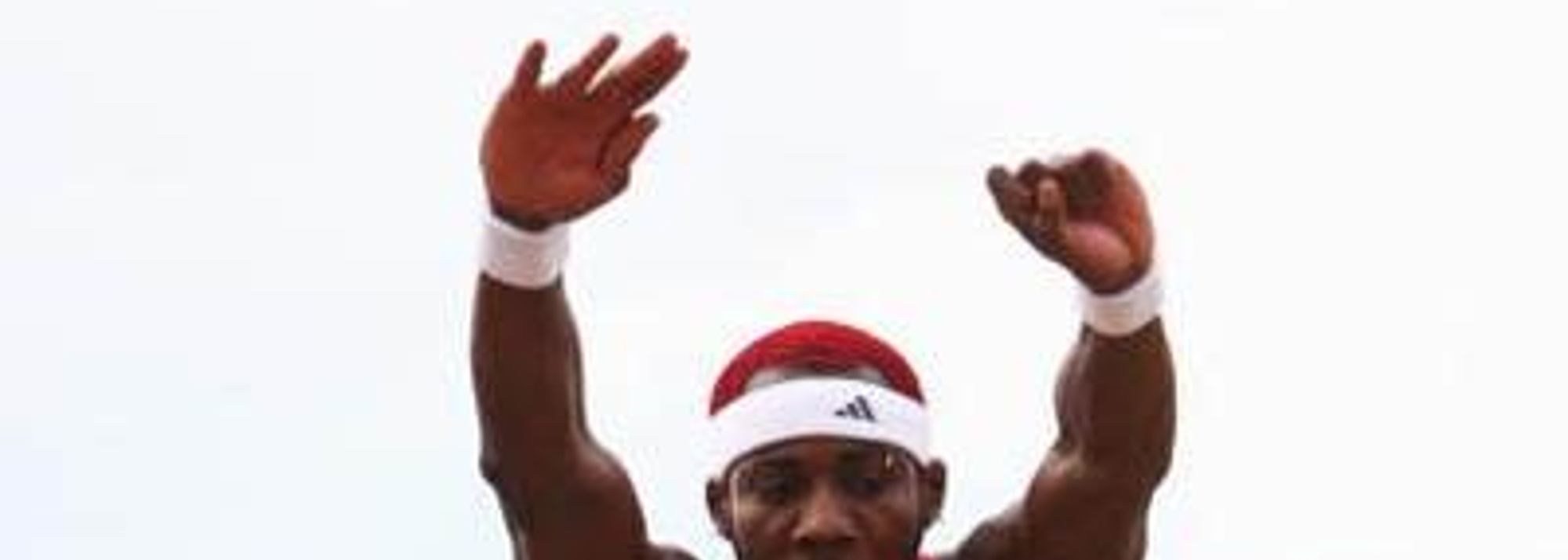


Phillips Idowu at UK Olympic Trials (© Getty Images)
By his own admission, Phillips Idowu doesn’t look like “an average Joe”.
A peaked beanie cap pulled low and lopsided over his dyed red hair, goatie beard, rings in his nose and ears, and studs through his bottom lip and left eyebrow – Idowu looks every bit the laid-back east London street kid he used to be.
“I’m a cool person by nature,” says the world’s leading triple jumper and Britain’s main hope for Olympic gold. “Beijing?” he says, that’s “just another sandpit in another country”.
The attitude is just as well, for the 1.92m 29-year-old has suddenly become the poster boy for British athletics, with a weight of expectation on his shoulders that could buckle many a less “cool” athlete.
“Something special” set for the Palace
In Britain, his performance at the Aviva London Grand Prix – IAAF World Athletics Tour on Friday night (25) – his last before the Games – is likely to attract as much attention as Asafa Powell’s performance in the 100m, or Yelena Isinbayeva’s latest assault on the women’s World Pole Vault record.
And the withdrawal of the reigning champion, Christian Olsson, after yet another injury on Tuesday night, only piles on the pressure.
Not that Idowu seems to feel it. Indeed, the World and European indoor champion is happy to play up the expectations himself, hinting after his world-leading jump at the UK trials two weeks ago, that the Palace could witness “something special”.
“I’m very comfortable with the expectations,” he says with a characteristically broad grin. “I’m not bothered by it at all. If anything, my aspirations are higher than everyone else’s. They’re higher than the gold medal.”
“You can interpret that how you wish. You can say it’s the world record, or jumping 18 metres, or a PB. I have my own personal achievements and my goals.”
“I want to be the greatest triple jumper in the world and whatever it takes to get there that’s what I’m going to work towards.”
Troubled youth
In his own way, that’s what Idowu’s been working towards since he was first taken to a track at the age of 11 by Humphrey Long, a physical education teacher at his secondary school in east London’s Bethnal Green, just a hop and step from the site of the 2012 Olympic park.
“He didn’t have to say much to convince me to go,” remembers Idowu, who describes himself then as a “troubled young black kid from the streets of Hackney”.
“I was always active and loved sports, so I went as soon as he suggested it. I didn’t know it was going to turn into my career at the time. But he put me on the first steps to where I am now.”
As a teenager, Idowu’s first sporting love was basketball, and it was only at 17, after winning the English Schools title without really trying, and narrowly missing out on a European junior medal in 1997, that Idowu thought, “You know what, I could be good at this. Let me see what I can do.”
“That’s when I started working at it seriously,” he says. Seriously, meant getting a proper coach and taking the long bus journey from Hackney, in north east London, to the national sports centre at Crystal Palace, in the far south.
Within three years he was travelling further south, to the Sydney Olympics as Britain’s third triple jumper. He finished sixth as Jonathan Edwards won gold on “Magic Monday”. “It was a great experience for me,” says Idowu. “I’ll never forget it. Managing to finish in the top six was a great achievement.”
Although just 21, he was clearly talented and soon hailed as the great hope to take over Edwards’ mantle. But somehow it didn’t quite work out like that.
A silver behind Edwards at the 2002 Commonwealth Games was Idowu’s only major medal in the following six years as Olsson emerged to become Edwards’s successor as Olympic, World and European champion.
Three no-jumps in Athens
The greatest disappointment for Idowu came in Athens in 2004 when his big hopes of an Olympic medal crash-landed thanks to three no jumps in the final. “The way it happened in Athens wasn’t nice, but I don’t like to think about it, or even talk about it now,” he says.
In many ways, his Olympic performance four years’ ago was typical. After 18 months of injuries he just couldn’t get fit enough to do himself justice. It’s a problem that surfaced again last summer in the run-up to the World Championships in Osaka when he injured his back.
“I went to Japan hoping that I would be able to jump and carry on into the final,” he says. “I did qualify for the final and managed to get two 17-metre plus jumps.”
Bullet proof training plan in place
Nevertheless, expectations had been high after Idowu had won the European indoor title earlier that year in Birmingham and it was put down as yet another failure. Something had to change.
First, Idowu resolved to get to the bottom of the back troubles that had blighted too many seasons. “It was uncomfortable all the time,” he says. “But you get used to it. I couldn’t bend, I couldn’t twist, I could walk fine – but certain positions were really uncomfortable.
“It was a combination of bad technique and just doing the wrong things in training. Going into 2008 I knew exactly what the problems were, what I could and couldn’t do training wise. So we got a plan together and it’s been successful so far.”
The plan involves revised weight sessions, running only in straight lines, and lots of exercises.
“I’ll probably have to keep doing rehab for the rest of my life but it’s all worked into my training sessions and schedules,” he says. “It’s just different bits and pieces that kind of activate the muscles in my back and stabilise it.”
Having made himself “bullet proof”, as he puts it, the new Idowu exploded onto the world in Valencia this March when he took the World indoor gold with 17.75m, breaking Edwards’ UK and Commonwealth record and pushing him up to fifth on the world indoor all-time list.
Coach change too
Still not satisfied, Idowu then made another change, switching coaches from his long-time guide, John Herbert, to Aston Moore, former coach to Ashia Hansen, among others. This, he says, is what’s given him the new self-confidence.
“It was something I’d been thinking about for a few years, but it was just never the right time because I was always hurt,” he says. “I wasn’t competing at the level I wanted to compete at.
“I hated going to Golden Leagues and Grand Prix meetings and finishing second or third, or not being in the mix. I’d look around at other guys and think ‘You are no more talented than I am’.”
Moore told him straight – “You’ve underperformed” – but set about renewing his self-belief.
“In the early days if I wasn’t winning, I wasn’t happy,” says Idowu. “Even if I was up against Mr Edwards, I didn’t want to go there and come second. I was always an aggressive competitor, and I always enjoyed competing. But I kind of lost that over the years due to injuries.”
“If someone had jumped 17.60m, I’d be thinking ‘OK, what do I need to do to come second, or third?’ That’s not the kind of attitude that I started with. I should be able to go out and jump 17.50, 17.60, 17.70 on a weekly basis.
“Confidence is so important in this game and I’m feeling really confident again this season. Now, I’m loving what I’m doing.”
Looking forward to London
Out of confidence comes consistency. Idowu is unbeaten in 2008 and has the three longest jumps of the season to his name. Not surprisingly, he’s looking forward to the London Grand Prix.
“I can’t wait. It’s my home town event so I want to put on a good show there. I want to jump well in Crystal Palace and head to Beijing with my unbeaten record intact.”
Not that he’s taking anything for granted. “You don’t need to tell me that nothing has been achieved yet this summer. All this form will count for nothing if I can’t convert that into the gold medal in Beijing.”
After all, he’s been down that road before, and knows the consequences. “If I don’t come away with the gold, it’s going to be ‘Phillips Idowu went away and underperformed’. I’ve had too many years of hearing that.”
Matthew Brown for the IAAF

