

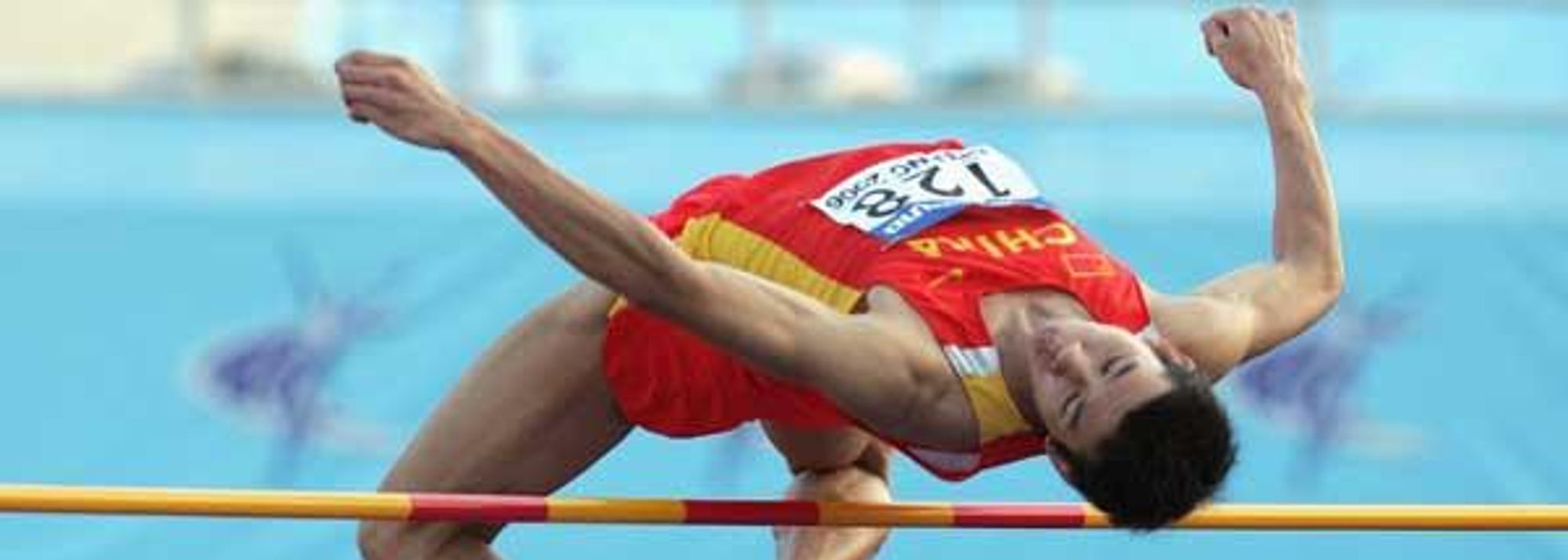


Haiqiang Huang of China during the qualifying round of the men's High Jump (© Getty Images)
China’s tradition in the High Jump is an illustrious one, not least with World record breaker Zhu Jianhua and a myriad of previous IAAF World Junior Championships medallists among their number, but Huang Haiqaing could yet be the best.
Huang added the World Junior title, the first ever by a Chinese high jumper at this level, on Thursday night to the World Youth crown he won in Marrakesh 12 months ago.
In front of an ecstatic home crowd he twice improved his personal best, firstly to 2.29 metres and then to 2.32m, just one centimetre behind the Asian Junior record held by Zhu since 1982, and he has another year in the junior ranks in which to improve on that long-standing mark.
His winning leap was a superb under-pressure effort as he was behind on count back to Israel’s Nikki Palli until he went over the deciding height on his third attempt.
The difference between Huang and the many other likely Chinese medallists here at the IAAF World Junior Championships, including Xue Fei who won the women’s 5000 metres on Tuesday night and whose prospects of Olympic medal success more realistically lies six years down the line when London stages the 2012 Olympics, is that he is already a world class competitor at senior level.
Olympic ambitions
“This will be a good platform for me to go forward and try to challenge for a place in the China team when the Olympics come to Beijing in 2008,” said Huang ahead of Thursday’s competition.
The cheers from the crowd in Beijing when he went clear at 2.32m suggested that he would not be a controversial choice if the Chinese athletics authorities named him to their team tomorrow, even though the Games are two years away.
Zhu, three times a World record breaker in the 1980s and China’s first athlete to get an Olympic medal when he won a bronze in 1984, still holds the Asian record with a leap of 2.39 metres, which has stood for 22 years, but it now in Huang’s sights.
“Zhu is an idol of mine, everybody who is involved in high jumping in China knows who he is, but I think I can beat his record in two or three years.”
“That’s my ultimate target. I may not have reached that level by the time Beijing stages the Olympics but I think I will be able to at least challenge for a medal there,” added Huang, who met Zhu for the first time in person this week.
Video education
Ironically, Huang has never seen any footage of Zhu’s World record feats and only read about them.
“Videos of these jumps are hard to come by in China but I have seen videos of the current World record holder (Cuba’s Javier) Sotomayor so I know what it looks like to jump a World record.”
Huang attributes much of his prodigious success to a monastic lifestyle at sports school in his native city of Hangzhou, in Zhejiang province which nestles China’s eastern coast, where 70 of China’s young Olympic hopefuls from across all sports are based and where Huang spends much of the year.
He does not possess a PlayStations or many other teenage trappings. Discos are not on his agenda either.
“No, I don’t go out much. Yes, it can be boring at times. For entertainment, I generally look at other sports videos. But this is the sort of hard work you must do if you want to succeed.”
One of the reasons he is prepared to accept all the sacrifices at this stage of his career is that he has seen all the rewards reaped by China’s 2004 Olympic 110 metres Hurdles champion Liu Xiang, who is also the World record holder at his event.
Liu was a promising teenage high jumper before being brutally told by his coach that he would not succeed at the event and encouraged to concentrate on the hurdles.
By contrast, Huang had the reverse experience as a useful hurdler and was told by his coach to stick with the high jump.
“I was a little angry because I think I could have broken the World record myself in that event. No, I’m just joking, I really don’t think I would,” smiled Huang, demonstrating a nice line in self-deprecating humour.
Phil Minshull for the IAAF


