

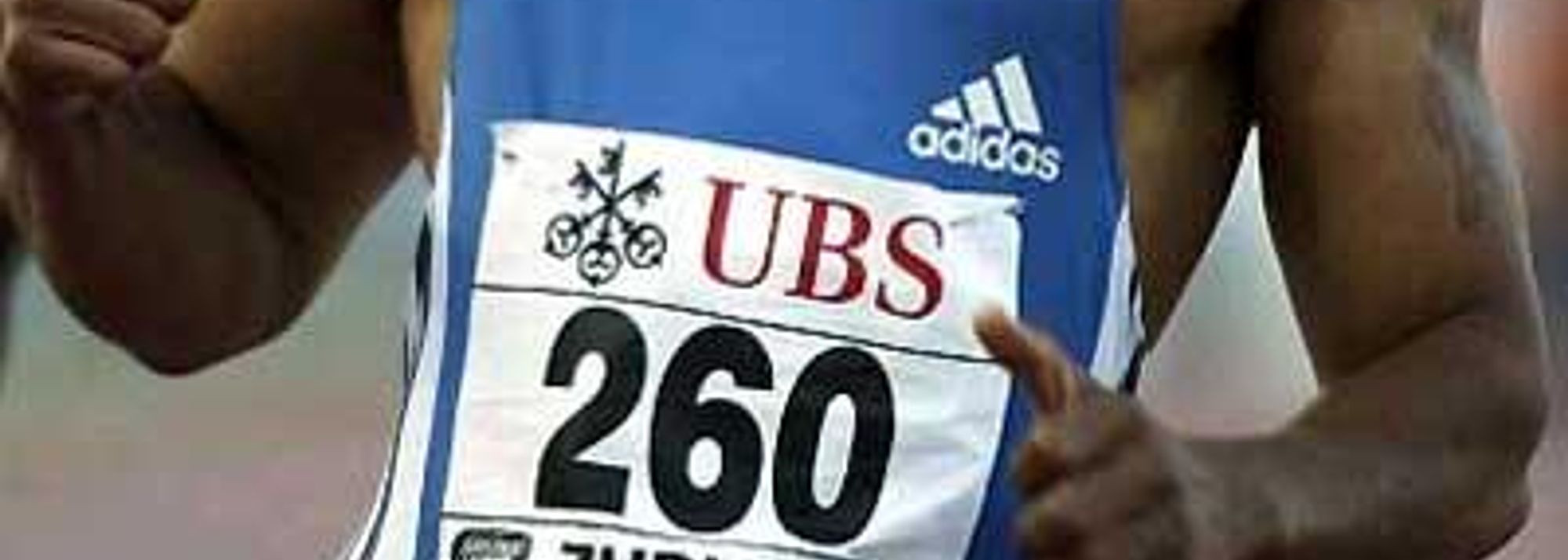


Maurice Greene running in the 2000 Weltklasse, Zurich (© Getty Images)
The 2000 edition of the IAAF Golden League offered great head-to-head competition, superb performances and, of course, all the drama of the IAAF Golden League Jackpot recounts MEL WATMAN of 'Athletics International'.
23 June 2000 - Meeting Gaz de France Paris-St Denis
The IAAF Golden League 2000 got off to a flying start with the inaugural Meeting Gaz de France Paris- St Denis at the magnificent Stade de France. It proved a great night for North Africans: they won the three best races, two of them run over 3000m.
The men's flat 3000m revealed a fantastic new talent in Algerian Ali Saidi-Sief - who smashed his personal best by over nine seconds to win in 7:27.68. Daniel Komen had led with 600m to go after following Luka Kipkoech and David Kisang through 1000m (2:29.14) and 2000m (5:01.09) - but was then overtaken by both Saidi-Sief and Million Wolde of Ethiopia. The Kenyan bravely battled back though, to overtake Wolde in the final straight and finish in 7:31.47. Slim and long legged, 22 year-old Saidi-Sief is proof that the Mahgreb can now rival the East African nations in uncovering distance running talent.
Ali Ezzine of Morocco supplied another North African highlight by winning the 3000m steeplechase. His reward - the fastest time ever achieved by a non-Kenyan of 8:03.57, but also the scalps of Bernard Barmasai (8:03.92) and Reuben Kosgei who improved his best to 8:03.92.
With Noah Ngeny opting for the 800m, Hicham El Guerrouj was in a class of his own in the 1500m, running a season world leading 3:30.75, virtually as a time trial. Expertly marshalled by his two pacemakers - only Kenya's Bernard Lagat remained within spitting distance of the Moroccan world record holder. But although he was just a few strides behind with 300m to go, once El Guerrouj had made his decisive kick on the final bend, Lagat's challenge faded away. He still finished in 3:33.14, ahead of Frenchman Mehdi Baala who clocked 3:33.67.
Cathy Freeman ran superbly in the 200m, beating half-lap specialists like world junior champion Muriel Hurtis and Juliet Campbell, with a strong acceleration in the last 50m. Freeman's performance of 22.62 was particularly impressive on a cool night that was not conducive to fast-sprint times.
Kutre Dulecha of Ethiopia was a superb winner of the women's 1500m, crossing the line in 4:03.73, ahead of the fast finishing Chinese athlete Li Jingnan who is just 17 years-old but clocked 4:04.84 in her first race on the international circuit. Jingnan and her team mate Lan Lixin (coached by Ma Junren) took up the pace early on - going through 800m in 2:11.40 - but Dulecha and the Russian Olga Kuznetsova - were close behind. Dulecha began pushing the pace on the third lap and kicked hard at the bell - building a gap of almost 10m by the finish line.
The long jump was won by Tatyana Kotova with a personal best of 7.04m. The 1999 world indoor champion was delighted with her success, particularly as she achieved it with her last effort. Barber finished a credible third in 6.77m, behind 1995 world champion Fiona May, who was disappointing with just 6.88m.
The men's pole vault was won by Maksim Tarasov with just 5.65m (the same mark as second placed Mike Stolle) and the High Jump by Sergey Klygin - who beat world number 1 Vyacheslav Voronin - with 2.31. The men's shot put was virtually over as a contest after John Godina achieved 21.25m in the first round. Yuriy Belonog came closest with 21.06m.
Sonia O'Sullivan, continuing her comeback following maternity leave, finished third in the women's 3000m. The race was taken out hard by two Chinese athletes - Dong Yanmei and Yin Lili - but Lidia Chojecka of Poland ran the most tactically astute race. The reigning European under 23 champion crossed the line an emphatic victor in 8:33.35 - with Yanmei second in 8:36.25 - and O'Sullivan making up a lot of ground to finish third ahead of Lydia Cheromei. Morocco's Zahra Ouaziz, hampered by injury, finished 7th in 8:47.18. The women's 100m hurdles provided another demonstration of 1999 world indoor champion Olga Shishigina's incredible finishing strength. As usual, the Kazak started slowly, with Glory Alozie and Linda Ferga quickest away, but Shishigina made up for lost time over the last three hurdles, easing ahead to cross the line first in 12.76.
In the women's javelin, Tatyana Shikolenko (RUS) scored an emphatic victory with 64.50m, ahead of the World Junior champion Osleidys Menendez.
30 June 2000 – Golden Gala Rome
In an evening filled with season’s bests and national records, Trine Hattestad set a new world record of 68.22m in the javelin to notch up her first IAAF Golden League win of 2000.
Four athletes, Saidi-Sief, Dulecha, Kotova and Tarasov repeated their Paris victories and went a step closer to the five wins needed to win a share of the Golden League jackpot.
Hattestad, who won bronze in last year’s World Championships, after wins in 1993 and 1997, threw the new world record mark at her fourth attempt. Hattestad’s performance this evening bettered the previous record of 67.09m set by Greece’s Mirela Tzelili. Second place in Oslo went to Tatyana Shikolenko with 63.83m with Cuba’s Osleidys Menendez third (63.23m).
Any doubts about Maurice Greene’s fitness were dispelled as the world champion at 100m and 200m ran a faultless race ahead of Francis Obikwelu and Greene’s training partner Ato Boldon. Greene’s own race was powerful, if predictable, as the American star showed the form that led him to double gold in Seville last year as well as a world record 9.79 in Athens. Obikwelu was the surprise performer of the evening.
The 21 year-old Nigerian, who won a bronze in Seville in the 200m, challenged Greene throughout the race stopping the clock at 10.00 - just 3/100ths behind Greene. Less than an hour later, Greene totally dominated the 200m in 20.02.
Race favourite Marion Jones powered ahead at the 50 metre mark to easily win the 100m. Relatively slow out of the blocks, Jones then steamed past Torrie Edwards and Christine Arron. Ideal conditions for sprinting, with 21 degrees C and a legal tailwind of 1.0 mps, combined to help Jones clock 10.91.
Jones failed to live up to her own expectations in the long jump, where she had to settle for third place with 6.71m, behind Tatyana Kotova (RUS) with 6.89m and Italy’s Fiona May (6.75m).
Ali Saidi-Sief followed his sensational win in the Paris 3000m – in a personal best of 7:27.87 - with a season best and new Algerian national record of 12:50.86 in the 5000m. More surprisingly, this was the 22 year-old’s first outing at 5000m. Saidi-Sief’s kick came 700m out as he pulled away from Kenyan Sammy Kipketer (who narrowly missed a new world junior record with his time of 12:54.07) and seasoned campaigner Paul Tergat, who was making his season’s track debut.
No less than three national records fell in the course of the 1500m, which was won by Noah Ngeny – the world record holder at 1000m – in a season’s best time of 3:29.99. Ngeny and his compatriot Bernard Lagat (3:30.78) took the first two places with Jose Redolat of Spain third with 3:31.71.
National records were set by Kevin Sullivan (CAN) in fourth place with 3:31.48, Vyachslav Shabunin (RUS), with 3:32.28, in fifth and Hailu Mekonen from Ethiopia, whose 3:33.14 for seventh improved the Ethiopian record of 3:33.73 owned by Haile Gebrselassie.
In the women’s 1500m, Kutre Dulecha (ETH) gained her second successive victory in 4:02.92, outsprinting Lidia Chojecka from Poland (4:02.96) to the finish line. Nouria Benida-Merah was third in 4:03.02.
Vyacheslav Voronin entered this year’s Golden League jackpot stakes, as he won the high jump on count back from Mark Boswell, with both athletes clearing 2.35m. Canada’s Boswell may not have won, but he did set a new national record with his clearance. Both athletes failed at 2.37m. Konstantin Matusevich was third with 2.33m.
Gail Devers recorded her third fastest time ever in the women’s 100m hurdles to win with 12.47. Both Devers and Michelle Freeman (JAM) got away well at the start, but Devers was already pulling away at the third hurdle. Anjanette Kirkland (USA) came back strongly in the finish with Olga Shishigina (KZK), who had won the first leg of the Golden League in Paris, but neither could match Devers at the finish.
In the 400m hurdles, Great Britain’s Chris Rawlinson made the most impressive start, at the 150m mark he had passed world champion Fabrizio Mori in the next lane, but Eric Thomas (USA) was on the same pace and moved into the lead at the eighth hurdle. Angelo Taylor (USA) finished strongly to take second place and improve on his own season’s best with a time of 48.03, behind Thomas’s 47.94. Eronilde De Araujo was third in 48.38.
A disappointed Jonathan Edwards had to settle for fourth place in the triple jump after the silver medallist from Seville, Rotislav Dimitrov (BUL), cleared 17.25m with his first attempt to take first place. Yoelbi Quesada of Cuba was second with a second attempt of 16.87m, which he followed with three fouls. Charles Friedek (GER) was third with 16.84m. Edwards never looked comfortable and it was only with his final attempt that he managed his competition best of 16.81m.
The 800m was won by Algeria’s Djabir Said-Guerni, finishing strongly ahead of Switzerland’s André Bucher and Japhet Kimutai of Kenya. Going through 400m in 50.12, Said-Guerni took up the running and crossed the line first in a finishing time of 1:44.32, despite a strong challenge from Bucher, who finished just behind in 1:44:44.
The last national record of the evening came as Brahim Boulami won the 3000m steeplechase in 8:03.82. Leading for the last lap, Boulami sprinted for the line, leaving Kikirui Misoi (KEN) far behind as he set a new Moroccan record.
28 July - Exxon Mobil Bislett Games
A capacity crowd in Oslo’s historic Bislett Stadium was treated to a new world record in the javelin and some great distance running. They also saw Tatyana Kotova become the first person to notch up three wins in this year’s IAAF Golden League.
The darling of the Norwegian crowd, Trine Hattestad started her run towards the throwing zone and a roar split the skies as her javelin soared and soared before landing 69.48m from the throw line. It was a new world record for Norway’s queen of the spear. Better still, the record came with her last throw of the evening.
Hattestad’s record was the 62nd world record set in the Bislett stadium which will now be completely refurbished. Germany’s Tanja Damaske was second with 65.74m and Osleidys Menendez third with 65.05m.
Russia’s Tatyana Kotova followed her wins in Paris and Rome with a third win in this year’s edition of the IAAF Golden League. On her sixth attempt the Russian cleared 7.00m to narrowly defeat Italy’s Fiona May, who was unable to better her first round attempt of 6.95m. Sweden’s Erica Johansson was third with 6.81m. Reigning World Champion Niurka Montalvo took fourth place with 6.63m.
The winner of the US Olympic Trials shot put, Adam Nelson, confirmed his form in Oslo. His fifth attempt of 21.43m, overtook CJ Hunter's second round 21.26m. The 114kg Nelson may look slight alongside some of his mountainous rivals but he is an excellent thrower. Of his five legal attempts (he fouled his final attempt), only his first put was under 20m. John Godina was clearly off-form, failing to produce a single put over 20m (8th with 19.65). Third place went to Yuriy Belonog of the Ukraine with 21.05m.
Suzy Hamilton-Favor had the Bislett crowd on its feet as she finished the women’s 1500m in a new meeting record of 3:57.40, just 23 hundredths off the American record and the fastest time in the world this year by nearly 3 ½ seconds. Second placed Lidia Chojecka set a new Polish National Record with 3:59.22 and was closely followed across the line by Violeta Szekely-Beclea from Romania with 3:59.22.
Kenya dominated an excellent 5000m, with victory going to Sammy Kipketer in 12:55.03. The field were tightly bunched for the first 3000m, paced by David Kisang and Martin Keino for 7:44.91 before Morocco’s Salah Hissou took up the running, going through 4000m in 10.24.86. A Kenyan pack of Kipketer, Mark Bett, Benjamin Limo and Luke Kosgei made a break in the last lap, with Kipketer leading as they rounded the bend into the home straight. Bett kicked strongly as they approached the line, but Kipketer held off the attack to take the victory.
Two national records were set in this race, with Belgium’s Mohammed Mourhit runnig 12:56.60 in sixth place and Frenchman Ismail Sghyr clocking 12:58.83 in seventh place.
Gail Devers was superb in the women’s 100m hurdles. The 33-year old, who had run a personal best of 12.33 at the US Olympic Trials, was a convincing winner in Oslo with 12.56, a new meeting record.
Cathy Freeman left the field standing in the women’s 400m. Strong out of the blocks, the lithe Australian completely outclassed the field. Freeman was never challenged easing right up twenty m out from the finish, before crossing the line in a leisurely 50.74.
Vyacheslav Voronin (RUS) was the winner of the high jump, following up on his success in Rome. Voronin cleared 2.31m at his third attempt at the height to beat Wolfgang Kreissig (GER) and Staffan Strand (SWE), who both cleared 2.28m before three failures at 2.31m. Kriessig got the nod on countback.
The men’s pole vault was won by Jean Galfione (FRA), back in competition after an operation for a collapsed lung. Unfortunately his main rival, world champion Maxim Tarasov, withdrew after receiving a blow to the face from his pole after a failed attempt at the winning height of 5.80m. Eric Thomas added to his Golden League tally with his second win in the 400m hurdles. Previously a winner in Rome, the American beat Samuel Matete (ZAM) across the line - 48.66 to 48.90. Pawel Januszewski of Poland was third in 49.24.
In the final event of the evening, Hicham El Guerrouj won the Exxon Mobil dream mile in 3:46.24. William Chirchir (KEN) was second in 3:47.94 and John Kibowen third in 3:49.87. Kevin Sullivan set a new Canadian record with his fourth place time of 3:50.26.
11 August - Zurich Weltklasse
The track of the Letzigrund Stadium shimmered in the heat as the world's finest athletes gathered for the fourth stage of the IAAF's Golden League, the Weltklasse in Zurich. It was Meeting Director Res Brugger's last show, for which he was honoured by IOC President Juan Antonio Samaranch with the Olympic Order of Merit, but the athletes quickly took the centre stage.
In the men's 1500m, two superb exponents of middle distance running Hicham El Guerrouj and Noah Ngeny had a great duel. El Guerrouj had beaten Ngeny the previous Saturday over 1 mile and was seeking to extend a winning streak at this distance stretching back over four years.
Ngeny seized the initiative by following the pacemaker through 400m in 54.02 and 800m in 1:50.16. But although El Guerrouj was content to follow, he decided to make his move with about 1 and a half laps to go. At the bell, reached in 2:32, the Moroccan was running with the effortless cadence that is such a joy to behold. With a last lap of approximately 54 seconds, El Guerrouj stopped the clock at 3:27.21 - the third fastest time in history. Ngeny and his compatriot Bernard Lagat clocked 3:28.12 and 3:28.51 respectively in second and third, both times inside the Kenyan 1500m record.
The women's 3000m was one of the fastest in history. Gabriela Szabo was anxious to kick-start a season that had started badly by her own high standards. Closely followed by Regina Jacobs, Paula Radcliffe, Lydia Cheromei, Sonia O'Sullivan and Tegla Loroupe, Szabo was ushered through 1000m in 2:46.25.
The pace then slowed significantly. At the bell, it was Radcliffe and Loroupe who had the pole position with O'Sullivan just behind and Szabo, boxed into the curb. Just as O'Sullivan made her bid for victory on the back straight, Szabo popped up - kicking past O'Sullivan and easing clear round the final bend. The all-conquering runner of 1999 was reborn and she crossed the line in 8:26.36. O'Sullivan hung on for second in 8:27.58, with Radcliffe losing out on the line to Marta Dominguez - 8:28.80 to 8:28.85.
Dominguez improved her personal best by almost 1.5 seconds for a new Spanish record. Lydia Cheremoi (KEN) and Irina Mikitenko (GER) also set national records (8:29.14 and 8:30.39).
After suffering from an achilles injury, Haile Gebrselassie started the 5000m without his usual aurora of invincibility. Yet the man from Ethiopia showed every ounce of his fighting spirit as he held off the challenge of the world's best specialists to win in 12:57.95.
At halfway, Sammy Kipketer, distinctive in his IAAF Golden League Jackpot contender golden bib, was shadowing Gebrselassie but it was the Ethiopian who led with 2000 m to go.
His face contorted with effort, Gebrselassie allowed Mohamed Mourhit to take the lead with two laps remaining, and was also closely shadowed by Kipketer, Paul Tergat and the reigning world champion Salah Hissou. At the bell, reached in 12:05, there were still six runners in the race. Mourhit was leading, but with 200 m to go, Gebrselassie made the decisive acceleration. Paul Tergat began to close the gap, but the Ethiopian held on down the final straight for a confidence boosting win.
For sheer showmanship, no-one could match Andre Bucher. The Swiss 800m runner had promised his home crowd he would not give up his world number 1 status lightly. And so it proved - he latched onto his pacemaker and tore round the first lap in 49.7 - his rivals some way in arrears. But he then seemed to ease up, and Japheth Kimutai caught him with 200m to go. But Bucher knew what he wanted - a winning sprint to the line in the last 100 m that would bring the crowd to their feet. With Kimutai straining to hold his form, the Swiss man edged ahead punching the air as he stopped the clock at 1:43.72.
It was hard to follow Bucher, but US stars Maurice Greene and Gail Devers tried. Devers clocked 12.39 for a convincing victory while Greene was also masterly, running 9.94 into a headwind.
The men's 400m hurdles was a superb race as Angelo Taylor, fastest in the world so far this year, edged out Llewelyn Herbert, who has lost only once in 15 outings in 2000, 47.90 to 47.93. Taylor had started faster - was caught by Herbert in the final straight - but then fought back to steal victory on the line.
Marion Jones just edged out Inger Miller - 10.95 to 10.96 in the 100m and came back to win the long jump as well. Her first round effort of 6.93 clinched the contest - just. Bulgaria's Iva Prandzheva leapt 6.92 and a delighted Heike Drechsler 6.91 with her last jump.
Maria Mutola won her 8th consecutive Weltklasse victory in the 800m, overtaking early leader Ludmila Formanova in the last 200 m to ease home in 1:56.90. Lars Riedel was another athlete seeking an 8th consecutive win - but he was beaten by the in-form Virgilius Alekna who threw the discus 71.12.
In the steeplechase, Bernard Barmasai let his feet do the talking, but couldn't match the finishing speed of Wilson Boit Kipketer who snatched victory in 8:11.19.
World record holder Jonathan Edwards confirmed his excellent form in the triple jump by beating world champion Charles Friedek for the second time in six days. Edwards had pulled up halfway through his first effort of the night clutching his back - but he returned to cut the sand at 17.27m. With his next attempt, he increased his lead to 17.36m.
In the 110m hurdles, Anier Garcia had the beating of Allen Johnson until he crashed into the last hurdle, lost his balance, and allowed the Olympic champion to steal past him for victory in 13.17.
18 August - Zepter-Herculis, Monaco
The Zepter Herculis Meeting in Monaco - seemed like being "Ladies' Night" until a French-based Algerian runner struck a blow for male rights.
Distinctive in his Jackpot contender golden bib, Ali Saidi-Sief destroyed an excellent field to win the 3000m in 7:25.03, to become the third fastest man in history. His time also improved the Algerian (and former world) record set on the same track by Noureddine Morceli six years ago. Saidi-Sief, as his habit, began the long sprint for home with about 900m to go, chased hard by Mohamed Mourhit, Brahim Lahlafi and Daniel Komen, and completed the last 800m in 1:55 with a last lap of approximately 56 seconds. Mourhit finished second with a European record of 7:26.62.
Another Algerian, Djabir Said-Guerni, outkicked Kenyan stars Noah Ngeny, Japheth Kimutai and South Africa's Olympic silver medallist Hezekiel Sepeng to win a tactical 800m. The pace was slow - with the field going through way off the pacemaker in about 52 seconds, before engaging in a torrid burn-up for the rest of the race. Said-Guerni found an extra gear on the home straight to cross the line in 1:43.79, ahead of Kimutai's 1:43.93 with Ngeny a tired sixth.
Twice a European 200m champion, Irina Privalova showed tremendous potential as a 400m hurdler. Reacting to the gun like a sprinter, Privalova built up a huge lead over the first half of the race. Even at the 8th hurdle she was still 10m clear of the chasing pack and although she tired, her rivals could not catch her. Privalova, contesting only her fourth hurdles race, finished in a superb personal best of 54.06 ahead of Tatanya Tereshchuk of the Ukraine (54.27).
Tegla Loroupe improved her 3000m personal best for the second time in a week to 8:30.95. Lydia Cheremoi, the race leader at 2000m with 5:43.41, held on to win in 8:30.80. Gail Devers, who needed to win the 100m hurdles in 12.50 with a nil-wind to overtake Marion Jones in the IAAF World Rankings, came tantalisingly close, winning in 12.54. Cathy Freeman controlled the 400m from the gun - leaving her decisive surge until the halfway stage before coming home in 49.48 - the fastest time in the world this year.
Romania's Beclea-Szekely overcame the talented young Ethiopian Kutre Dulecha to win the 1500m in 3:58.29, the second fastest time in the world this year and a personal best. Dulecha, with 3:59.02, and Nouria Merah-Benida with 3:59.12, also confirmed they were in great shape. Former Olympic champion Paula Ivan, now 37, showed her comeback is a credible one by finishing fifth with 4:04.66. She still owns the Romanian record for 1500m of 3:53.96.
Outstanding field events included the men's pole vault - with a superb victory by Germany's Michael Stolle over Jeff Hartwig (5.95m to 5.90m) - and the women's javelin, where Tatyana Shikolenko set a Russian record of 67.20m to beat Trine Hattestad. In the men's high jump, Javier Sotomayor marked his return to the Golden League with a victory in 2.30m.
Yuriy Belonog scored an emphatic victory in the shot put. After contesting all the Golden League meetings to date, the giant Ukrainian (2.00m tall) was delighted to win with 21.02m. Even his worst effort of 20.61m was better than the next best. Adam Nelson (20.51m) suffered his first defeat since the end of June.
The last men's track event, the men's 3000m steeplechase, proved an excellent race, as two Kenyans Bernard Barmasai and Raymond Yator battled it out with Morocco's Khalid Boulami down the home straight under the gaze of Prince Albert. Barmasai's just held his lead over the Moroccan to stop the clock at 8:02.76 (world best for 2000). Boulami recorded 8:02.90, while Yator's 8:03.74 was a new world junior record.
25 August 2000 - Ivo Van Damme Memorial, Brussels
There is an old saying that sometimes the best is saved for last - and that was the case for the patriots among spectators at the Ivo van Damme Memorial in Brussels. Home favourite Mohammed Mourhit had been promising a European 5,000m record all week and he proved as good as his word despite erratic pacing through the first half of the race. To cheering which raised the rafters of the Roi Baudouin stadium, Mourhit and Morocco's Brahim Lahlafi took it on from 4,000m - helping each with the pace before fighting a cat-and-mouse duel over the final lap.
It was Lahlafi who got the upper hand, sprinting home in a national record of 12:49.28 but Mourhit was not far behind and shaved nearly five seconds from Dieter Baumann's three year-old European best with 12:49.71. Into the bargain, Lahlafi and Mourhit become the third and fourth fastest men of all time over 5,000m.
Marion Jones won the 100m with the time of 10.83. The bare statistics show it was the second fastest time this season - but it was achieved INTO a 1.3 mps breeze. No woman - not even the late Florence Griffith-Joyner – had ever run as fast into such a strong wind. For once Jones had a good start – and from 30m she held a comfortable lead until the finish. Bahamas' Sevatheda Fynes, quicker away than Jones, finished second in 11.08 with her compatriot Debbie Ferguson third in 11.11.
The wind swung around behind the backs of the men in the 100m, less than 30 minutes later, but Maurice Greene still posted a hugely impressive 9.88 seconds with a barely illegal 2.1 mps following wind. Greene didn't have the best of starts but once he hit the accelerator there was nothing anyone could do to stop him breasting the line first.
The result kept Greene in the race for a share of the IAAF Golden League Jackpot of 50 kg of gold.
Paul Tergat had happy memories of the Belgian capital. He set his former world record of 26:27.85 in Brussels in 1997 and went below 27 minutes again the following year.
In 2000 he settled for victory in 27:03.87. The halfway point was reached in 13:18.98 but after being tracked for 6.5 kilometres by his friend and training partner Patrick Ivuti, Tergat took the lead.
Behind Tergat, Felix closed on the five-times world cross country champion in the home straight to slice more than a minute off his best with 27:04.54. The emergence of Limo may cause confusion in the ranks of track aficionados - with Richard Limo and Benjamin Limo already well-established. None of the trio is closely related to the other.
In the men's shot put, the 2000 world leader Adam Nelson won the contest with his first round effort on 21.58m. Over in the discus circle, Lithuania's Vigilijus Alekna won by more than a metre, with a third round throw of 68.06m.
South Africa's Frantz Kruger failed to find his the form which saw him launch the implement out to a Commonwealth record 68.13m in Cottbus just two days earlier, and finished second with 66.82m.
Having won in Paris, Rome and Monaco, the Algerian Djabir Said-Guerni added a victory in Brussels to his catalogue of triumphs this season.
After a tremendous sprint for the line, Said-Guerni was clocked in 1:43.25, the second fastest time of the year. Following him home was the season's world leader Andre Bucher in 1:43.31 while third was Denmark's reigning world champion Wilson Kipketer, who set a season's best of 1:43.35.
Gail Devers became the first athlete to be certain of some Golden League gold after a sparking 12.53 100m hurdles victory. She would have gone faster still but for a 0.8 mps headwind.
The 7.00m barrier was not broken in the women's long jump but it was heartening to see Tatyana Kotova back in action after injuries from a car crash ruled her out of the Zurich and Monaco Golden League meetings.
The Russian - also in contention for the Golden League Jackpot - leapt out in the first round to 6.91m and in the fourth round she improved to 6.96m.
Like Kotova, Michael Johnson also returned to the athletics arena after a brief absence through injury. Johnson, who pulled a hamstring at the US Olympic Trials, sped around one lap in 44.07. The gusting wind almost certainly stopped him going under 44 seconds for the third time this year.
Hicham El Guerrouj came to Brussels aiming to improve his mile world record but the attempt unravelled on the third lap when Benson Koech - well known as a runner but inexperienced as a pace maker - was too ambitious during his stint at the front. El Guerrouj held his concentration on a lone last lap for 3:47.91, but may have relaxed too much, as Kenya's William Chirchir closed dramatically at the finish. Chirchir - who could only finish fourth in the Kenyan 1500m trials - stopped the clock at 3:48.23.
1 September - ISTAF Berlin,
The IAAF Golden League reached its climax in the Olympia Stadion of Berlin when all four remaining Jackpot contenders won again. Watched by 41,300 spectators, the first Jackpot contender to impress was Maurice Greene. He tore up the track with a superb 9.86, one of the quickest times ever run into a headwind (-0.2mps). With a start reminiscent of Berlin legend, Jesse Owens, Greene reacted well, pumping his arms and knees hard over the first 30m. Training partner Jon Drummond also got a great start and the pair remained neck and neck until the last 20m, when Greene began to pull away. Drummond's reward was his first sub-10 second clocking of the season - 9.96. Ato Boldon was a surprise last place finisher with a humble 10.23.
Hicham El Guerrouj notched up his fifth win at 1500m, but he laboured to victory, just as he did the previous week in Brussels. As the Moroccan slotted in behind his pacemakers, (800m in 1:52.84) he found himself, yet again, uncomfortably close to the young Kenyan William Chirchir with 500m to go. El Guerrouj's 1200m split was 2:49.09, and his last 400m took 55.88 - allowing him to cross the line in 3:30.90.
Trine Hattestad made sure of her fifth win on the Golden League circuit with a third round effort of 68.32m. The World Junior champion Osleidys Menendez was the early leader with 67.83m, before Hattestad found her golden touch.
Last, but certainly not least of the contenders was Tatyana Kotova. Predictably, the Russian was pushed all the way by Germany's Heike Drechsler. The former world champion (1983 and 1993) put the pressure on immediately with a first round effort of 6.95. Kotova, stressed by the crowd as well as the imminent loss of a sizeable cheque, could manage no better than 6.80m with her first five jumps. With only one effort remaining it seemed as if Drechsler had done it … but the long legged Russian took a deep breath, powered down the runway and hit the take off board perfectly. As she got up from the sand she knew it was close - and then the result flashed up - 6.96: a centimetre that was potentially worth over $100,000!
All Jackpot winners needed to contest the IAAF Grand Prix Final in Doha to be eligible for the pay-out.
Marion Jones took the absence of her closest rivals Inger Miller and Zhanna Pintusevich as a spur to run even faster than usual in the 100m. Reacting smoothly to the gun, her powerful acceleration helped her build up a huge lead by the 70m mark. Two metres clear of her closest rival, she crossed the line in 10.78, a Stadium record, and achieved with the help of a negligible 0.1 mps tail wind.
When Gabriela Szabo kicks past her rivals in any race, that race is usually over. But in Berlin, when Szabo passed Leah Malot on the last lap of the 5000m, instead of powering to another victory, she began to tire. Sensing she could gain a famous victory, Malot dug deep and with 30 metres to go, passed the Romanian to win in 14:39.83. The Kenyan improved her personal best by almost eight seconds for a new national record. Szabo, disheartened at her unfamiliar fate, eased down before the line to record 14:40.61 - still six seconds ahead of the next finisher Tegla Loroupe.
Lars Riedel showed a champion's temperament to win a dramatic discus competition. Trailing the world leader Virgilijus Alekna into the last round, Riedel unleashed a mighty effort that sailed out to 69.72 - just 2 centimetres ahead of his Lithuanian rival.
Britain's Jonathan Edwards was less happy. The world record holder had three fouls, leaving the way clear for Germany's Charles Friedek to earn a comfortable victory in 17.20m. Edwards' third effort looked close to 17.50m, but his take off foot smacked down well ahead of the foul line.

