

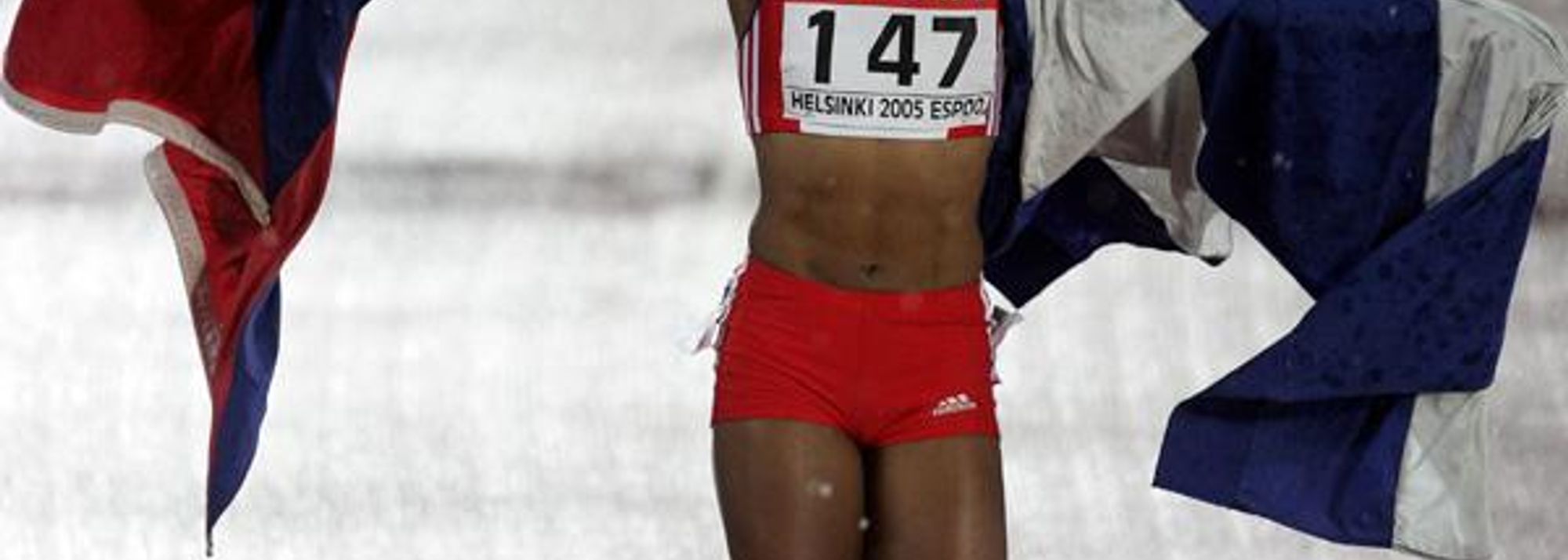


Zulia Calatayud celebrating her World Championships victory (© Getty Images)
Havana, CubaIt takes about two minutes for an elite female runner to run 800 meters. But Zulia Inés Calatayud has completed a longer race to overcome adversity and physical difficulties to become the new World champion over the distance.
Memories are still fresh of her epic run at the World Championships final in Helsinki on 9 August. A strong finish propelled the 25-year old Cuban to the gold medal, a well-deserved title for an athlete who had devoted her youth to athletics and kept going despite misfortune along the way.
Promising junior
At 19, Calatayud claimed the 1999 Pan American silver medal in her international debut at 800 metres, a year after reaching the World Junior Championships semifinal in Annecy, France. Before turning 20, she ran 1:58.66 to finish sixth in the 2000 Olympic final in Sydney. Her performances confirmed her still untapped talent along with the potential of a bright future.
2002 - First victory over Mutola
She made notable progress in 2002 when she smashed her personal best by more than two-and-a-half seconds to 1:56.09, beating World and Olympic champion Maria Mutola in the process at the Herculis Golden League meeting in Monaco in July 2002.
However, she could not medal at the World Cup in Madrid two months later where she finished fourth. That would be her last competition in more than a year-and-a-half. A shin injury in her left leg delayed her preparation for 2003 and when she resumed training, the same injury in her right leg forced her to rest in order to avoid surgery.
As part of her recovery and comeback to athletics, she first trained in a pool to gain endurance before beginning light sessions on grass. She was finally able to return to the track in January 2004. 19 months after her last competitive outing, Calatayud was second in the 400 metres at the National Championships, clocking 52.07.
Gradual return in 2004
In her first international 800 in almost two years, she won a meeting in Algiers in 1:59.48, signaling a comeback. Six more meetings followed, including her victorious run at the IberoAmerican Games in Huelva, Spain, before the 2004 Olympic Games in Athens. A season’s best 1:59.21 advanced her to her second consecutive Olympic final where she finished eighth. While she didn’t have enough time in her comeback season to event’s super elite, the season was nonetheless a fine reward for a woman whose athletic future looked uncertain just a year earlier. With eight competitions in three months, she ended the season ranked ninth in the IAAF World Rankings.
2005 plan fulfilled
Fighting asthma as her more dangerous rival, Zulia Calatayud resumed training in late October 2004 for the 2005 season, under the guidance of coach Faustino Hernandez.
Their plan for the season, she said, was fulfilled almost completely. She preferred to start her season in the longer 1500, which she did with a 4:23.84 clocking at the National Championships in March, finishing third.
Two local wins in May preceded her European tour. With the exception of her first race in Alcalá de Henares, Spain, she ran under two minutes in all of her six competitions prior to the World Championships.
In Helsinki, she ran a season’s best 1:57.92 in her semifinal, her second fastest ever. In the final, Calatayud matched every move made by Mutola and world leader Tatyana Andrianova and patiently before switching gears into a kick phase that was simply unstoppable. In the end, her 1:58.82 performance didn’t necessarily reflect how commanding a race she had just run.
A pair of Golden League wins in Zurich and Berlin followed, before she ender her season with another convincing victory at the World Athletics Final in Monaco. The winning streak landed her atop the IAAF World Rankings, replacing Mutola who had led the event ranking since its introduction in 2001.
“I definitely had my best season ever,” Calatayud said. “Helsinki brings me good luck. I won a Grand Prix event in 2001 and now the world title. It will always have a special place in my heart.”
Looking ahead to 2006
Reflecting on her performances, Calatayud said, “I am happy to stay consistent and to have run 1:57.92 this year. If a faster pace is set, we can definitely run around 1:56. I believe I could have dipped under 1:56 in Monaco, in 2002. In order to run those times, you have to have the desire to go out fast and feel euphoric.”
Ana Fidelia Quirot’s Cuban record of 1:54.44, set back in 1989 and still the third fastest performance ever, Calatayud said, is “Almost impossible to break, but I can definitely run faster [than 1:56.09].”
No indoor season
Calatayud has decided to bypass the 2006 indoor season.
“I need to build up a solid endurance base to prepare for the outdoor season,” she said. “High performance sports involve a lot of risks. I am young and asthma is my main concern. The most important thing is to stay healthy and aim at a long career.”
With two Olympic finals in her pedigree, Zulia obviously sees an Olympic medal as her main long-term objective, but next year she will focus on the Central American and Caribbean Championships in Cartagena, Colombia, and September’s IAAF World Cup in Athens.
Part of the new generation
“Yes, we see new faces in the 800 metres. It’s not just about Mutola anymore, and Kelly Holmes is close to retirement. However, the event will remain very competitive.”
Cuban 800 metre tradition
Calatayud inherits a successful tradition of Cuban quarter milers who have excelled at the double distance. Carmen Trustee and Aurelia Penton were the first to win both races at international competitions in 1967-1969, and were then followed by Alberto Juantorena’s historic double victory at the Montreal Olympics in 1976. Juantorena also set World records at 800 metres twice, in 1976 and 1977.
Quirot set CAC Area records in both events, but her superior performances came in the two lap event, with two Olympic medals and two world titles, in 1995 and 1997.
Norberto Tellez, another quarter miler, also moved up to the 800 successfully to claim the silver medal at the 1997 World Championships in Athens. At the 1996 Olympics in Atlanta, he broke Juantorena’s national record old record with a 1:42.85 performance.
Different from the international tradition - runners specializing in 800 and 1500- Cubans continue to bet on their athletes’ speed for the two-lap race. Calatayud is the latest example as her country aims to remain a strong force in the event.
Javier Clavelo Robinson for the IAAF

