

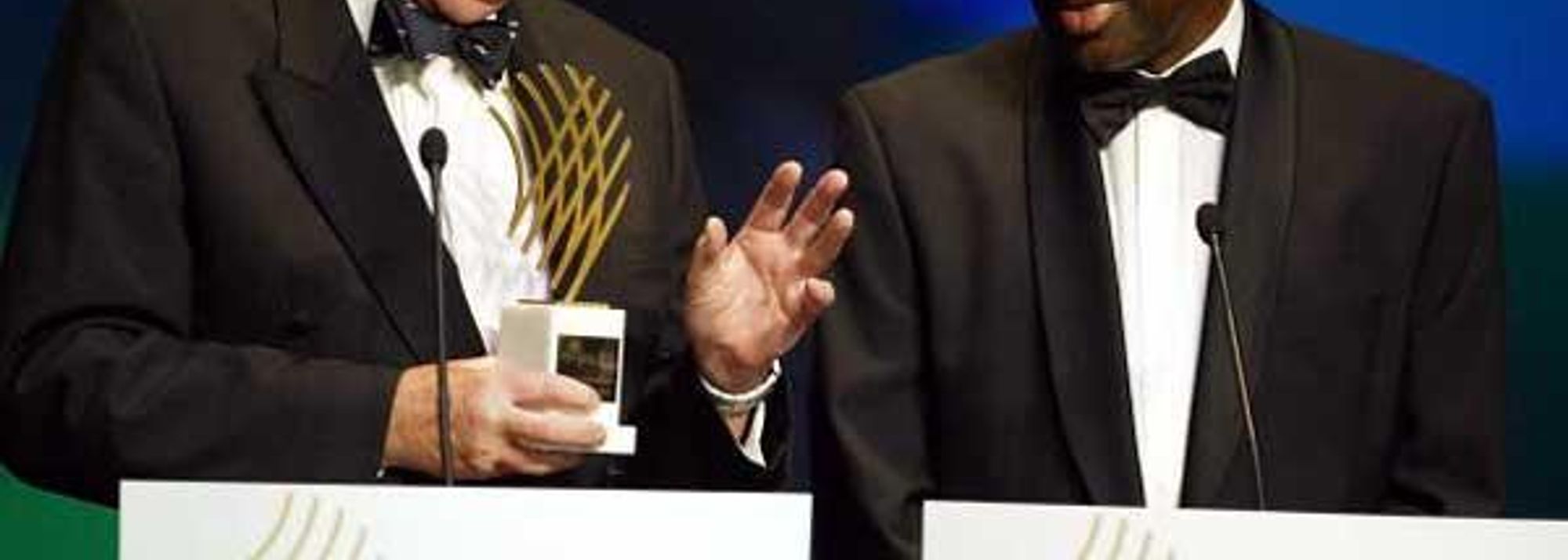


Sir Roger Bannister with Lamine Diack at the IAF Gala (© Getty Images)
To celebrate the 50th anniversary of the world’s first sub-four minute mile, the IAAF presented Sir Roger Bannister with the Lifetime Achievement Award. Neil Allen remembers what made Bannister become an all-time hero on 6 May 1954.
Fifty years after I had the pleasure of witnessing Roger Bannister of Britain becoming the first man to beat the 4-minute barrier for the mile, the IAAF, through the much appreciated presence of its president, Lamine Diack, at a celebratory dinner given by the organisers of the Flora London marathon, underlined the importance of this feat - perhaps the most celebrated world athletics record of all.
As 20 of us gathered at the Pont de la Tour restaurant by London’s land mark Tower Bridge, M. Diack, chatting before we took our places, left me in no doubt how fortunate I was to have been a 21-year-old reporter among a crowd of only 1200 at Iffley Road track, Oxford on 6 May 1954 when Bannister, aided by his friends Chris Brasher and Chris Chataway, beat Swedish Gunder Hagg’s 1945 World mile record of 4:01.4 with the historically significant figures of 3:59.4.
When M. Diack rose to speak, the elite audience, headed by Sir Roger Bannister himself, included 10 men who, between them, had beaten 27 official World records and won 13 gold, silver or bronze Olympic medals. In alphabetical order they were Bannister, David Bedford, Chris Chataway, Seb Coe, Steve Cram, John Disley, Brendan Foster, Derek Ibbotson, Kipchoge Keino and Alan Pascoe.
President Diack summed up the unique atmosphere when he said:
“On 6 May 1954, I was a footballer in my native Senegal but I still recall hearing the news that a young man in England had achieved what had been considered impossible - he had run 1 mile -
4 laps of the track - in less than 4 minutes! It was a sensation.
“There is no question in my mind that the drama, excitement and publicity caused by this single race helped form the development of modern athletics. This race was a turning point in our history and the amount of Media coverage that this fiftieth anniversary has caused shows that even today the world remains fascinated by the achievement.
“By running 3:59.4 and breaking a barrier that had been considered unbreakable, Roger Bannister had also transcended sport and became an eternal symbol of the limitless possibilities of the human mind and body. Bannister and his famous pacemakers Chris Chataway and Chris Brasher had been carefully prepared by their coach Franz Stampfl, but they still needed to take a great leap of faith to turn what had been a dream into reality.
“Following that epic race 50 years ago, you went on to build a highly successful career in the demanding field of neurology, but you also continued to stay closely involved in sport.
“Your love for sport as a means of realising human potential and spreading joy has been evident to me on every one of the occasions we have met in the past years.”
The following week, on the exact half century anniversary date of 6 May, the occasion was marked at Oxford by a match on the former cinders, now all weather track between Oxford University Athletic Club, founded in October 1860, the oldest athletics club in the world, and an under-23 team representing the Amateur Athletic Association of England, founded at Oxford in 1880.
At the special request of Roger Bannister himself there was no commercial sponsorship or advertising and no money for competing. Happily, top class international runners like Ireland’s Sonia O’Sullivan, Australia’s Craig Mottram and Britain’s John Mayock had appreciated it was privilege enough to take part.
O’Sullivan won the women’s mile in 4:27.79 and Mottram set a new track men’s record of 3:56.64. But there was as much pleasure for the university crowd in seeing precocious 14-year-old Emily Pidgeon recording 4:50.66 and 12-year-old Sarah Hopkinson 4:50.66 for the four laps. Fittingly, their awards were presented by Diane Leather who, 23 days after Bannister’s feat in 1954, became the first woman to run a mile in under 5 minutes.
On this sunny afternoon, my mind went back once more to the chilly evening 50 years earlier when the wind was gusting so strongly (at more than 8 miles an hour or 18 metres per second) that the record attempt was nearly called off by the nervous, highly strung Bannister. Even when the gun went, at just after 6pm, an old photo shows the flag of St. George on a nearby church was stretched full length.
There as a junior reporter for the magazine Athletics World, I was aware of the secret, advance record planning because my editor was Norris McWhirter, founder later of the Guinness Book Records but then friend and athletics adviser to Bannister. I was able to stand on the inside of the track, so close to the specially rolled cinders surface that, on the first half lap, I clearly heard Bannister shout “Faster, Chris’ to pace-maker Brasher.
Fortunately the future 1956 Olympic 3000 metres Steeplechase winner ignored the cry and continued at the right tempo, 57.4 for 440 yards and 1:58 for 880 yards before Chataway, who was so strong he was to beat the World 5000 metres record in London later that season, took over to reach the bell in 3:.00.4.
By the middle of the final lap, on the back straight where there was just a thin line of standing spectators, mainly Oxford students, the tall pale skinned Bannister began to build into his extraordinary finishing burst, the crowd at last appreciating that the 4 minute “barrier’ could be beaten.
Bannister passed the single 1500 metres time-keeper, Norris McWhirter’s twin brother Ross, in 3:43, which unofficially equalled the World record held then jointly by Hagg, his fellow Swede Lennart Strand and German’s Werner Lueg.
All that remained was a home straight gallop, half fainting through the tape to sporting fame and, subsequently, professional respect as one of the leading neurologists in the world.
It is, however, sometimes forgotten that Bannister was to have two major international victories in the next 111 days. In Vancouver on 7 August, he faced up to the great Australian front runner, John Landy, who, on 21 June in Turku, had lowered the World mile record to 3:58 after being extended, up to the bell, by Chataway.
The Vancouver ‘Mile of the Century’, as it was labelled, ended with Landy setting a torrid pace (passing 1500 metres in 3:41.9), in spite of having cut a foot on a photographer’s flash bulb the night before. It was a great effort but Bannister came through to win the British Commonwealth Games gold medal in 3:58.8.
On 29 August 29 1954 in Berne, Bannister faced a solid field in the final of the European Championships 1500 metres including the new European record holder Sandor Iharos of Hungary and Denmark’s Gunnar Nielsen. Yet the British champion unleashed an unanswerable final 25-second 200 metres to win in 3:43.8 and end his racing career in triumph.
Fifty years later, at Oxford this spring, it was a poignant reminder of the life-long friendships our sport can engender to see Bannister welcome to the track side, and dinner later, his old rival and successor as World mile record breaker in John Landy, now the governor of Victoria, Australia. “When we were rivals” reflected Landy, “we admired one another’s athletic ability but now our friendship is much deeper.”
Five years ago, another visitor to Oxford to meet Sir Roger Bannister was Hicham El Guerrouj. Though he has now lowered the mile record to a remarkable 3:43.l3, the modest Moroccan, having watched a video of the 1954 feat, said: ”Roger Bannister had a great style and was so talented that, if he had been competing now and training harder, with the technology and the tracks we have, he would have been unbelievable.”
My modest friend Roger, father of four and grandfather of 14, smiles and shakes his head. What concerns him, as it does the IAAF, is the future: “At 75 I still cannot imagine a World without sport and all its pleasures I have enjoyed, including walking, cycling, sculling, sailing and playing embarrassingly bad golf. But sport without fairness, allowing drugs, is nothing but a cheat’s charter. Our children deserve better than that.”
Neil Allen, a former President of the AIPS Athletics commission, reported 14 Summer and Winter Olympics for The Times, London Evening Standard and, finally, the New York Times from Melbourne l956 to Atlanta l996.
Published in IAAF Magazine Issue 4 - 2004

