As the year draws to a close, we look back at the key moments of 2025 in each area of the sport.
The series continues with a review of road running events – the mile, 5km, 10km, half marathon and marathon – and will be followed over the coming days by reviews of all the other event groups.
Emmanuel Wanyonyi's road mile victory in Herzogenaurach in 3:52.45 heads the season’s top list and is the third-fastest time in the history of the road mile.
The Herzogenaurach event produced the second and third fastest times of the year, courtesy of Hobbs Kessler (USA) 3:54.34 and Nico Young (USA) 3:54.50, respectively. They now sit in sixth and seventh place on the world all-time list. A total of 30 athletes produced a sub-four-minute performance for the mile this year, 16 more than in 2024.
In the 5km, Yomif Kejelcha was within six seconds of the world record when he won in Herzogenaurach in 12:54, his third fastest time in the distance. He is the season’s top performer.
Jimmy Gressier, second on the season’s list, set a European record when he clocked 12:57 to win in Lille. Uruguay’s Santiago Catrofe set a South American record coming second after Gressier in a time of 12:57, both tied for fifth place on the world all-time list.
Four men are tied on 13:00 minutes this season – France's Yann Schrub, Uganda’s Harbert Kibet, Djibouti’s Waberi Igueh Houssein and Ethiopia’s Yismaw Dillu.
Honolulu once again produced the fastest road mile performance, 4:21.66, courtesy of Sinclaire Johnson's win at Kalakaua Merrie Mile in December. Johnson shaved off seven seconds from her time last year to break the North American record, elevating her to second on the world all-time list.
The USATF Road Mile Championships, produced the second, fourth and fifth best performances of the year through Kristlin Gear, Karissa Schweizer and Gracie Morris (4:23.98, 4:24.40, 4:24.73), respectively. Kenya’s Nelly Chepchirchir takes the third best performance of the season due to her 4:23.99 victory in Herzogenaurach, moving her to fifth all-time.
In the women’s 5km, Kenya’s Caroline Nyaga ran a world-leading 14:19 at the Asics Tokyo Speed Race, propelling her to joint third on the world all-time list. Hirut Meshesha’s 14:30 in Lille remains the second fastest time of the season. Italy’s Nadia Battocletti set a European record with her 14:32 second-place finish in Tokyo, ranking her third for the season.
He did not attain the world record he was chasing, but Ethiopia’s Yomif Kejelcha improved on his 10km time from last season, lowering it from 26:37 to 26:31 when he broke the course record in Castellon. Paced by Burundi's Rodrigue Kwizera, Kejelcha missed the world record by six seconds but clocked the second-fastest 10km performance in history and set an Ethiopian record. Nominated for the Male out-of-stadium athlete of the Year, Kejelcha, finishes the season top of the world list.
Sweden's Andreas Almgren began the year superbly on the road, winning in Valencia in a European record of 26:53, making him the first European to run inside 27 minutes. The time is the second-best performance of the season.
Uruguay’s Santiago Catrofe set a South American record of 27:16 in Valencia, a race that also saw 12 national records fall in the men’s contest, among them for Switzerland, Belgium, Eritrea, Great Britain, Spain, Netherlands, Ireland, Denmark, Lithuania and China.
This season has seen five athletes tied on 26:54 - Dominic Lokinyomo Lobalu, Birhanu Balew, Gemechu Dida and Rodrigue Kwizera from the Herzogenaurach event and Khairi Bejiga from Brasov. A record 99 men have gone under 28 minutes this season, 17 more than last season.
Kenya’s Agnes Ngetich is the fastest and first woman to break the 30-minute barrier in the women-only 10km, thanks to her world-record performance of 29:27 in Herzogenaurach.
This season’s top performance is Ethiopia’s Medina Eisa, who successfully launched her 10km road debut with a sub-30-minute time of 29:25 with her Castellon victory.
There has been significant movement on the world all-time list. Behind Eisa in Castellon, Likina Amebaw clocked 29:40 to move to ninth all-time. Kenya's Hellen Lobun clocked the fifth fastest women's time ever when winning in Valencia in 29:30 ahead of Girmawit Gebrzihair (29:34) and Fotyen Tesfay Haiylu (29:42).
Valencia accounts for five of the 10 fastest times this year, while Castellon accounts for three, as a total of nine women ran under 30 minutes.
Two-time world cross-country champion Jacob Kiplimo clocked a staggering 56:42 in Barcelona in February, a mark that is pending ratification. Yomif Kejelcha’s 57:30 from last year still stands as the official world record.
The season’s second quickest time came out of Valencia, where world 10,000m silver medallist Kejelcha won in 58:02. Nicholas Kipkorir’s 58:23 win in Copenhagen, followed by Vincent Langat and Gilbert Kipkosgei Kiprotich's 58:27, rounds off the top five performances in 2025.
World 10,000m bronze medallist Andreas Almgren set a European record of 58:41 in just his second appearance at the distance, becoming the first European athlete to break 59 minutes in the half marathon.
15 men ran under 59 minutes. The top ten performances were shared between Valencia (4), Copenhagen (2) and Barcelona, Berlin Malaga and Buenos Aires one each.
Agnes Ngetich brushed off her World Championships disappointment with a world-leading 1:03:08 in Valencia, missing Letesenbet Gidey’s world record of 1:02:52 by 16 seconds.
Ethiopia’s Fotyen Tesfay broke the Berlin Half Marathon course record with 1:03:35.
31-year-old Joyciline Jepkosgei lowered her own Barcelona course record to 1:04:13. Tsigie Gebreselama won in Lisbon in 1:04:21 and Likina Amebaw in Copenhagen with 1:04:44.
The top five times this season have been produced from five different competitions. Compared to last year, fewer women broke 1:06 (12 this year compared to 16 in 2024), but there were 100 sub-1:08 performances this year, which is 12 more than last year.
Ten years after his first World Championships, eight years after earning world bronze, and four championships after his first medal, Alphonce Felix Simbu achieved a historic breakthrough. He became the first athlete from Tanzania to win a global title, claiming gold in the men's marathon at the World Championships in Tokyo in 2:09:48.
The win came off the back of his second place in Boston (2:05:04). He won in Tokyo in a close finish with Germany’s Amanal Petros as just 0.03 separated them, both credited with 2:09:48. Italy’s Iliass Aouani was just five seconds behind to take bronze.
Sabastian Sawe, the 2025 men's out-of-stadium athlete of the year, won his second career marathon in London in 2:02:27 – the second-fastest ever London Marathon time. Sawe then went on to win in Berlin with a world-leading 2:02:16.
Two-time world cross-country champion Jacob Kiplimo set a Ugandan record of 2:03:37 on his marathon debut in London and went on to win in Chicago in 2:02:23, moving him to seventh on the world all-time list. John Korir, winner in Valencia in 2:02:24, is now eighth on that list.
Petros lowered the German record with 2:04:03 to finish second in Valencia and move to third on the European all-time list.
There was another close finish at the New York City Marathon with Benson Kipruto crossing the line ahead of his compatriot Alexander Mutiso Munyao by three-hundredths of a second – both timed 2:08:09. 27 men dipped under 2:05.
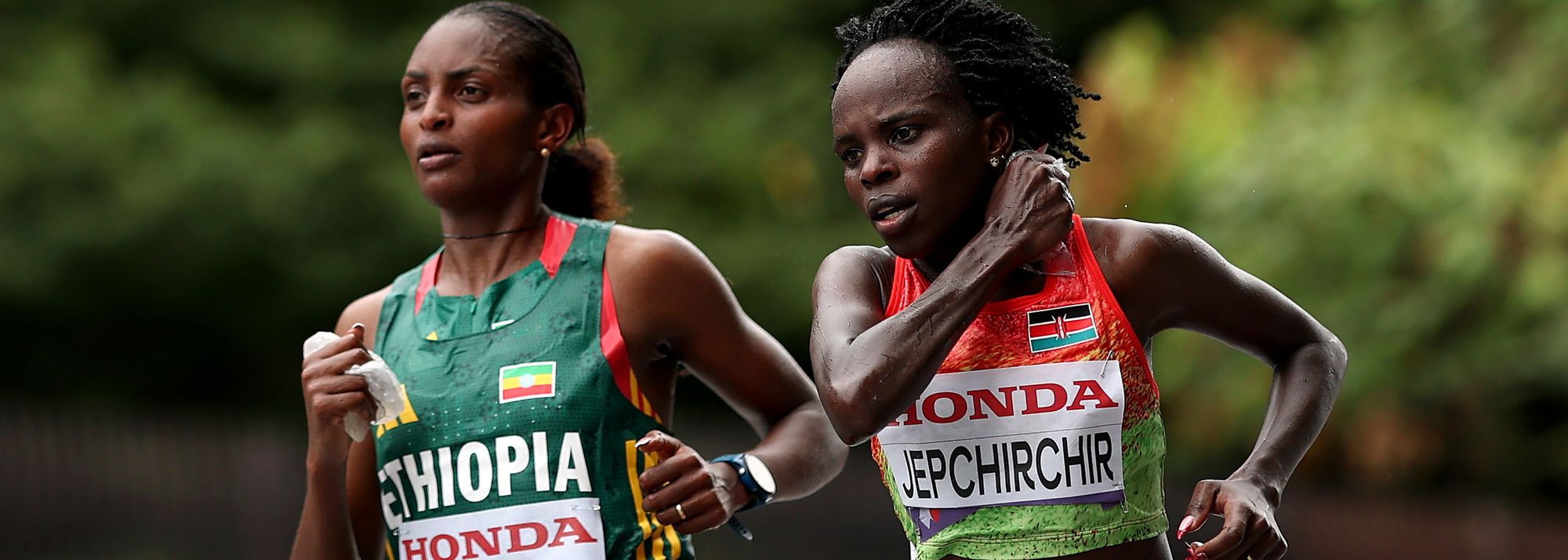
The world gold honour went to Peres Jepchirchir, who won the world marathon title with a powerful sprint past Tigst Assefa, timing 2:24:43. This was her second global title in Japan, following her 2021 Olympic gold. Jepchirchir went on to finish second in Valencia three months later, her 2:14:43 performance puts her second-best performance of 2025 and sixth overall in history.
Assefa earned the same colour medal she achieved at last year's Olympics, claiming silver (2:24:45), while Julia Paternain took the bronze medal (2:27:23) - a historic achievement winning Uruguay’s first-ever medal at the World Championships. A record 11 countries finished in the top 12, highlighting the diversity in marathon running.
In April Assefa smashed the women-only world record by 26 seconds at the London Marathon, running 2:15:50 to win her first London Marathon title. She improved Jepchirchir’s record of 2:16:16 to rank fourth on the season’s top list.
Joyciline Jepkosgei's 2:14:00 triumph in Valencia is the world’s fastest time this season and ranks fourth on the world all-time list
Other notable performances include Sharon Lokedi setting a Boston Marathon course record with 2:17:22, shaving off two minutes and 37 seconds from the previous course record that had stood for 11 years. Hellen Obiri became the first woman to go under 2:20 when she posted 2:19:51 to win the New York City marathon, lowering the 22-year-old course record set by her compatriot Margaret Okayo. The 36-year-old led a Kenyan podium sweep.