

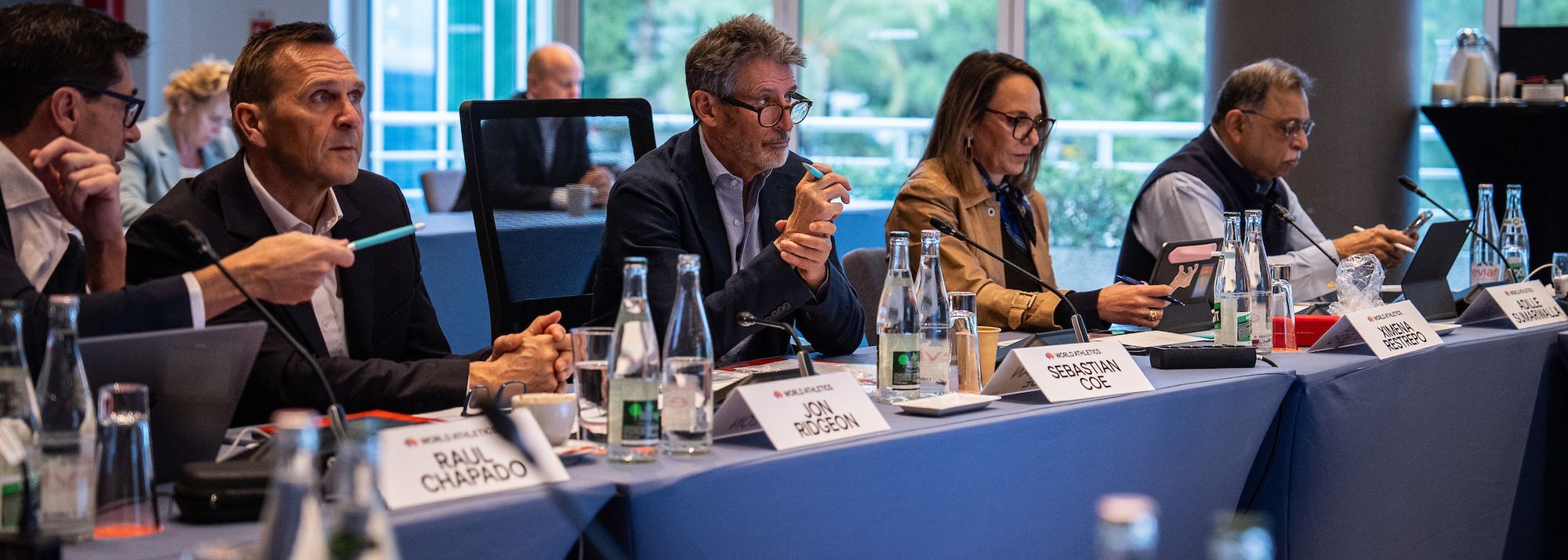


The 239th World Athletics Council Meeting in Monaco (© World Athletics  Christel Saneh)
World Athletics President Sebastian Coe reflected on a successful year for the organisation at the 239th World Athletics Council Meeting in Monaco and reinforced how 2026 offers an unprecedented opportunity to build lasting geopolitical and geoeconomic relationships for the world’s most universal sport.
The Council also decided on updates to the eligibility rules and regulations and competition matters during the two-day meeting on 2-3 December.
“Our recent World Athletics Awards celebrated the very best in our sport and provided the perfect opportunity to reflect on what has been another outstanding year,” said Coe.
“Attendance figures across all three World Athletics Series events were strong, reflecting our focus on full stadia through a targeted marketing strategy. For our two championships in China, the World Indoor Championships in Nanjing had a sell-out crowd of 12,000 and the World Relays in Guangzhou attracted 37,000 fans. In Tokyo we saw full evening sessions and impressive morning sessions with a total crowd of 619,288, making it the third-highest attendance for a World Championships after Beijing 2015 and London 2017.
“Our media reach outside of broadcast in 2025 was 38 billion, our social media followers grew by 3 million, from 14 million to 17 million, and we signed up more than 1 million new fans to reach a total of 2.15 million addressable fans, literally at our fingertips.
“On the field of play, a record 84* countries achieved a finalist or top eight placing at the World Championships in Tokyo. This shows how far we have come in 30 years – just 47* countries achieved the same feat in Tokyo in 1991. No other sport has this reach. I never tire of saying that and I never tire of finding the proof points to show it.”
Next year features a calendar of six World Athletics Series events as well as the new World Athletics Ultimate Championship in Budapest and Run X World Treadmill Championship, Area Championships, a Commonwealth Games, and Youth Olympic Games. Preparations will also continue for the World Athletics Championships in Beijing the following year.
“Next year we have an unprecedented opportunity to build lasting geopolitical and geoeconomic relationships, with world championship events in Europe, Africa, USA and South America, and the ongoing work we are doing to raise our sport’s profile in China. Don’t underestimate this opportunity,” added Coe to his Council colleagues.
“We are doing more than just holding an athletics event in these countries. The relationships we form, the respect we show, will stand us in better stead in the coming years as geopolitical rivalries reshape global markets. And our Member Federations, the lifeblood of our organisation, sit at the epicentre of what will be a challenging few years ahead. We all need to understand this and seize the opportunity to build strong alliances and networks.”
Eligibility regulations: female category
The World Athletics Council received an update on implementation plans for the regulations concerning eligibility conditions to compete in the female category for world ranking competitions.
The rule regarding eligibility to compete in the female category has not changed. Following the introduction of once-in-a-lifetime testing for the SRY gene ahead of the World Athletics Championships Tokyo 25, the regulations confirm where test results will be requested on a staggered basis from 2026 to 2030.
SRY test results will be requested by World Athletics from athletes competing in the female category at the following events during 2026, unless they had a confirmed clear test result at the 2025 World Championships in Tokyo.
• World Athletics Series events and the World Athletics Ultimate Championship
• Diamond League meetings
• Marathon Major Platinum events
The categories of world ranking competitions at which SRY test results will be requested will be reviewed each year. The competitions will be announced by 1 November the previous year for implementation the following year.
Member Federations were also informed that onsite testing options for the World Athletics U20 Championships Oregon 26 were being explored, paid for by World Athletics. Information on the plans for testing at the World U20 Championships will be developed by the end of March 2026, including detailed information on permission protocols for minors.
The Council approved the proposed amendments to the Eligibility Rule 3.5 and Regulations for the Implementation of Eligibility Rule 3.5 (Male and Female Categories) with immediate effect.
The Council also heard how testing at the World Athletics Championships Tokyo 25 was successfully completed. A total of 1015 female athletes, including reserve athletes, underwent the SRY test.
Competition decisions
Timetables published
Timetables for four 2026 World Athletics Series events were approved:
• World Athletics Race Walking Team Championships Brasilia 26 (12 April)
• World Athletics Relays Gaborone 26 (2-3 May)
• World Athletics U20 Championships Oregon 26 (5-9 August)
• World Athletics Road Running Championships Copenhagen 26 (19-20 September)
In addition to approving the timetable for the WRRC Copenhagen 26, the Council endorsed the LOC’s proposal to introduce a mixed team competition in the mile and 5km events.
The timetable for the Dakar 2026 Youth Olympic Games was approved, the Council taking note of the IOC’s final structure for the event and acknowledging that World Athletics has limited influence over the participation system.
Inaugural world record standards set
Following the announcement that the half marathon and marathon will become the official senior road distances for race walking events, the Council approved the following inaugural world record standards for those events:
• Men’s half marathon race walk: 1:21:30
• Women’s half marathon race walk: 1:30:30
• Men’s marathon race walk: 2:56:30
• Women’s marathon race walk: 3:17:00
These inaugural standards must be surpassed to set a world record. Performances will be recognised from 1 January 2026.
Event and rule updates
Other approved decisions included:
• having two sections for the World Indoor Championships 400m final, each with four athletes, with combined results, to take place for the first time at the World Athletics Indoor Championships Kujawy Pomorze 26;
• adopting World Athletics rules for World Athletics Series qualification regulations, allowing athletes who turn 16 in that calendar year to compete at World Athletics Series events for all events and disciplines;
• introducing a single, clear substitution policy for World Athletics Series and Olympic competitions, covering both track and field events;
• limiting relay substitutions to a maximum of two athletes between rounds and finals for the single gender 4x100m and 4x400m events;
• authorising the use of electronic assistance for athlete line-up management in relay events, particularly the 4x400m;
• amending Technical Rule 22.6 (hurdle displacement); and
• amending the Race Walking Technical Rules 54.6 and 54.11.1, to clarify operational procedures and improve event flexibility.
Updates were also provided by the various commissions and the Athletics Integrity Unit, the details of which will be available on the World Athletics website in due course.
World Athletics
*Includes athletes who finished 9th-15th in finals in events with heats or qualifying rounds.