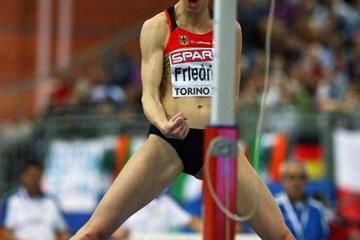


Ariane Friedrich roars with delight after clearing 2.01m (© Getty Images)
Turin, ItalyIt was to be the most attentively-watched duel of the final day of the 30th European Indoor Championships, but ultimately and fairly quickly, the expected battle for High Jump honours between co-world leaders Blanka Vlasic and Ariane Friedrich ended before the medals were even decided.
Friedrich reigns supreme
Vlasic, the reigning World champion indoors and outdoors, saw the end of her 42 consecutive meet streak of two-metre jumps come to an unceremonious end when she simply found a relatively lowly 1.96m too much to handle this afternoon.
Friedrich on the other hand, encountered no difficultly in rising to the occasion with a first attempt clearance at 2.01m to become the first German champion in the event since 1996.
“I can’t believe yet that I have really won the gold,” said Friedrich, who took just five jumps on the afternoon. “I found it strange that Blanka had such problems.”
With the Croatian’s early demise, her closest competitor was Ruth Beitia of Spain, one of Europe’s most consistent jumpers in recent years but largely overshadowed by the world’s big two this year.
The Spaniard led briefly after sailing clear at 1.99m with her first try – Friedrich needed two – but was forced to settle for second after missing once at 2.01m and twice at 2.03m. After her second try at the latter, Friedrich decided to call it a season to end her campaign undefeated in eight competitions.
It was Beitia’s third medal at these championships – she took silver in 2005 and bronze in 2007 – and a season’s best as well for the 29-year-old.
“Once Beitia missed at 2.03, I stopped because there was nothing more I could do today,” said Friedrich, who had fighting off a cold for the last three days. She dedicated the victory to her coach Gunther Eisinger’s mother who passed away last week.
Russians Viktoriya Klyugina and Svetlana Shkolina each cleared 1.96m, with Klyugina taking the bronze on the countback.
Meanwhile, Vlasic’s chase for that ever-elusive continental medal will recommence in Barcelona in the summer of 2010.
Bekele rains on Alminova’s parade
Anna Alminova, who won the 1500m in dominating fashion yesterday, was the focal point of the 3000m today, which seemed to suit Turk Almitu Bekele just fine.
The 31-year-old, who has represented Turkey for more than a decade, controlled the proceedings for most of the race to take home an impressive victory with a national record 8:46.50.
“This is great,” said Bekele, who was seventh in the Olympic 5000m last year after a two-year post-maternity break. “I just followed my coach’s advice.”
Taking the lead about 800m into the race, the Turk was shadowed by Alminova who seemed to be relishing her opponent’s decision to lead. But the brisk pace would eventually take its toll on Alminova who was racing for the fourth time this weekend.
Irishwoman Mary Cullen made a move for the lead with just under a kilometre remaining, but couldn’t shake the duo. Bekele retook the lead at the bell with Alminova trying to follow, but while the Turk forged on to create an insurmountable gap, Alminova’s ambitious weekend plans began to unravel. Cullen, Portugal’s Sara Moreira, then Spaniard Nuria Fernandez passed by. Italy’s Silvia Weissteiner followed suit as well.
While Bekele proved uncatchable, Moreira snuck by Cullen over the final ten metres to take the silver in 8:48.18, a personal best by more than five seconds. Cullen hung on for the bronze, clocking 8:48.47, with Fernandez, the world leader in the 1500m, notching a PB 8:49.49 for fourth. Weissteiner (8:50.17) was next across the line, with Alminova (8:51.36) sixth.
Bekele’s was the first ever medal in the event for Turkey, while Moreira’s was the first for Portugal since Carla Sacramento’s silver in 2002.
Savinova surprises with 1:58.10 world leader
No woman has ever successfully defended a European indoor 800m title, a footnote that didn’t bode well for Oksana Zbrozhek, the surprise winner in Birmingham two years ago. Today, she, and the rest of field were themselves caught off guard, this time by Briton Marilyn Okoro who decided to try and steal the race with a big move and subsequently suicidal pace from just before the 200m point onwards.
Fourth two years ago, Okoro’s rampage began with a 27.7 first lap before she reached 400m in 56.1, nearly a second-and-a-half ahead of World record pace. Russia’s Mariya Savinova was the first to respond and gradually began to make up the gap, with the rest of field still lingering well behind. With Okoro slowing, Savinova moved to the front at the bell, quickly building a significant lead.
Zbrozhek was the first to give chase, followed by world leader Elisa Cusma of Italy, whose move stirred the sell-out Oval Lingotto crowd into a frenzy. The defending champion managed to narrow the gap somewhat but still fell well shy of catching Savinova, who crossed the line in 1:58.10, the fastest in the world this season and more than a second faster than her 1:59.45 PB set earlier this season.
“I planned this for (the World Championships in) Berlin, not Torino,” the 23-year-old Russian champion joked. “That’s why I’m really surprised. I really wasn’t thinking about a victory.”
Zbrozhek, who ran with a sore and wrapped left Achilles, clocked 1:59.20 for second, while Cusma (2:00.23) fought off another Briton, Jenny Meadows (2:00.42) to take the bronze.
Taranova-Potapova bounces back to Triple Jump title
There was another world leading performance just a bit earlier on the action-packed afternoon program, but this time by the world leader Anastasiya Taranova-Potapova who took control of the Triple Jump competition from the outset, and held on to take Russia’s second gold of the afternoon.
A former World and European junior champion, Taranova-Potapova opened with a 14.51m leap, and would never surrender the lead. After a 14.47m effort as a follow-up, she unleashed the clincher in the third round, a 14.68 jump that added one centimetre to her own world-pacing performance. It was a marked contrast to the modest 14.06m jump from Saturday which was barely enough to squeeze her into today’s final.
“I didn’t fell well yesterday during qualification, but today I didn’t make any mistakes,” said Taranova-Potapova, who ended her indoor campaign undefeated in four starts in the event.
Her only significant challenge came from Slovenia’s Marija Sestak, the World indoor bronze medallist, whose opening round 14.46m would have sufficed for silver. Despite a back injury that’s been dogging her this winter, she did improve to 14.60m in the fourth round, a marginal improvement from the 14.52m season’s best she produced in qualifying.
Dana Veldakova took the bronze thanks to her 14.40m Slovak national record in the third round, a 10cm improvement on her previous record set last year and a major jump from her sixth place finish two years ago.
First victory of the season for Polyakova
Taking the lead for good just beyond the 30m point, Yevgeniya Polyakova cruised to the 60m title clocking a season’s best 7.18. It was a fitting season’s end for the Olympic 400m Relay gold medallist whose gold medal dash was her first victory in five outings.
“Race after race I gained more self confidence and started to believe I had a chance to win,” said the 25-year-old, whose career best of 7.08 was set a year ago.
Ezinne Okparaebo again broke her own Norwegian record, knocking 0.01 seconds from the 7.22 she ran yesterday, to take silver, the first 60m medal of any color for Norway. Just a hair behind, Verena Sailer of Germany took the bronze in 7.23.
While the race was close, it also produced the slowest winning performance in 16 years.
Russia concluded yet another successful European Indoor Championship with an expected victory in the 4x400m Relay. Anchored by 400m winner Antonina Krivoshapka, the Russian quartet clocked 3:29.12 for a comfortable victory over Great Britain (3:30.42) and Belarus (3:35.03). In all, Russian women collected eight gold, two silver and three bronze.
Bob Ramsak for the IAAF