

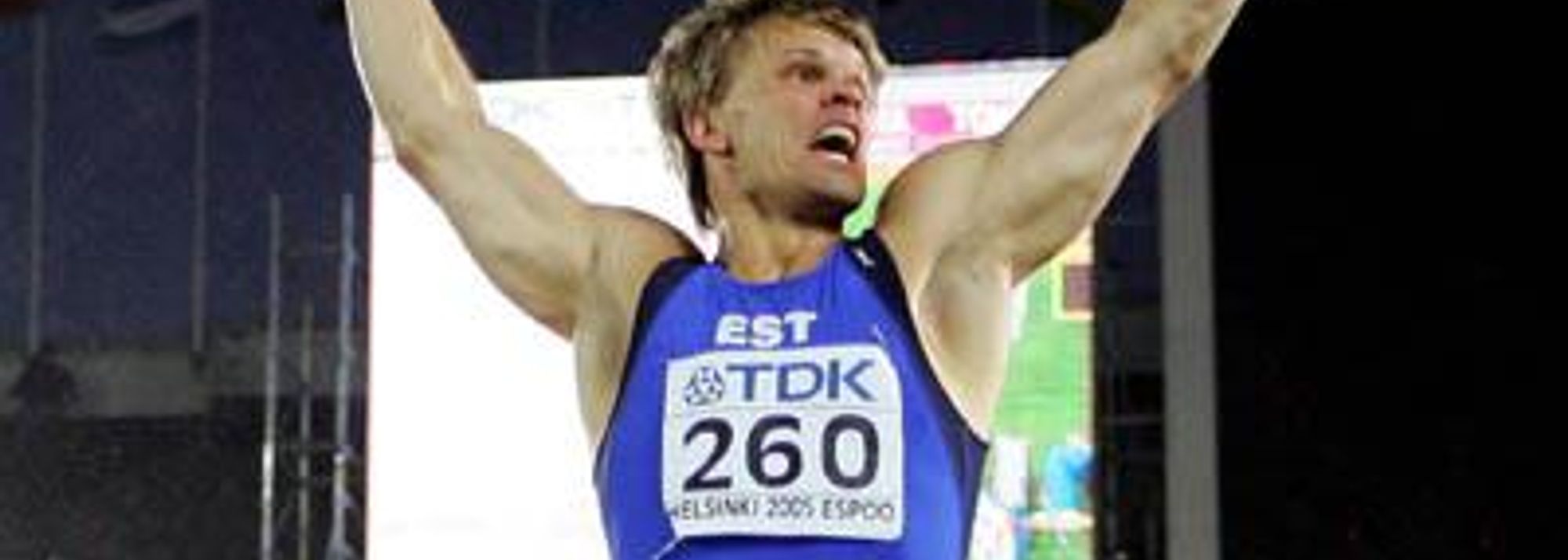


Andrus Varnik of Estonia celebrates after throwing 87.17m (© Getty Images)
In 1994 at the European Championships in Helsinki’s Olympic stadium, Britain’s Steve Backley completed a hat-trick of continental men’s Javelin Throw titles, and then rather than the customary lap of honour, paraded down the middle of the infield with the Union Flag, dancing in triumph. Tonight, it was Estonian Andrus Värnik’s turn to take the applause of the home crowd, displaying the Estonian colours in the infield, after sealing the gold medal on the fifth day of the 10th IAAF World Championships in Athletics.
Just as in 1994, the home crowd had a hero. However, if the manner of the greeting they gave the new World champion was slightly more muted than is traditional in the home of the discipline, it was a reflection that unlike eleven years ago when their man Seppo Räty had taken silver, tonight their 22-year-old talent Tero Pitkämäki could manage no better than fourth.
Gutsy athlete with the right physical build
Värnik had the fire of a champion on a night of extreme cold and dampness in Helsinki. That competitive spirit brought him through to victory in what Backley described as the worst conditions he had ever seen at a major championship competition for the event.
“When I came to the stadium today and saw the extreme head wind I immediately marked two men down on my start-list as favourites,” confirmed Backley, who is now a BBC radio commentator. “Värnik because he has a stocky low build and a gutsy temperament which you need to contend with such weather conditions, and (Sergey) Makarov, as he is a supreme competitor.”
“The two men I had doubts about were (Andreas) Thorkildsen and (Tero) Pitkämäki. They are both slight builds but the Olympic champion showed exactly why he won in Athens, while the Finn is just a little too inexperienced and it showed tonight. He has thrown very high when he has made all his long distances this summer, and that was not possible tonight in the wind, and he couldn’t control his spear when he tried to alter the angle of attack.”
Trouble with runway and his health
If Backley had predicted the likely winner when arriving in the stadium, then quite naturally his manager and coach had believed all along that their man would win through.
Aivar Karotamm, who manages the 27-year-old star, reflected that their concerns had been two fold. “Andrus has had trouble getting used to the surface of the runway at the Olympic stadium. It caused him problems when he came to compete here (Helsinki) in July (25) when he finished 9th (74.99m) at the Grand Prix meet. It was the same in qualification yesterday which is why it took him all three throws to get into the final.”
The other difficulty had been his health, and he even had to spend some time in hospital in May. “He has suffered from very high blood pressure and that has caused him terrible problems, and that is why his season has been so inconsistent.”
Experienced coach
Värnik’s coach is the 1980 Olympic fourth placer Heino Puuste. The two have been together since 2003, and Karotamm acknowledges Puuste’s great influence in securing this win. “He is the best coach in the world for this event, he combines the mental and physical aspects of the event so well and throws out a confidence in which Andrus believes entirely. He is a coach, a teacher and friend.”
But what about the Finn? “I think there was too much pressure on such a young man. The pressure of the Finnish media killed him.”
For the World champion himself the verdict was a lot simpler. “Competition is competition, whatever the conditions, rain or wind, it is the same for all and the best man wins, and I controlled them (the conditions) best,” said Värnik. “The first throws were not good but I got used to the run-up gradually and the result is what you see.”
A dance of happiness
But what about the ‘Backley-like dance’ in the infield at the end of the competition?
“Steve Backley is a good guy and very important in the history (of this event). I did my best today, and (though) I am not yet that important, I hope maybe to be someday. We both have won great medals in Helsinki, and we were both happy. The celebrations were only that, just my complete happiness of achieving gold after the silver in Paris.”
Will you be a big star in Estonia now?
Modestly he replied, “maybe a little bit”.
There is no doubt.
Chris Turner for the IAAF


