

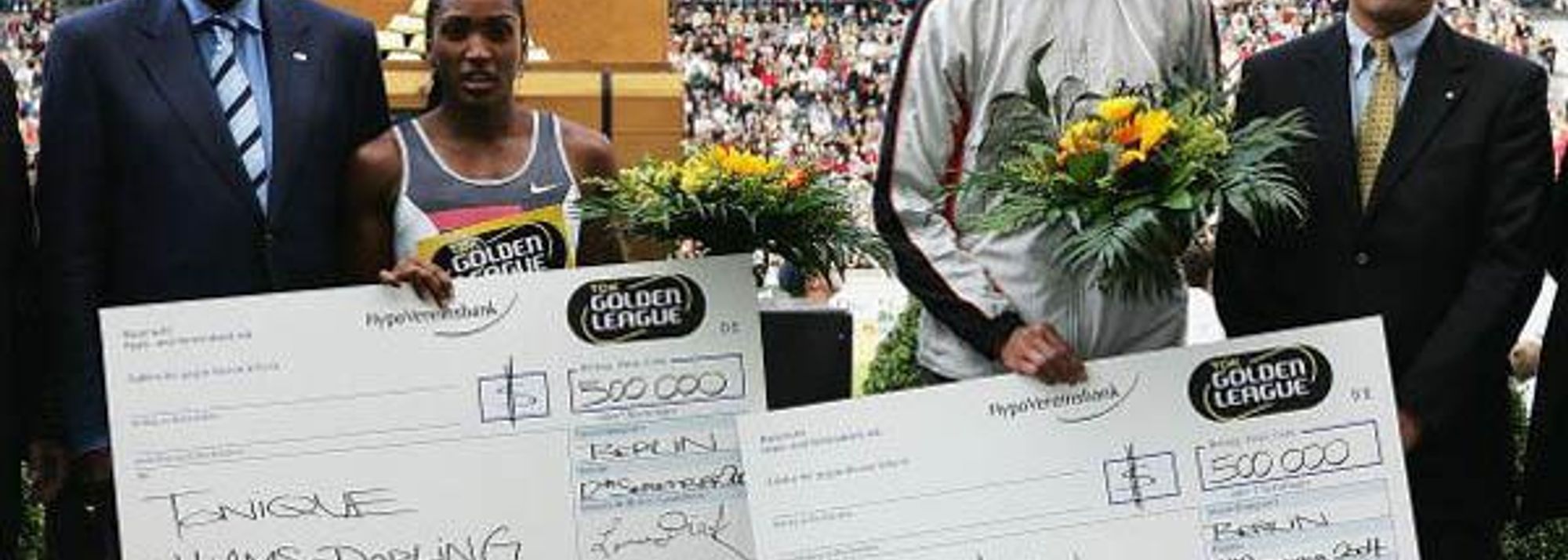


IAAF President Lamine Diack and M. Nosaka of TDK present Tonique Williams-Darling and Christian Olsson with the TDK Golden League Jackpot (© Getty Images)
Tonique WilliamsDarling and Christian Olsson cruised to half shares of a Jackpot of one million dollars this afternoon in ISTAF Berlin, the final of the TDK Golden League 2004, in front of 61,155 spectators in the ‘blue wonder’, the German capital’s newly renovated 1936 Olympic stadium.
Olsson leaves nothing to chance
Christian Olsson was the first of the Jackpot pair to succeed in the task of accomplishing six straight wins in the TDK Golden League 2004, which was the requirement for at least a share of the prize.
The 24 year-old Swede who yesterday commented he was physically fit but mentally exhausted by the effort of his Jackpot campaign which had begun in Bergen, Norway on 11 June, satisfyingly killed any fears of a last meet defeat when landing a 17.45 leap in the second round.
Providing the slightest of scares in the final round was American Walter Davis who leapt to 17.21 but by that time the World, Olympic and European champion was probably already looking up the number of his bank manager in Monaco, where Olsson's home now resides, to agree the best way to invest his winnings.
Williams-Darling produces the race of the day
The exact amount of Olsson’s prize was not to be determined for another 10 minutes, as he had to wait for the result of the women’s 400m race, which turned out to be the race of the day.
Williams-Darling also attempted to leave nothing to chance early on, blasting off in her usual uncompromising style. However, she was dramatically challenged with about 60 metres to go by a fully body-suited Ana Guevara, who powered into the home straight. But then suddenly the Olympic champion found new resolve, and opened up a sizeable winning margin in the last 40 metres, over last summer’s World gold medallist.
Guevara’s surge made great theatre out of what would otherwise have been another routine triumph for Williams-Darling. The Mexican who finished in 49.53, a season’s best, has with sense steadily, race by race, recovered her fitness since her winter's injury, without risking a relapse, and will surely pose a more potent force in the world next year.
Most significantly, Williams-Darling can thank Guevara for pushing her to a national record of 49.07, the fastest time in the world since the Mexican herself stormed to the World title in Paris last summer (48.89).
Further back, behind Monique Hennagan’s 49.67 finish for third, Greece’s Olympic 400m Hurdles champion Fani Halkia set a national record of 50.56 for fourth.
Hayes’ race from the gun
Olympic champion Joanna Hayes took a gun to tape - well, at least from the first hurdle - win in the 100m Hurdles, in the second fastest ever performance of her career (12.46). Only her Olympic win in Athens was quicker (12.37). The dominant manner of her victory today was there for all to see, as she held a two tenths advantage over the second placed Olena Krasovska of Ukraine, the Athens second placer.
The Olympics were a literally bruising disaster for quadruple men's 110m hurdles World champion Allen Johnson. Perhaps still smarting from his quarter-final crash-out in Athens, he seemed to high jump the last hurdle today after heavily bashing the penultimate barrier. Johnson’s win was nearly as emphatic as that of Hayes. His time was 13.16, with Jamaican Maurice Wignall next best in 13.27.
Tomashova takes revenge
The middle and long distances could not have produced more absorbing finishes. The highlights were the women’s 1500m and the men’s 800m.
In the former, Britain’s Kelly Holmes looked like she had timed her attack perfectly in the same manner as her two Olympic final victories. Yet as she drew level and then went past Athens silver medallist Tatyana Tomashova, the Russian found new energy and counter attacked. This was the final play of the race, and Tomashova, the World champion, crossed the line in 4:04.41 to gain some revenge over the Briton (4:04.49). Third was Russian Yelena Zadorozhnaya in 4:04.61.
Kamel mimics father’s tactics
The run of Saad Youseef Kamel (now racing for Bahrain but formerly a Kenyan) in the men’s 800m was a joy to see. Imitating the legendary finishing style of his father (the twice World champion Billy Konchellah) the 21 year-old drove down the last 100 metres in a perfectly timed charge which swept past the desperately flinging arms and legs of Kenyan Wilfred Bungei just before the line. The win was taken in 1:45.07 to Bungei’s 1:45.27.
World Youth best
The men’s 5000m couldn’t have been closer with a sprinter’s lean across the line needed for Kenyan Augustine Choge to win from Ethiopia’s Mulugeta Wendimu. The winner’s quote summed up the finish. “What was the decisive moment of this race? The last step before the finishing line!”
Choge had taken the lead with 600m to go but had been passed by Wendimu at the bell but the Kenyan had taken the advantage once more at the opening of the final straight. The winning time of 12:57.01 was a World Youth best for the 17 year-old World Youth 3000m and World Junior 5000m gold medallist, with Wendimu, second with 12:57.05 (PB). Third was Salim Jawher of Bahrain (13:00.40). Boniface Kiprop, who strode to a World Junior 10,000m record in Brussels set a new Ugandan record of 13:05.47 in sixth.
The 1500m which started half an hour later ended in the same style with Alex Kipchirchir swinging out wide into lane 3 in the final 40 metres in an ultimately failed effort to catch Kenyan compatriot Paul Korir, the World Indoor champion, who finished first in 3:32.46, just 4/100th ahead.
Adere holds on
Berhane Adere and Edith Masai did their best to replicate the script of the early men’s 5000m battle. The Ethiopian World 10,000m gold medallist whose last minute omission from their Olympic squad has caused much friction between her and the federation, drove for home with about 150m to go to win in 14:58.89.
However, it was a desperate struggle for Adere who had been withdrawn by her federation at the last minute from last Friday’s Brussels race. She eventually hung on despite a determined counter attack from Masai, the World championship 5000m bronze medallist, who had won last week in Adere’s absence.
Olympic champions have a good day in the infield
The men’s Discus had got the meeting underway at 1300hrs and provided another winning performance from World and Olympic champion Virgilijus Alekna. However, it took a third round 66.69 effort by Spain’s Mario Pestano to spark the life into the giant Lithuanian, who finding himself in second place responded in the next round with 68.12 for the win.
Another of the many Athens winners showing good form infield was Russian Yelena Slesarenko in the women’s High Jump, even though she was surprisingly shaky at both 1.94 (2nd time clearance) and 1.97 (third time clearance). Her 2m leap by contrast was clean and crisp and that ultimately was what separated her from USA’s Amy Acuff, whose own 2m jump (season’s best) came on her third attempt. Double World champion Hestrie Cloete had a best of 1.97, and three failures at 2m, for third.
Also on a high was Olympic winner Tim Mack, who succeeded in the men’s Pole Vault with a first time 5.80m clearance, enough to hold the advantage over compatriot Derek Miles who took three attempts to beat the bar at this height. Athens silver medallist Toby Stevenson was not on good form with a best of just 5.50, a level which he only achieved on his third try.
World record holder Osleidys Menendez had come within one centimetre of her best (71.54m – 2001) when winning the women's Javelin in Athens. Yet while not in the same form this afternoon, the Cuban’s 65.98 in response to Germany’s Olympic silver medallist Steffi Nerius' 5th round 65.60, was the mark of a champion, and good enough for the win.
Another German Olympic silver medallist Nadine Kleinert was also beaten with 18.52 for second in the women’s Shot. It was a competition which saw a personal best for Belarussian Nadezha Ostaptschuk whose fourth round 20.36, produced the sixth best competition result in the world this summer.
Athens fifth placer Bayano Kamani of Panama brought his country (he is ex-USA) their third major circuit win in history with a 48.55 clocking in the men’s 400m Hurdles. This followed-up on his victory last week in Brussels, and an earlier “B” race triumph in Zurich.
Bahamas’ Debbie Ferguson was the victor in the women’s 100m dash in 11.14, having pulled clear of Bulgaria’s Ivet Lalova (11.19) with half of the sprint remaining. The Bulgarian held on for second, getting the verdict over Brussels' winner Aleen Bailey of Jamaica, who had the same time.
Goodbyes
It seemed for one glorious moment that Frank Fredericks who won the 1993 World Championship 200m title in Germany, some 700km away in Stuttgart, might end the German section of his illustrious career in winning form. He closed impressively on Jamaica’s Asafa Powell in the last 20 metres of the 200m but even a low level dive across the line couldn’t quite pull off that fairytale ending. Powell, first 20.24, Fredericks, second 20.25.
But there was not even a glimmer of a memorable ISTAF farewell for former twice World and Olympic Long Jump champion Heike Drechsler, 39, who ended up ninth and last (5.92) this afternoon in a competition won by Tatyana Lebedeva, who succeeded her as Olympic gold medallist this summer in Athens. The Russian’s winning leap was 6.89. Drechsler who has been hampered by injury, has two more competitions this year – Yokohama and Tahiti – before retirement.
The final event of the day, a special Decathletes 1500m which was set up to bid farewell to another German hero, 1996 Olympic silver medallist Frank Busemann, also fell short of a perfect ending, as the protagonist finished fourth (4:27.67). In any case, it seemed an unusual choice for a farewell to any Decathlete, as this discipline is universally acknowledged by combined eventers as the most unpopular of their ten events. As if to make that point, finishing seventh and last (4:47.74) today was Olympic champion and World record holder Roman Sebrle. The winner was Christopher Hallmann in 4:16.71, a personal best.
------------------
The flame of the 1936 Olympic cauldron was rekindled at exactly 13:48hrs this afternoon signifying the return of athletics to this stadium after a two year dalliance in the east of the city. In another symbolic gesture in this temple of athletics, 2009 children dressed in blue 2009 Bid T-Shirts, jogged into the centre of the infield to make the point that the city is also very serious about its bid to host the World Championships of that year.
The German women’s 4x100m relay team from the 2001 World Championships were also presented with their gold medal following the disqualification of the USA squad after the annulment of Kelli White’s results earlier this year.
Chris Turner for the IAAF

