

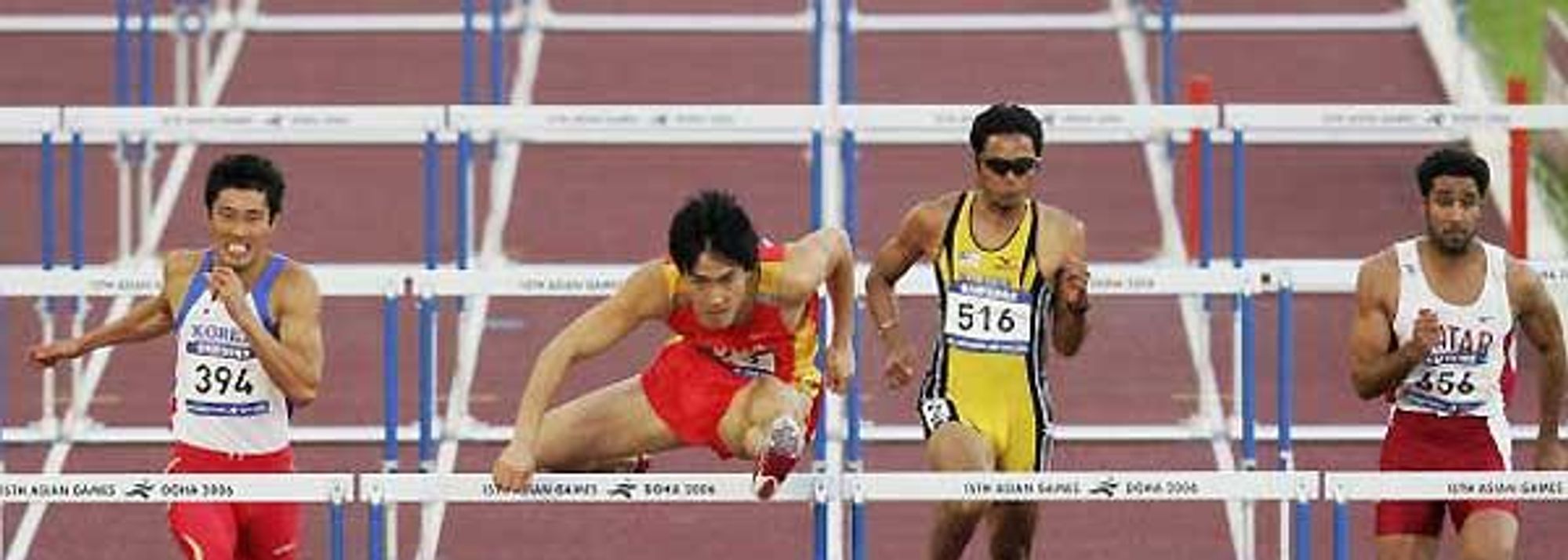


Liu Xiang storms to his 13.15 second win at the Asian Games (© Getty Images)
Another edition of the athletics in the Asian Games has come and gone, and China’s stranglehold on Asian athletics remains strong.
However, there has been no increase in their power, with 14 victories which is exactly the same as four years before in Korea. Also in terms of the minor medals there has been a minor reversal of fortunes from the peak of 2002 when 13 silvers and 13 bronze medals were taken, to the 9 second place and 8 third place spots secured at the 2006 Asian Games.
Yet despite such statistics China remains the colossus of Asian athletics well clear in Qatar of the Games' second-placed nation which was Japan with 5 gold, 9 silver and 13 bronze.
And with less than two years to go before China hosts the world’s biggest sporting showpiece, the Olympic Games in Beijing hopes for athletics success remains strong within the Chinese team.
Amidst the seemingly permanent media frenzy concerning everything that bears the name Liu Xiang, it is sometimes easy to forget that China had two athletics winners at the last Olympic Games in Athens. Xing Hunia, who missed the Qatar competition due to injury, was an overlooked bronze medallist at the Asian Games of 2002, and two years later spectacularly out-sprinted the African favourites to become the women’s Olympic 10,000m champion.
As determined to succeed in Beijing is Xue Fei. “I have yet to achieve anything,” said the 17-year-old World Junior champion, who took victory in the women’s 5000m race in Doha. “I am happy with victory in Doha, but my big goal is the Beijing Olympics in 2008.”
“Our country is making leaps and bounds in every aspect,” said the newly-minted Asian Games men's 400m Hurdles champion Huang Xiaoxiao. “We, as the athletes, are expected to follow the country’s progress and make the big leaps and bounds. I think we have tried to do that here in Doha.”
Twenty of China’s individual medallists, including Xiaoxiao, made their Asian Games debut in Doha, and their team is young.
It is the Chinese women’s squad which remains the dominant force winning ten of their fourteen gold medals in Qatar.
“Chinese women runners have always been strong,” commented Asian Games Pole Vault champion Gao Shuying. “We are also trying to win medals in the field events. Personally, I hope to keep up with this form.”
Topping the list of achievements in the field events was Zhang Wenxiu, who threw the only Asian record of the entire Athletics competition to win gold in the women’s Hammer. She says the success of Chinese field events, twelve medals, is down to good coaching and discipline.
“Hammer Throw is new in China and I used to throw the Shot Put. Based on the advice of my coach, I tried my hand at the Hammer and became successful. There is no secret to my success. I work hard, I listen to my coach, and I want to achieve more. I am not satisfied about my Asian record because I felt I could have thrown further. This is not only true for me, but for the athletes in Chinese team.”
Discipline is also an integral part of the Chinese approach to major competitions. There are no exceptions, not even to Liu Xiang, the country’s idol and World 110m Hurdles record holder.
"It is the end of the season, but we still have to work hard,” his coach Sun Haiping admitted before Doha. “If I have to, I will make Liu (Xiang) train until his head spins."
"My coach was just trying to keep me focused,” said Xiang. “I am now in excellent condition. An athlete’s career is very short and as long as you are competing, you have to try and run faster. I don't know how long I can maintain it, but I'll do my best."
And after Doha, Xiang believes that the gap between the performances of Chinese athletes and those who currently top the world in their events is getting smaller and smaller.
“The gap is getting smaller,” he said after defending his title in 13.15s. “The possibilities are endless as long as the athletes train well and listen to the advice of their coaches.”
One should never overlook the motivational aspect to any athlete of competing at an Olympics on home soil. Yet in the context of Beijing 2008 with the world’s most populous nation desperate to crown national sporting heroes to match its rebirth as a global economic power it is arguable that this national impetus will have its greatest ever influence on home performances at an Olympics.
Elshadai Negash and Chris Turner for the IAAF


