

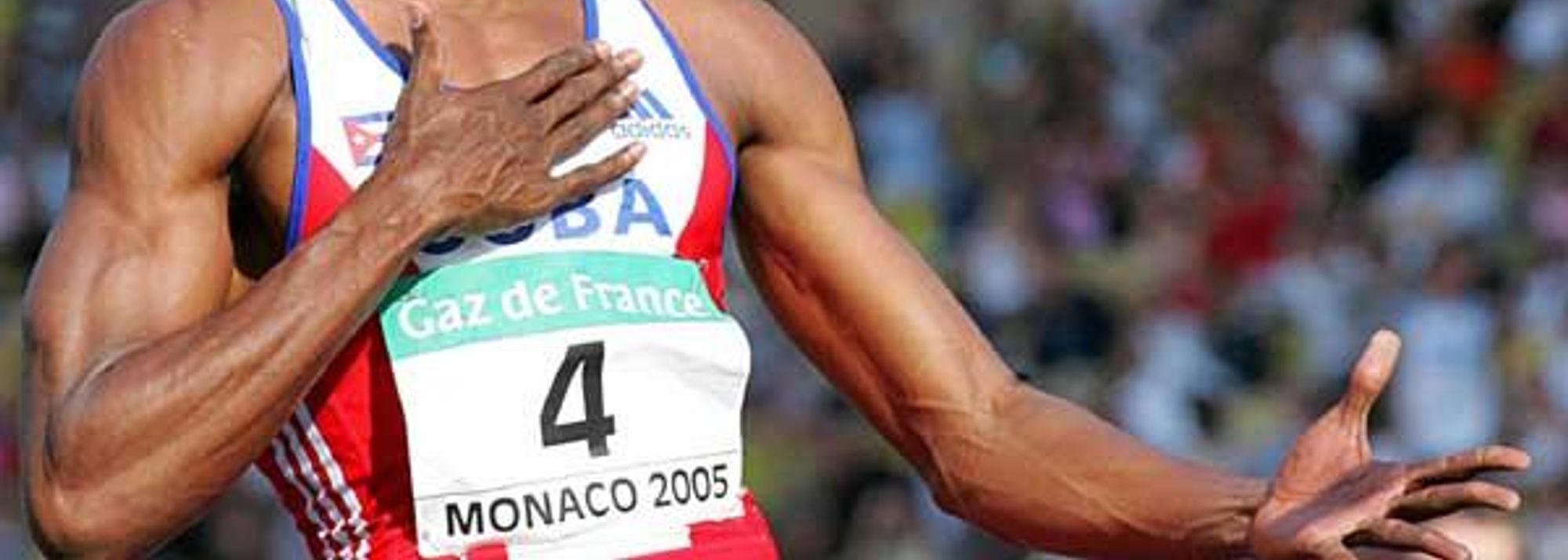


Victor Moya celebrates his 2.35m win in Monaco (© AFP/Getty Images)
Havana, CubaMagic Moya. That’s how Victor Moya’s 2.35m win at the World Athletics Final in Monaco was greeted last month. The new Cuban High Jump sensation has proved this summer that his country can still produce fine athletes in this event.
A 10-centimetre improvement in just one season, the World Championship silver in Helsinki, and third spot in the IAAF World Ranking for the event (he was 51st in 2004) confirms Moya’s sudden and impressive rise to the elite of his event, but he insists that the ‘magic’ is all about hard work and learning.
2.30m was the initial target of 2005
At the start of the year, the bar was set at 2.30m at the Estadio Panamericano in Havana. This was the goal of the new generation of Cuban High Jumpers, led by 2004 Olympic finalist Lisvany Pérez, and in their first meet of the 2005 season, on 27 January, Moya improved his personal best from 2.25 to 2.28 and started to dream of Helsinki. Both Perez and Moya made a short indoor tour of four competitions in Europe, where the Olympic finalist jumped 2.27 and the latter 2.23.
Their first training period ended at the National Championships in March. Both improved 2.29, just one centimetre from the IAAF ‘A’ standard (2.30), which would allow both athletes to attend the World Championships in the Finnish capital.
But it turned into a bittersweet story, as Moya was finally the lone Cuban choice for Helsinki, as neither could reach 2.30m in time, and his gold at the CAC Championships in Nassau, on 11 July, proved decisive for Moya, leading coach Bárbaro Díaz to name him in preference of Perez for the World Championship squad.
“It was very sad to see Lisvany out of team. Both have dreamed of Helsinki”, Moya recalls.
A shorter approach to the bar
Once in Helsinki, Moya was assisted by World record holder and six-time (two outdoor/ four indoor) World champion Javier Sotomayor, the new manager of the Cuban team, as his coach Diaz stayed in Cuba.
They worked on his weakest point, the run-up, and reduced it from seven to five steps. It would eventually work out in his favour.
World silver
A faultless qualification at 2.27 took him to the final. Two days later, he cleared 2.15, 2.20, 2.25 and 2.29 on his first try to share the lead with Russia’s Yaroslav Rybakov.
“When I jumped 2.29, I felt very excited as I saw my name leading the standings in the board. I have to say that it affected me a bit. I was so happy that I could not control myself,” Moya remembered.
However, a PB equalling 2.29 was good enough to reach the podium and share the silver with Rybakov, as Ukraine’s Yuriy Krymarenko was the only man who could clear 2.32, so taking the gold.
At the same time at the other end of the track, fellow Cuban Osleidys Menendez was improving her Javelin Throw World record to 71.70m to seal Cuba’s second best ever performance in the history of World Championships.
Two gold and four silver medals catapulted Cuba to the fourth place in the medal tally, behind only the United States, Russia and Ethiopia.
Just the beginning of 2.30+ success
Helsinki marked the beginning of 30 magic days for Moya. Before the World Championships, he had only competed in three IAAF Grand Prix events (1st at the GPII in Fort-de-France, 4th at the Athens SGP and third at the Prague GP II). But his silver in Helsinki earned him an invitation to the TDK Golden League meet in Zürich, where he jumped a rain-soaked 2.28 for second.
Two days later, he finally entered the 2.30m club with a second place at the Hochsprung in Eberstadt, Germany, thus becoming the fourth Cuban in history over that height following Sotomayor, Marino Drake and Juan Francisco Centelles.
"I was very happy to compete in Eberstadt, a High Jump only event, and to have finally reached the 2.30m mark in front of the world’s best”, he stated.
He would never be under that mark again in 2005, as he improved his PB to 2.31 for his first TDK Golden League win in Brussels, followed by second place (2.30) in Berlin, and his impressive 2.35 win in Monaco.
In the Principality, he cleared a PB 2.32 on his third attempt, but was still out of the top three positions in a quality competition. A successful first try over 2.35 moved him from fourth to first, and with it came a World Athletics Final record.
With all his compatriots returned home, Moya continued on in Europe after the Final, ending his season with his 23rd competition of the year, another 2.30m win at the Jumping Gala in Salgótarján, Hungary, on 17 September.
International experience the key to improvement
“I said that we needed to compete more internationally to reach 2.30. I was given the chance and the results are here. It is not magic. It requires a lot of hard work, training and sacrifice. I am very consistent and will try to maintain this consistency”, confirmed Moya, who thanked his first coach, former decathlon national record holder Luis E. Milanés, his current trainer Bárbaro Díaz, Javier Sotomayor, Jorge Luis Alfaro, Marima Rodríguez and Guillermo de la Torre.
"Sotomayor means a lot for all of Cuba. I grew up following all his wins and records. Comparisons are inevitable, but I am not his substitute. He is the best High Jumpes of all times and a role model for the generation of Cuban athletes. Having close to him in Europe gave me a lot of confidence”.
Moya first met Sotomayor at the 2001 National Champs, the year when the latter retired.
His origins – 'would be' sprinter turns jumper
Born on October 24, 1982 in the eastern city of Santiago de Cuba, Victor Rafael Moya Carvajal began to practice sports like many Cuban kids, doing Physical Education. His primary school sports teacher discovered his potential for the vertical jumps. His father Víctor Manuel Moya also practiced High Jump and competed at National Youth Games in the 70’s.
“I wanted to become a sprinter, but I began to grow up and lost speed. I did combined events in the school categories and took up High Jump at the age of 14,” said the 1.94m tall athlete.
His second coach, former national record holder Marima Rodriguez (1.83m PB in 1972), “taught me the competitive spirit and to jump aggressively. I enjoy competitions”.
After jumping 2.21, he joined the national team in 2001. A year later he made his international debut with an eighth place at the 2002 Iberoamerican Champs in Guatemala.
In his limited free time, he studies Physical Education and shares his sentimental life with beach volleyball player Kirenia. He travels to his native Santiago de Cuba twice a year to visit his parents and childhood friends. He also loves to read, listen to music and talk to his friends.
Moscow is the aim - Back to training for 2006
After a four week rest, Moya has resumed training this week, focusing on the 11th IAAF World Indoor Championships, to be held in Moscow, 10-12 March.
“The most difficult task comes now, to continue at the world elite. I want to stay consistent over 2.30 as I was in 2005. I had planned to reach 2.35 in 2008 for the Olympic Games, but I achieved it this year. I can’t improve that much in one year, but I can definitely better my PB”, he explained.
Two other major objectives for 2006 include the Central American and Caribbean Games in Cartagena de Indias, Colombia, and the World Cup in Athens.
“This 2.35 (of mine) is a great incentive for the young athletes to aim at higher goals. Lisvany Perez, Yunier Carrillo (2.26) and Dailén Ortega (2.23) can also reach 2.30. We inherit a successful tradition with great names and we want to show that the Cuban High Jump School is alive,” Moya concluded.
Javier Clavelo Robinson for the IAAF

