

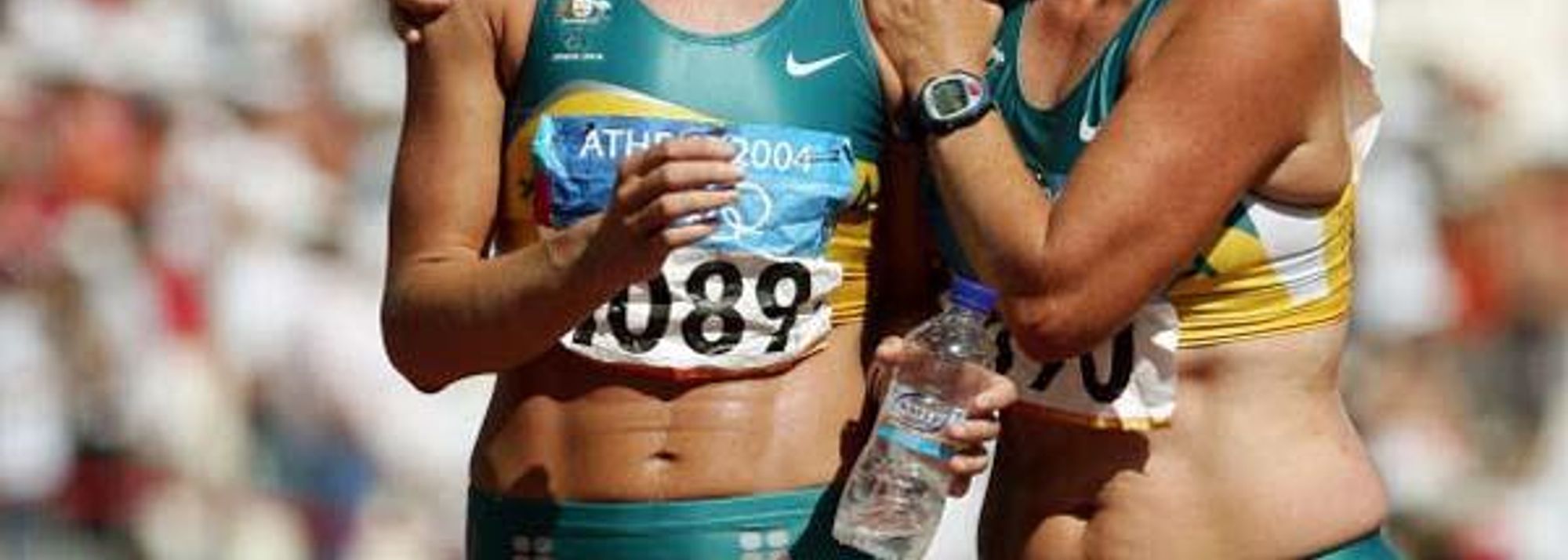


Jane Saville is congratulated by sister Nathalie after winning bronze in the 20km Walk (© Getty Images)
Jane Saville will be forever known as the race walker who nearly did. But the 34-year-old Australian, who announced her retirement last weekend after succumbing to on-going shin injuries, is surprisingly philosophical about one of the Olympic Games’ most dramatic moments which saw her disqualified 200 metres from a gold medal.
Leading into the stadium on home turf at Sydney in 2000, she was shown the dreaded red paddle just as she began to celebrate. Her horrified face was replayed thousands of times around the world, and millions who wouldn’t have known Race Walking from jaywalking suddenly had an opinion about the sport.
For a while, Saville’s and Bernardo Segura’s DQ in the men’s 20k unwittingly putting the sport’s place at the Olympics under the microscope.
Just last week, and more than eight years later, a gym instructor in west London referred to the discipline as ‘speed walking’ and asked if anyone remembered that ‘poor girl who was disqualified just as she…”
Saville reportedly asked for ‘a gun to shoot myself’ straight after, but now sees the infamous moment as something of a bonus.
Australia had already lined up Ian Thorpe and Cathy Freeman as home-grown heroes along with 13 other gold medallists, and had Saville not been removed she would almost certainly have disappeared as just another gold-and-green winner.
But not only did her DQ give her the will to keep going – it made her strong enough to post an impressive 87:44 PB for 20k four years later as well as a glorious bronze in Athens at the next Olympics.
“I’ve never followed the pack,” she said, “so being known for something different is not the worst thing. It put race walking out there, and a lot of people who didn’t know about the sport, now do.”
“But I often think that a lot of people forget that I got a bronze medal next time, as well as three Commonwealth Gold medals in a row.”
The first of her Commonwealth Games titles which saw her beat her idol Kerry Saxby for the first time in a major event in Kuala Lumpur in 1998.
Sleepless before the race, the win marked the focus in Australian women’s walking from the tough Saxby to the slighter Saville, who’s topped her country’s rankings without break ever since.
But her slim build has also been her downfall – at least in the last couple of years. She went to her third Olympics in Beijing hoping to disguise injury problems, and ended up with a half-decent 20th-place finish.
Secretly hoping she could ‘have at least one more year’ of racing, even if that meant missing the IAAF World Championships in Berlin, Saville’s return home to Bronte, a beachside suburb of Sydney, convinced her she was unlikely to recover from her shin problems.
She said: “I could race walk with another groin-related problem, but not the shin.
“And anyway, I wasn’t sure I wanted another year of struggling to keep fit. Another 20th-place in Berlin didn’t appeal. If you can’t do this event 100 percent – it’s not worth the effort.”
Despite putting on seven kilos since August, Saville has not been idle. She’s in the middle of single-handedly organising a fun-run and walk event in Sydney next month. She’s also an elected member of the IAAF Race Walking Committee, and plans to add a new generation of Savilles to walking, although they will be called Whites.
She and husband Matt White, a professional cyclist, want to start a family who might add medals to the family mantelpiece.
Asked whether she was prouder of her Olympic bronze or her fourth at Naumberg in the IAAF World Walking Cup in 2004 for a superfast PB, the response was instant.
“Times come and go – even the fast ones,” she said, “but a medal is forever.”
Although to millions who know nothing else about race walking – it will be the medal cruelly snatched out of Saville’s grasp.
Those on the inside will have a different perspective.
Walkers and other athletes recognise you don’t get to lead the Olympic 20k, no matter what the conclusion, unless you’re extremely talented in the first place.
Paul Warburton for the IAAF

