

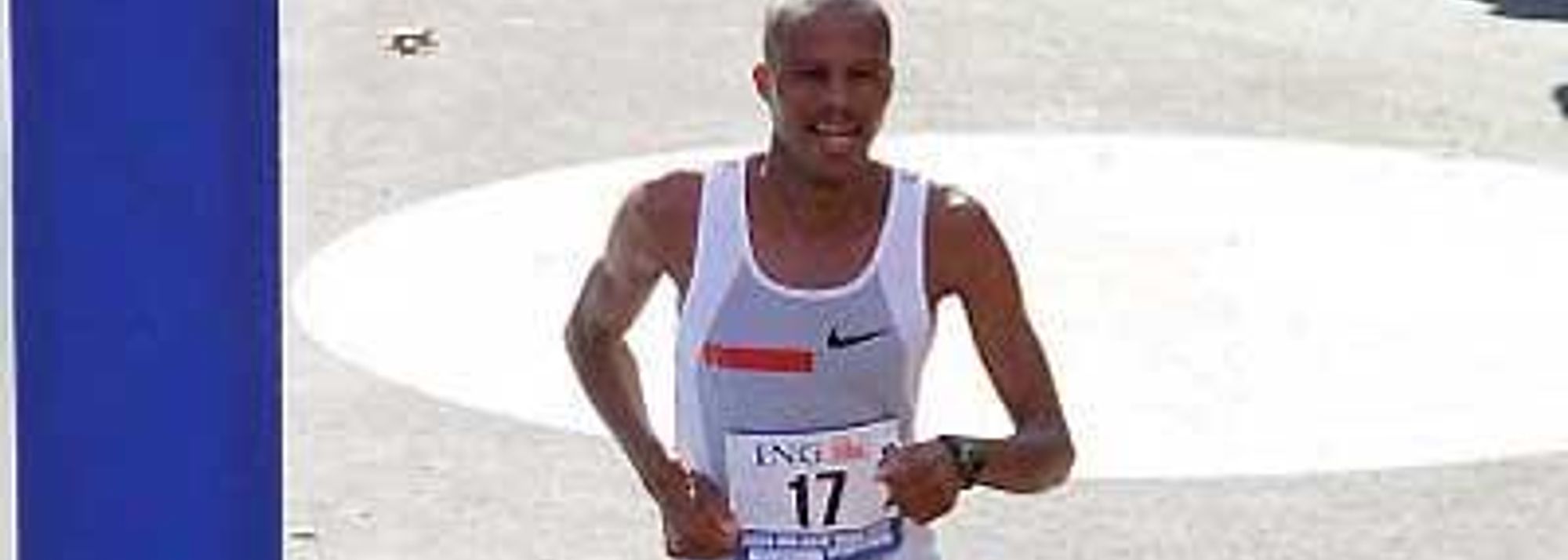


Hendrick Ramaala (RSA), the 2004 New York Marathon winner (© Getty Images)
Hendrick Ramaala’s victory in the New York City Marathon last Sunday (7 Nov) finally proved the South African does have what it takes to a be a world-class performer over 26.2 miles.
The race in the Big Apple was the first time Ramaala had finished higher than fifth in a major marathon - he won in Mumbai, India on 15 February 2:15:47 - since he turned to the event in 2000.
“I’m notorious for being a bad marathon runner,” he joked afterwards. “They told me, ‘You are good in the half-marathon.’ I always knew I could win a big-city marathon.”
A frozen drop-out
Renowned as one of the world’s leading distance runners for several years, the personable 32-year-old law graduate excited much interest when he lined up for his first marathon in Chicago five years ago.
After impressive performances over 10,000 metres and the half-marathon, including finishing second in the 1998 and 1999 IAAF World Half-Marathon Championships, Ramaala was tipped as the hottest new talent over the distance.
Unfortunately. the weather, relatively balmy in the days leading up to the race, changed, and the temperature plummeted to zero degrees. The chill Chicago wind made it seem even colder and at 15 miles Ramaala, freezing in a short sleeve vest, could run no more and dropped out in a race that Khalid Khannouchi set a World record of 2:05:42.
“It was embarrassing afterwards having to explain to South Africans that I had dropped out because of the cold when a runner born in Morocco was able to break the World record,” he said later.
Ramaala finished fifth in his next attempt, in London the following April, in 2:09:43. But the only time he had broken 2:10 since then was again in London last year when he finished eighth in a personal best 2:08:58.
In control all the time
He did not need to run that fast on Sunday to beat America’s Olympic silver medallist Meb Keflezighi but New York is a notoriously more difficult course than London and temperatures were a relatively warm and humid 62 degrees, although that was probably a bonus to Ramaala.
But the victory, which was worth $130,000 in prize money and bonuses plus a car, was the most important thing to Ramaala, who had run New York twice before, finishing fifth in 2001 and 14th in 2002.
“When I had run before I was not in control and got carried away, running too fast too early on the gentle hills,” he said. “Today I was in control all the time.”
Missed the tape
Victory also helped make up, like it did for Britain’s Paula Radcliffe, winner of the women’s race, for dropping out of the Olympic marathon in Athens with a groin injury with a groin injury.
“I am very relieved,” said Ramaala. “I always said I would be a marathoner one day. I finally made it.”
Yet, not surprisingly, Ramaala, who broke away after 17 miles, was not convinced something was not going to happen to deny him his moment of glory.
“I was scared, thinking the finish is still too far,” he said. “Only the last 100 metres when I turned back and the guys weren’t there did I say, ‘This is wonderful’.”
His only mistake on the day was being so deep in concentration he did notice the race director Allan Steinfeld and the New York City Mayor Michael Bloomberg standing on the finish line holding a tape and he mistakenly crossed under a different line.
“I am sorry and I would like to apologise to Mr. Steinfeld and the Mayor,” he said the next day. “I did not see them.”
Steinfeld joked that was okay because he had never won a major race before. “Maybe he didn’t know what the tape meant,” joked Steinfeld. Even Ramaala smiled.
Never give up
Ramaala, who has a law degree from Witswatersrand University in Johnannesburg, had not started running until he was 20. He played football but found that team sports did not suit him. When trainers tried to dissuade him running, he decided to coach himself. “I refused to be pushed around,” he said.
Ramaala became only the second South African to win the New York race, following Willie Mtolo in 1992. “Today shows that South Africa has the talent to be successful,” he said. “We have to get it right.”
And who better than Ramaala to demonstrate to his comrades with his performance in New York what the rewards are if they never give up and continue to believe in themselves.
Duncan Mackay for the IAAF

