

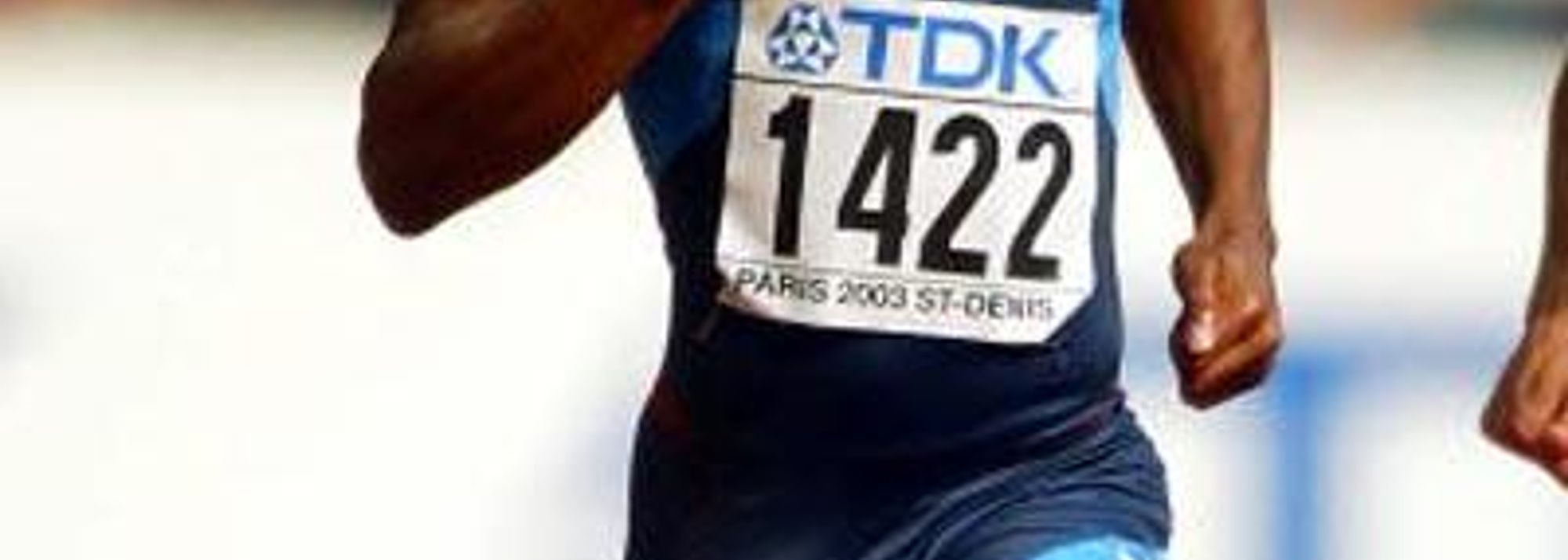


Darvis Patton of the USA in the 200m heats (© Getty Images)
If aficionados of the men's sprint scene thought 2003 was a wildly unpredictable year, it's very likely that they can expect even more uncertainty in 2004. Among those in the mix will be Paris 200m silver medallist Darvis Patton, whose aim next season is a simple one: to remove some of that unpredictability.
"I'm on a mission in 2004," the personable sprinter says, and like others whose eyes are firmly cast on Athens, he's very hungry. "I got a little taste of it this year, but now I want the whole pie."
Fredericks - “one of the best”
A ten-time All-American at Texas Christian University, Patton emerged from the collegiate scene in 2001 with respectable 10.14 and 20.29 PBs, along with an 8.12 best in the Long Jump, the event that brought him to the sport as a bright-eyed fan of Carl Lewis as a junior in high school. But it was in 2002, he recalls, that he found his confidence as a force to be reckoned with on the world stage. That July, he finished second to Frank Fredericks ' 19.99 in Rome's Golden Gala.
"After that, I knew I could run with the best," he said, "because he's one of the best 200 metres runners of all-time. Running with Frankie Fredericks let me know that I could run with anyone in the world."
He clocked 20.14 in that race, won three of his four remaining races over the distance, and ended the year with a 20.12 PB as the top ranked half lap sprinter in the USA.
A 9.97 bang and then a first national title
After a handful of indoor races, he began this year's outdoor season with a bang, riding a 2.9 m/s wind to a 9.97 win in Fort Worth in late April, and followed up with a 20.38 to finish second in a virtual dead heat with John Capel in a bitterly cold torrential downpour at the Adidas Oregon Track Classic in late May. He quickly returned the favour at the US Championships a month later.
"I knew I had a pretty good chance of winning the race," he said of his 20.15 win in Stanford to earn his first national title. "The field was pretty equally matched but it came down to good training and who was going to be more poised at the end of the race. I came close last year, with second, and I knew if I did the same things I did last year but a little better, I knew I had a good shot at winning." He edged Capel by 2/100s, signaling the beginning of a friendly rivalry with the Sydney Olympic finalist.
"Yeah, you can call it a friendly rivalry," he says. "Off the track we call each other when we get a chance to, and we talk trash to each other. But it's just innocent fun. We laugh and joke about it. He'll call me and tell me that he's going to bust my head, and I'll call him and tell him I'm going to bust his head."
Friendships are what sport is all about
Patton savours the kinship that training and competition fosters. "That's what it's all about," he says. "If we can be friends off the track and still be competitive on the track, it makes the sport a lot better. From what I've heard, in days back, you had some guys who didn't want to be friends, they couldn't talk to each other if they saw each other in the lobby of the hotel. That's just taking it to the extreme. If you can't talk to one of your competitors, then why run?"
Paris Final – I wasn’t aggressive enough on the curve
The rivalry continued at the World Championships, and Patton, much like the American General with the same name did 58 years before, landed in France prepared for battle. After a pair of easy wins in the opening rounds, Patton, whose nickname "Doc" predates his first birthday, sped to a 20.03 win in the semis, a performance that would hold up as the year's third fastest.
"I wasn't trying to run that fast," he says. "It wasn't all adrenaline, it was just the kind of shape I was in at the time. I was in a comfort zone. I wasn't pressing, I wasn't trying to go too hard. I was really relaxed, and the time just happened to come out as 20.03. If you ask my coach, he said it looked like 20.30."
Run in cooler and slightly wet conditions, the final was considerably slower but thoroughly enjoyable, with Capel getting the win in 20.30 by the narrowest of margins. "I think I wasn't as aggressive on the curve as I had been earlier in the rounds," said Patton, who was clocked in 20.31. "I think that if I had been a little more aggressive on the curve, it would have put me in position to win the race."
The guy could barely walk
But there may be more to the story. "What Doc will not tell you, and I know he'll hate me for this," Patton's agent, Claude Bryan interjects, drowning out Patton's protests in the background, "that the morning of the final he woke up with a very bad knee. In fact the guy could barely walk. It was the left knee, so he had a problem negotiating the curve. So he conserved and tried to make it back up on the straightaway."
But Patton refuses to accept his agent's side note. "People always have excuses," he said. "I don't like excuses. I came there ready to run, and I should have run. My motto is, 'don't step up to the plate if you're not ready to run."
World Relay Gold
Despite the narrow loss, he describes Paris as a "wonderful experience." Particularly the unanticipated gold medal as the third leg on the 4x100 relay squad.
"That was almost like a dream," he readily admits. "The whole World Championships experience was like a dream to me. I remember in '97, '99, 2001, watching at home on my couch. I could actually remember sitting on the edge of my seat, waiting for the 4x100 to go off. And then for me to be there, and run the 4x100, was just amazing. Then to come out with gold, it was even that much sweeter."
Perhaps overshadowed by his silver in Paris was a 10.00 PB in Zurich, equaling the 10th fastest 100 metres performance of the year. In an incredible display of speed, his performance was also the fifth fastest in Letzigrund Stadium that evening, underscoring the depth in the sprints this year. "That was fun," he said. "I knew I had a 10.0 in me, I just didn't know when it was going to come. I think I was more excited about the 10 flat than I was about the 20.03."
“In 2004, the 200 is all mine”
Entering the Olympic year on the edge of sub-10 territory, Patton has no intention of deserting the short dash. "You can't run 10.00 and not like the 100," he said, adding that the upcoming season's preference, albeit a slight one, will be on the longer dash. "I feel like I have a point to prove," he says, again alluding to that hunger. "Someone just gave me a piece, and I want the whole thing. In 2004, the 200 is all mine."
Patton still trains in Fort Worth under Texas Christian head coach Monte Stratton, along with world 100 metres champion Kim Collins and Ricardo Williams, a Paris semi-finalist in the 200. Although the trio's schedules don't always mesh, they do take to the track together on occasion. "It works out best when we're all lined up side-by-side, knowing that you are practicing with one of the best guys in the world."
While some athletes curtail their competitive appearances preceding the Olympics, Patton says he has no such plans. "It worked out perfectly," he said of his 15-race schedule this year. "I just didn't win the gold. If I had won the gold, you could have said it was the perfect plan. So I think we're going to stick with that."
Improving Consistency
Improving his consistency will be the main item on his agenda. "One race I might run 20.50, and then come back with a 20.20 and then run a 20.40. I have to try to be consistent with 20.20s."
Lewis and Johnson are heroes
In his formative years as an athlete, he aspired to the heroics of Carl Lewis and Michael Johnson, but now he's ready to blaze his own path. "I wish I could follow in his footsteps," he said of Johnson. "But I'm Darvis Patton. I've got to make my own footsteps. I want people to say, 'I want to be like Darvis Patton.' I want to make a name for myself."
And he's allowing plenty of time to create that name. He plans to compete until the 2008 Olympics, perhaps longer. "Until my legs say, 'you just can' t do it any more.' It's not like a job to me yet. It's not like an obligation. It's still fun to me."


