

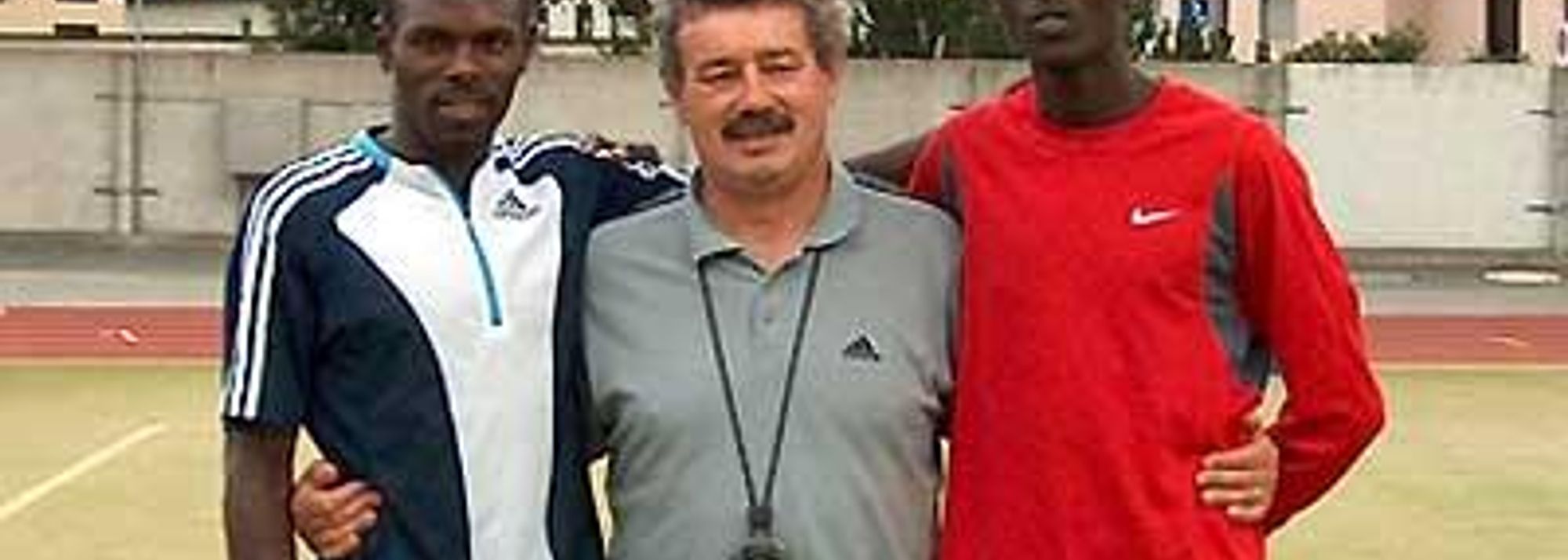


Ghidini with Bungei (left) and Kamel (right) in Davos the day after Weltklasse (© Zorzi)
Just imagine, the three best athletes this year’s Weltklasse's 800m are based and train together in the small North Italian town of Bussolengo: Kenya's Wilfred Bungei (1:43.06, world leading mark) and William Yiampoy (1:43.29) in the "A" race, and the surprising Youssef Saad Kamel of Bahrain (1:43.11) winner of the “B”.
Halfway between Verona and Lake Garda
All three athletes are coached by Italian Gianni Ghidini in Bussolengo, a town of 18-thousand-people, situated halfway between Verona and Garda Lake. They live in an apartment very close to the city’s track, where they usually train with the younger local athletes. They also have a 12-km running course for longer training.
The group also includes other Kenyan 1500m runners, Robert Rono (PB 3:30.99 in 2002) and Timothy Kiptanui, who ran in 3:30.04 (the 3rd best time in the world this year - Paris) in Paris behind Bernard Lagat, with whom he is going to represent Kenya in the Olympic Games.
Kamel will run in Athens for Bahrain, as will Bungei for Kenya. Yiampoy who was 4th in the Trials, must watch the Games on TV.
Kiptanui’s story is really interesting, as he was born in the same year as Bungei (1980), just one hundred metres from his house in Kapsabet. In 2001 the neighbours became training-mates, and in 2003 he also joined Ghidini's group.
The man who launched Bordin and discovered Benvenuti
Ghidini knows the two-lap event very well. In 1985, after training for seven years – from 1977 to 1984 – the future Olympic and double European marathon champion Gelindo Bordin, he then discovered the talent of Andrea Benvenuti, who was then 16-years old.
Coached by Ghidini for his whole career, Benvenuti reached the top in 1992. He was 5th at the Olympic Games in Barcelona, ran his PB with 1:43.92 in Monaco, set an Italian 1000m record (2:15.76), and won the IAAF Grand Prix Final in Turin.
Benvenuti was a very talented athlete, but his feet were really delicate. In 1993 he did not finish his World Championships heat in Stuttgart. However, a year later, he won the European title in Helsinki.
After skipping completely the 1995 season, he tried to enter his second Olympic final in Atlanta, but gave up after 500m in the semi-final. The Olympic gold was taken by Norway's Vebjorn Rodal, the man Benvenuti had beaten two years before in Finland.
His career stopped there, as in the following years he could never get back into shape. Nowadays he is married and works as a physiotherapist in San Marino.
Bungei – family ties with Kipketer and Rono
Benvenuti sometimes comes back to Bussolengo and has a look at the new stars. It was in 1999, when Benvenuti was definitively retiring, that Ghidini started the Kenyan challenge with Bungei and Yiampoy.
Born in Kapsabet, Bungei, who had already won the World junior bronze the year before in Annecy, was taken on by Italian manager Gianni Demadonna who entrusted him to Ghidini.
Bungei has athletics in his blood, as among his mother's cousins are Wilson Kipketer's mother and the great Henry Rono, who in 1978 set World records in 3000m, 5000m (improved again in 1981), 10,000m and Steeple.
In his first year with Ghidini, Bungei set a PB of 1:45.14, then in the 2000 Zurich Weltklasse he improved his best time to 1:44.23. In 2001, he went under 1:43 for the first time, taking third in Zurich again with 1:42.96, the week before he had taken the World silver medal in Edmonton, behind Andre Bucher.
Yiampoy – Directly to the top
Yiampoy is a Masai (though he is "just" 180 cm tall), a senior Kenyan Police official , and has had an even faster journey to the top. In 1999, in Barcelona, he closed out his third race in Europe with a very good 1:44.38. Since then he has had a very similar career to Bungei, who is 6 years younger than him.
Curiously in 2000, he ran exactly the same time (1:44.23) and took the same place in Zurich as Bungei, but in the "A" race. He also ran many other sub-1:45 times.
In Edmonton he probably was a little stronger than Bungei, but he risked all for the gold and tried to attack Bucher on the back straight. In the final 100m he paid for the effort and was out-sprinted also by Poland's Pawel Czapiewski, finishing ‘only’ 4th. Some days later in Zurich he finished just 4 hundredths behind Bungei in a PB of 1:43.00.
Also unforgettable was the race in Rieti in 2002, which was one of the fastest ever. Coming out of the last bend Bungei and Yiampoy got in each other’s way and in the confusion Kipketer passed them both and won the race.
In the process, Kipketer set the fastest time of the year (1:42.32) and Bungei was second with a PB of 1:42.34. Yiampoy lost more ground but set a 1:42.91 PB as well. If they had not hindered each other Ghidini is sure that they both could have run a sub-1:42 time.
Unlucky 2003 season
The 2003 season was unlucky for both, but for different reasons. In the first race of the year in Milan, Yiampoy was beaten by the World champion Djabir Said-Guerni. He finished the race with a bad cut which needed a dozen stitches and tragically he was forced to skip the whole season.
By contrast Bungei started the year in an amazing way. After taking the World Indoor bronze medal during the winter, he had three wonderful wins in a row during the first half of June - Hengelo (1:43.06), Seville (1:43.62) and Ostrava (1:43.24) - but in Oslo he was out-sprinted by Mulaudzi and finished in 1:44.15. He then won in Lausanne (1:44.53).
However, he ‘lost’ the most important battle of the year. During the Kenyan Championships some weeks after, he had a bad bout of bronchitis. He was forced to be treated in a Nairobi hospital and skipped the race, and so did not have the opportunity to qualify for the World championships in which he would have started as the favourite.
The illness was originally reported as malaria but it was evidently a misunderstanding, as just a month later he was on the track again, running 1:44.73 in Berlin and 1:44.70 few days later in Zurich. Late in the season he showed he had completely recovered, winning in Brussels in a wonderful 1:42.52, the best time of 2004.
Friendship off the track
Bungei and Yiampoy are also great friends. Yiampoy has been married for almost ten years and has an 8-years old son, and Bungei is going to get hitched on 17 December to his fiancée Priscah.
Konchellah's son - Last but not least
And then there is the new star of the group, Youssef Saad Kamel, who surprised the world in Zurich this month. Before his Weltklasse win, he had a PB of 1:44.51 set in Madrid last 17 July. The surprise grew when everybody realised that he was the eldest of the four sons that former double World 800m champion Billy Konchellah had with his first wife.
His father’s tactics was unforgettable: until 150m to go he would stay at the back of the group, then his sprint was something fabulous. Some coaches say that Billy Konchellah trained very little. If he had trained as a top athlete usually does, they think he would have been the first man under the 1:41, perhaps even the 1:40 - wall.
In Italy since last year
Last year Kamel-Konchellah spent three months in the summer in Bussolengo, and ran his PB in Turin with 1:45.88, and then was a pacer in some races.
On 23 November, he switched his nationality from Kenya to Bahrain, attracted by the money (he has now about $1000 every month), but also by the easier possibility of making the team for Championships, as in Kenya it always difficult.
World record in a few years?
"When I saw him running for the first time, I was really amazed," Ghidini remembers. "I was impressed by his beautiful style and lightness".
"I think seriously that in two years this guy can break the World record," another Italian coach Renato Canova said after the race.
He just needs more discipline. "When he is in Kenya, I don't really think he follows my full training programme, more probably just a little more than a half of it, so we decided he had better to stay in Italy with us," Ghidini said. "This winter he came for two months and now he has been here since April".
A more-than-two-second-and-a-half improvement in just few months seems to prove that the choice has been right.
Alberto Zorzi for the IAAF


