

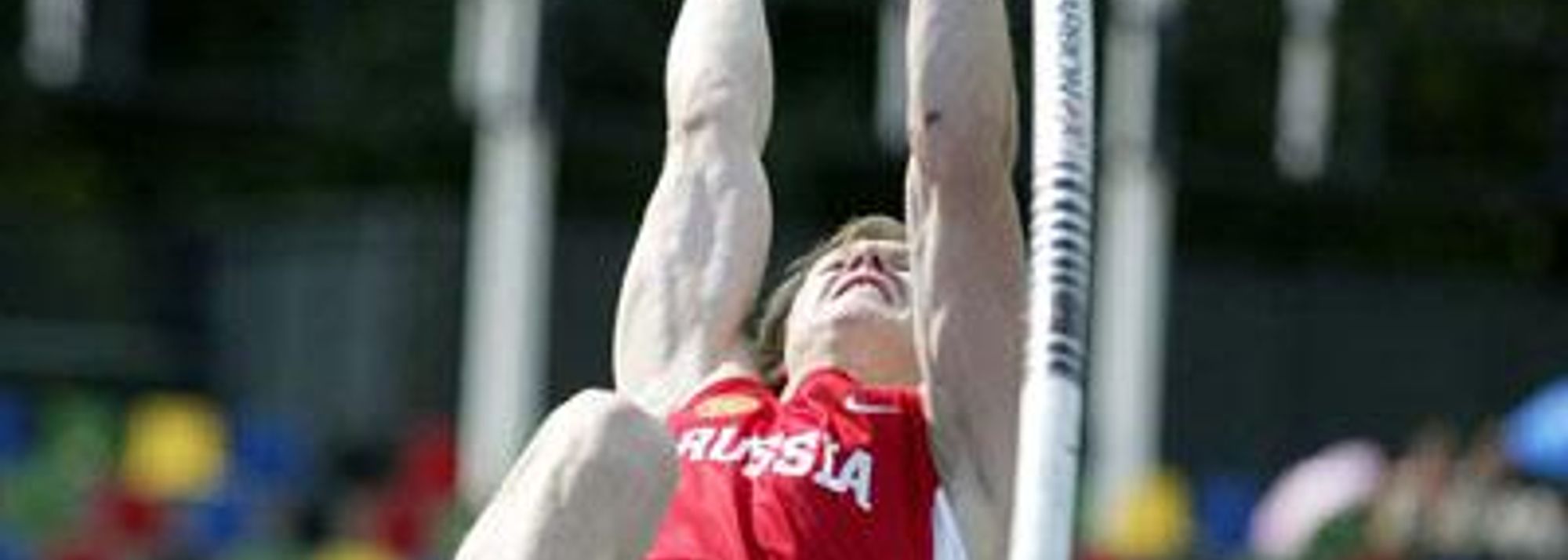


Leonid Kivalov (RUS) springing to victory in Hengelo (© Mark Shearman)
Part of the joy of junior championships, whether at world or continental level, is watching future stars of the sport establish their credentials, a feat certainly achieved at the 19th European Athletics Junior Championships by Russian pole vaulter Leonid Kivalov and Romania's 800m winner Mirela Lavric on Sunday (22).
Kivalov in pole position
Kivalov held his nerve in difficult conditions to equal the 18 year-old Championship record held by his compatriot Maksim Tarasov.
Three years after Tarasov won at the 1989 Championships in Varazdin, which were held in what is now Croatia, he became the Olympic champion and it would be not beyond comprehension to suggest that the 19-year-old from Stavropol could make his mark in similar fashion.
Kivalov went over his winning height on his first attempt before failing three times at what would have been a personal best of 5.70m.
Lavric won her event in equally emphatic fashion with a terrific turn of speed over the final 150m to overtake Britain's Emma Jackson 30m from the line before stopping the clock in a personal best in 2:02.84.
Even more impressively, Lavric has only just turned 16 and will be eligible to defend her title in Novi Sad, Serbia, in two years time.
"Winning the 800m at the World Youth Championships last weekend gave me a lot of confidence that I could win here. Even though the British girl was in front, I never panicked because I knew I had a very fast finish, that's my strength. Watching Cristina (Vasiloiu) win the 1500m yesterday (21) was also a big inspiration," said Lavric, who should be a force to be reckoned with at next year's IAAF World Junior Championships in Athletics.
Vasiloiu gets second victory
Shortly after being the inspiration for one gold medal, Cristina Vasiloiu added another to her name when she romped to victory in the women's 3000m.
Four women were together at the bell but Vasiloiu used the sprint finish she had demonstrated so effectively when winning her earlier event to take her second gold medal of the Championships in 9:31.51, and became the first women to notch up such a double at the Championships.
"I felt a little tired after the 1500m but neither that race nor this was so fast that I had any big problems," said Vasiloiu, who has a best of 8:56.07.
Poland's Artur Noga fulfilled his own expectations, and those of a boisterous contingent of his fans in Hengelo, when he sped to victory in the men's 110m Hurdles, over 99cm barriers, in a Championship record time of 13.36.
"Having won at the World Junior Championships last year, I felt that the pressure was on me. It was my race to lose but I'm in good shape despite a painful ankle so it was my day after all," said Noga.
Another impressive hurdling performance came from Russia's Aleksandra Fedoriva in the women's 100m Hurdles.
Three barriers from home, France's Laetitia Denis held a slender lead over Fedoriva but the Muscovite accelerated over the final two hurdles to win in a national junior record of 13.12, taking seven-hundredths off a standard that had stood for 26 years.
The mark of De Zordo
Germany's Matthias De Zordo rose to the occasion when he hurled the javelin out to 78.09m in the fifth round, a distance only he has beaten among European juniors this season.
"I know many people thought I was the favourite but I wasn't counting on the gold medal as there were other good throwers here. I was nervous at the start but the 20 minute break in the middle of the competition because of rain was good for me. I could calm down and concentrate," reflected De Zordo, who is coached by former German champion Boris Henry.
However, there were plenty of upsets as well, perhaps the biggest coming from Finland's Arno Laitinen who won the men's hammer with his first round 71.94m.
"I was aiming to get a big throw out in the first round like all hammer throwers want to do and I was reasonably happy with it for myself but I thought it would only be good for maybe eighth place as there were a lot of throwers who have gone over 73m this year," said Laitinen.
"I don't have an answer to why the other throwers didn't produce a big distance, I can't believe that they were disoriented by my first throw," added Laitinen humbly.
Russian gold rush
Russia's Alexander Bulanov had struggled in the Shot Put qualifying competition on Saturday (21) to make the final but bounced back with a massive heave of 19.95m in the second round to take the gold medal.
Bulanov's effort added 28cm to his personal best, equalled the best mark by a European junior this year and for good measure he had three other throws which would have won him the gold medal.
His discus throwing compatriot Vera Karmishina found a perfect quartering wind to produce a massive personal best of 56.16m in the first round, more than two metres more than any European junior had thrown this year and nearly three metres better than she had ever achieved before.
The two Russian throwers contributed to their country's haul of 10 gold medals in Hengelo, their best tally since the era of the Soviet Union and which propelled Russia to the top the medal.
Another notable winners among the 18 finals contested on the last day included the wind-assisted 14.02m women's Triple Jump victory by Estonia's Kaire Laibek, the 2006 World Junior champion.
Phil Minshull for the IAAF

