

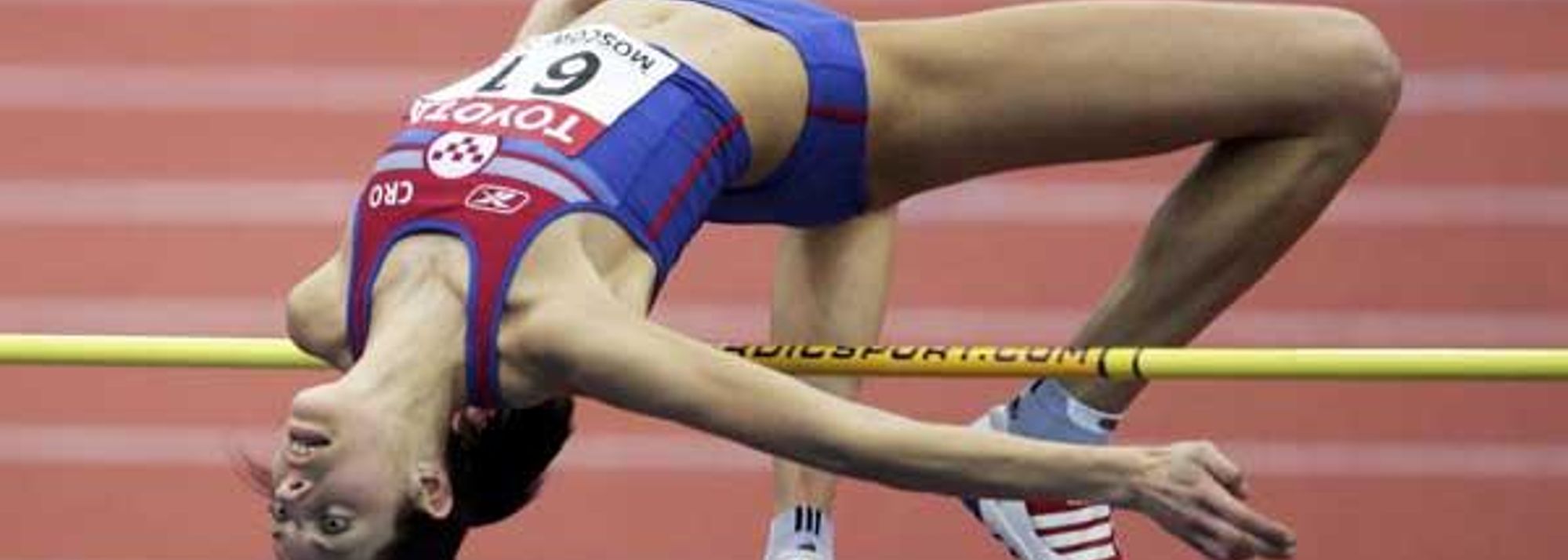


Blanka Vlasic of Croatia during the High Jump qualification (© Getty Images)
It has taken twotime World Junior champion Blanka Vlasiè a long time to confirm her immense talent in the senior ranks. But as Bob Ramsak report her 2006 World Indoor Championships silver may only just be the start of the Croatian’s breakthrough
When Stefka Kostadinova raised the World Record in the high jump to a seemingly impossibly high 2.09m on 30 August 1987, Blanka Vlasiè had not yet celebrated her fifth birthday. Now, 19 years later, after the best indoor season of her career and recent injury and illness woes behind her, that 2.09m standard set by the Bulgarian legend so long ago no longer appears so, well, impossibly high for the rising Croatian star.
While a serious assault by Vlasiè on Kostadinova’s record may seem on the surface as rather unlikely, her towering 2.05m clearance in Banská Bystrica, Slovakia, in February, one that capped a long string of national records indoors this year, provided ample evidence that Vlasiè has finally landed among the event’s all-time elite. Suddenly, she only trails recently-minted World Indoor record holder Kajsa Bergqvist of Sweden, who jumped 2.08m ten days earlier, and former standard bearer Heike Henkel of Germany, who had held the record at 2.07m for fourteen years, as the highest jumpers ever indoors.
To more clearly illustrate that she firmly belongs in such prominent company, Vlasiè continued to jump that evening and eventually offered a remarkably close attempt at a would-be World record of 2.09m.
No, no longer impossibly high.
Hers is not a new name on the international scene, which makes it difficult to remember that she is still just 22. But now armed with a pair of World Indoor Championships medals, she is finally beginning to tap the precocious potential she displayed after becoming the only back-to-back World Junior High Jump champion.
The product of a sporting family - her father Joško still holds Croatia’s national record in the Decathlon, a 7659 tally from 1983, and her mother was a basketball player and national level cross country skier - Vlasiè took on an athletics lifestyle when she was very young. As a coach, she said, “My father was on the field all the time. Sometimes when I couldn’t stay home alone, he brought me along. So I started to like it there.”
Vlasiè, who lives in the Adriatic resort town of Split, is coached by her father, who is also a basketball trainer, and Bojan Marinoviè, who lends his technical expertise. “We are a very good team,” she said. “It’s not boring when you have two coaches.”
At first, she remembers, she wanted to be a sprinter. “When I was young, I wasn’t interested in the High Jump. I was hoping that I would some day be a sprinter. But when I grew up, I was very skinny, so when I tried it, I fell in love with it. I tried everything before I decided on the High Jump.”
Others encouraged her to try more lucrative sports like basketball or volleyball, but carved out of a mold of fierce independence, she resisted. “I was very stubborn, and I didn’t like group sports. I like to work alone. When I make a mistake, I make it on my own. I’m guilty of that. And when I win, it’s all mine.”
By the summer of 2000, before her 17th birthday, she was already jumping 1.93m, made her first Olympic appearance, and arrived at the World Junior Championships in Santiago, Chile, as a clear podium threat. There, she defeated defending champion Marina Kuptsova with a 1.91m leap to take home an unexpected gold.
She improved to 1.95m the following year, finished a notable sixth at the World Championships in Edmonton with a 1.94m leap and not yet 18, was already a regular fixture on the senior circuit, earning invitations to the world’s finest meetings. When the next World Junior Championships rolled around, she arrived in Kingston as an overwhelming favourite. She didn’t disappoint, improving to 1.96m to win by a massive nine-centimetre margin. She capped her final junior season by finishing in a tie for fifth at the European Championships.
2003 was her breakout year. Still 19, Vlasiè began the year with her 1.96m personal best from Kingston and quickly went to work on removing that mark from her short-term memory. Vlasiè improved to 1.98m indoors at the Gugl meeting in Linz, Austria, in March, just a week before finishing fourth at the World Indoor Championships in Birmingham. She reached 1.98m again at the FBK Games on the first of June, then improved again five weeks later with a 1.99m clearance at the Gaz de France meeting in Paris for her first Golden League victory.
“I couldn’t believe that I beat all those girls, who were very strong,” she said. “I didn’t expect that.”
Three days later, at Croatia’s only Grand Prix meeting, Vlasiè would come of age. Before a capacity crowd at Zagreb’s Sport Park Mladost, Vlasiè electrified the stadium, her capital city and her nation with a third attempt clearance of two metres. Still a teenager, Vlasiè was now a member of the still-exclusive two-metre club.
“It was like a dream,” she remembers. “Now, nothing would be the same anymore. You are in the club. Not many girls have jumped that high. When you have two metres, you can say you are like a top jumper. I jumped two metres at home, in Zagreb, and it was very emotional for me. I was expecting it for such a long time, and when it happened I just couldn’t believe it. It was the most emotional competition for me.”
And for others as well. Seasoned local reporters openly wept. Fans, filling every nook of the stadium, roared. And fireworks, prepared ‘just in case,’ filled the northern Croatian sky. It mattered little that Hestrie Cloete, the reigning World champion, went on to win the competition. The evening clearly belonged to Vlasiè. To this writer, it was one of the single most indelible moments of the 2003 season.
Less than two weeks later she added another title to her trophy case, the European Under-23 crown in Bydgoszcz, Poland, with a 1.98m clearance. “It was a really big fight with the Russian girl,” future Olympic champion Yelena Slesarenko, “and it was also a nice result.”
Her improvement continued. At Zürich’s Weltklasse, she cleared 2.01m to finish second to Cloete. Suddenly, Vlasiè was a viable medal threat for the upcoming World Championships in Paris. But while she was overcoming physical barriers, psychologically she wasn’t yet prepared for the task at hand on the big stage. She qualified for the Paris final, but finished a disappointing seventh, managing 1.95m.
“It wasn’t very good for me,” she said. “I wanted more. I wanted to jump two metres. I was under so much pressure. Everyone in Croatia was like, ‘you can win a medal.’ It was expected. It wasn’t my first big competition, but it was the first time that I could do something. And then it was very hard for me to handle all this pressure.”
Paris was an omen of sorts for Vlasiè, as things began to slowly unravel in 2004. While her results - a bronze medal at the World Indoor Championships in Budapest, an indoor personal best of 1.99m and outdoor bests of 2.02m in Bastad, Sweden and 2.03m in Ljubljana, Slovenia - were certainly respectable, she was regularly feeling lethargic and having difficulties maintaining a consistent weight. She qualified for the Olympic final, but couldn’t manage better than 11th after a modest 1.89m clearance. It would be her last competition for nearly a year.
Diagnosed with a hyperthyroid condition, Vlasiè underwent surgery in 2005 and competed just twice, a 1.95m effort at the national championships in late July and in the qualifying round in Helsinki, where she missed advancing to the final. After a successful surgery, recuperation, and perhaps a break from her hectic competitive schedule was precisely what she needed, since 2006 has witnessed the resurgence of a new and improved Vlasiè.
This past winter, her rampage of personal bests culminated in a silver medal at the World Indoor Championships in Moscow, which, while personally disappointing, was an improvement on her finish of two years ago. But more importantly, with two-metre clearances in six of her seven indoor competitions, Vlasiè finally displayed her much-sought consistency at heights beyond two metres.
“Of course I wanted to win,” she said in Moscow. “But when I remember that I was in the hospital one year ago, [silver] is great.”
Her momentum has continued outdoors. After a 1.97m international debut in Doha in early May, she sailed over two metres in cold and rainy conditions in Ostrava and two days later won the Golden League series opener in Oslo with a 1.98m jump, there too competing in chilly conditions. A good sign for Vlasiè is that at both meetings she was jumping with training-weary legs.
“I’m still training this month,” she said in early June. “I didn’t prepare for these meets especially. I’m still tired from all this training and not too explosive. I thought no way I could jump good [in Ostrava]. I surprised myself I must admit.”
With illness behind her and as fit as she’s ever been, Vlasiè is upbeat about what she calls her “comeback year,” particularly with the High Jump designated as a Golden League event, and with the European title among her targets this summer. In both, her event is among the most competitive, and she relishes the opportunity to compete against the world’s best.
“I’m happy that lots of girls are jumping well this year,” he said. “I think this year will be very interesting and also very competitive. I’m really looking forward to it. For the first time in a long time, I don’t have any problems, and am healthy. It’s a good beginning of the season and I’m very happy.”
Published in IAAF Magazine Issue 2 - 2006