

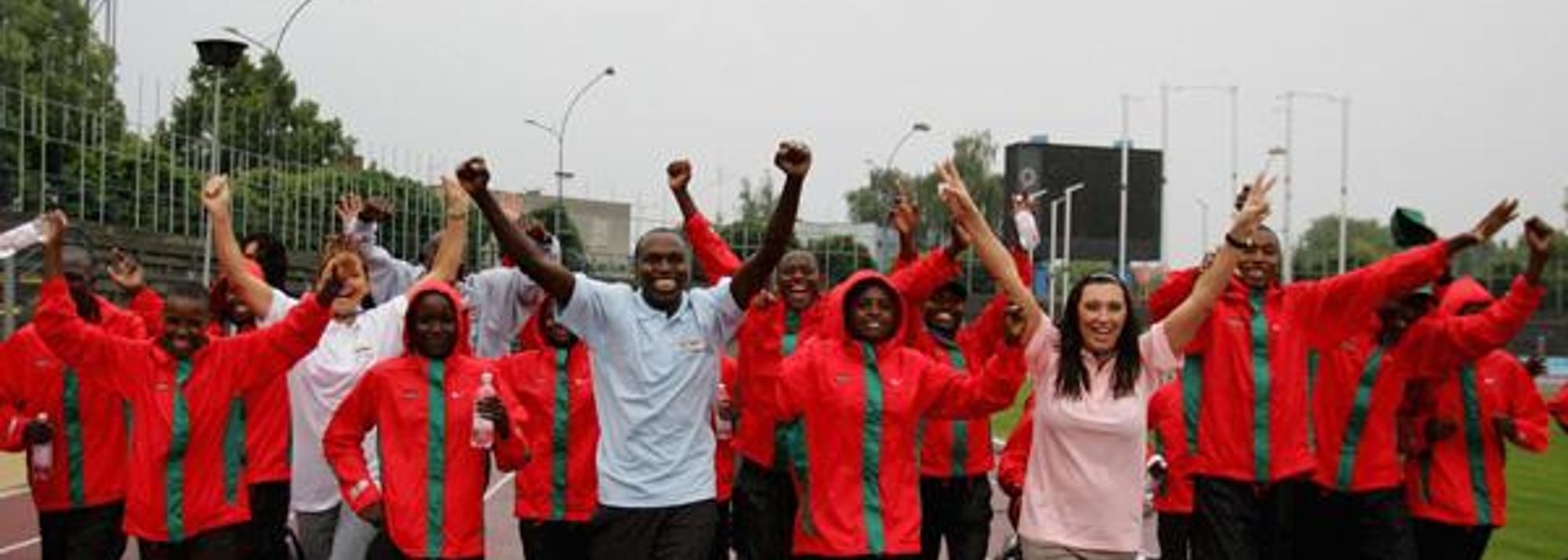


Wilson Kipketer of Denmark and Svetlana Masterkova of Russia lead the Kenyan team at the City Stadium during the IAAF Masterclass in Ostrava (© Getty Images)
Ostrava, Czech RepublicAthletics is much more than running fast, jumping and throwing far. Athletics is much more than winning or losing, setting a personal best or breaking a record. Athletics is a passion for life.
For the 15, 16 and 17 year old athletes competing here in Ostrava in what will be their first major global competition, the IAAF World Youth Championships represent a unique experience which will leave them unforgettable memories, and not just from the competition.
With just two days to go to the start of the competition, the IAAF Ostrava Masterclass gathered together over 350 young athletes including teams from the US, Canada, Kenya, Puerto Rico, Saint Kitts and Nevis Germany, Czech Republic, Peru and many more for a unique experience where they were given the opportunity to speak to World champions, Olympic champions and World record holders.
For more than three hours, the youngsters tirelessly listened to the advices of the IAAF Ambassadors who travelled to Ostrava in order to pass on their knowledge and share their own individual experiences.
Seize every opportunity
Double Olympic champion Svetlana Masterkova whose 12-year-old daughter Anastasia is an accomplished tennis player was warmly welcomed by the audience and discussed how difficult it was to remain focus when she was a 17-year-old runner.
“You have to seize every opportunity that you have. When you are 17 decisions are not always easy but nowadays things are much simpler than they were when I was your age. I had to move from a little Russian village to Moscow, it was hard to keep going but I succeeded. You should never give up and always believe in yourself.”
Winner of the 800m and 1500m at the Atlanta Olympic Games in 1996, Masterkova is currently writing a book which will include anecdotes from her own career as well as advices on fitness, nutrition and concentration.
Training is a life style
800m World Indoor and Outdoor record holder Wilson Kipketer who was given a standing ovation as he entered the lecture hall shared his view on the importance of training for a successful and long lasting career.
“Training when you are 17 is not that easy because there are a lot of distractions in life but it is important that you build the basis for your future career now. Now is the time when you can decide what you want to do and if you love the sport of athletics you have to be dedicated and focused. Training is not just running every day, training is a life style, training is knowing what to eat, what to drink. It’s important that you do it seriously.”
A father of two young boys, Kipketer is still actively involved in athletics and will take part in the IAAF Anti-Doping Outreach programme to educate young kids to remain drug free throughout the championships here in Ostrava.
Don’t sacrifice your studies
1997 World champion Sarka Kasparkova who still holds the Czech national record in the Triple Jump spoke about how crucial it is not to sacrifice one’s studies to athletics.
“The sport helped me a lot in my life but I am so glad that I finished my studies when I was 23. It was hard to fit in training and studying at the same time but I can say now that it is essential that you do it. Having a degree gives a guarantee for your life after athletics. It is possible to do both together, don’t leave your studies behind because afterwards it will be too hard to go back to it. It is also important that you learn English, being able to communicate with people from all over the world is so fulfilling. Myself I didn’t study English when I was younger and I realise it was a big mistake so I am taking special lessons now.”
Always listen to people who know you well
1999 World Indoor and Outdoor champion at 800m, Ludmila Formanova whose career was hampered by numerous injuries explained to the full house how to cope with obstacles and overcome difficult times.
“I have made many mistakes in my career especially when I was your age and I believe it’s important that you try and not make the same mistakes. When I was 17 and determined to win the World Junior Championships I ate something bad which gave me stomach cramps and I couldn’t compete. A year later, I didn’t pay attention to where I was walking and I twisted my ankle. I have also made the mistake of over training to try and catch up time or sacrificing rehabilitation coming back from an injury. You should always listen to the people who surround you and know you well and you should always trust specialists who know what is best for you.”
Don’t be afraid to make mistakes and learn from them
World record holder, three-time World and Olympic champion Jan Zelezny who travelled all the way back from Guatemala where he took part in the IOC session to be here in Ostrava with the young kids shared his opinion on how to cope with the pressure of performing at World Championships.
“The World Youth Championships are just the beginning of your career; the main thing is having confidence in your abilities and knowing that you’re here to do your best. Don’t be afraid to make mistakes and then learn from them. When I competed in the European Juniors I was the favourite for gold and I ended up finishing fourth. I was so disappointed. The turning point in my career was when I suffered a severe back injury in 1987 and people told me I wouldn’t be able to compete again. That is when I realised how much I loved athletics. I did several hours of physio every day, managed to get back on my feet and win the Olympic gold medal in Barcelona, my first big major win.”
France’s Marie José Pérec who won a superb 200m / 400m sprint double at the 1996 Olympic Games in Atlanta in addition to her two World titles at 400m spoke about the importance of the support team in athletics.
You have to be the actor of your success
“Although track and field is an individual sport it is important that you chose the right people to surround you and to help you. The support team including training partners, coaches, doctors and assistants is there to make your training and your competition easier. You need to choose the right people and in order to do that you have to be curious, responsible, open minded but also autonomous. Although it’s essential that your family and team support you throughout, you have to be the actor of your success in your career.”
Finally, former Olympic champion and multiple World record breaker Steve Ovett who also acted as the Master of Ceremony of today’s proceeding gave the young athletes an insight of what life on the athletics circuit will be like once they make it to the senior elite level.
Get used to traveling a lot!
“You have to understand the mechanics of the circuit, know and select a good agent to represent you, be a value to the circuit, be good enough for the meetings to want you. You also have to get used to traveling a lot, being late, sleeping in a different bed every other night and learn how to cope with jetlag. Athletics will be your job so you have to understand how you can make money, how the meetings pay prize money because it is important that you can survive doing what you love.”
Following a short Anti-Doping educational presentation where athletes were told the mechanics of a doping control and given precious advice on how to provide samples and make sure these are not tampered with, the Ambassadors moved on to the Vitkovice Arena where they jogged around the track, chatted with all the youngsters and signed autographs.
The Ostrava Masterclass was undoubtedly a great success which will inspire the next generation of athletics World and Olympic champions.
Laura Arcoleo for the IAAF


