

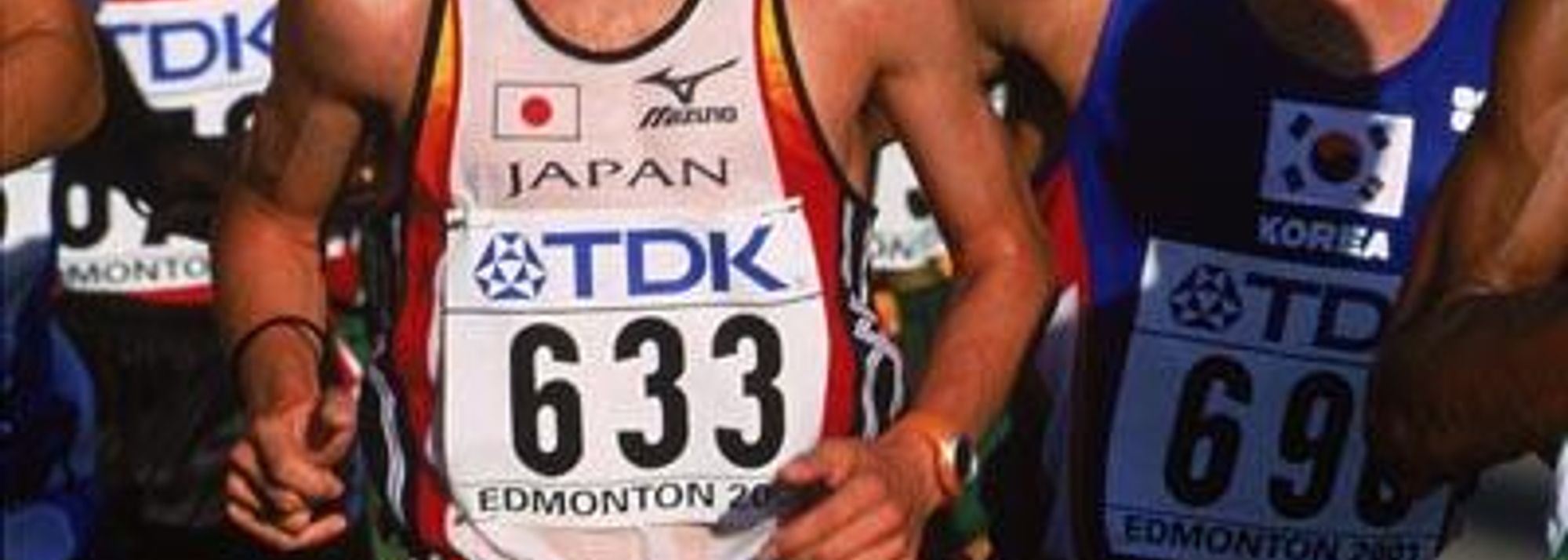


Atsushi Fujita at the 2001 World Championships in Edmonton (© Getty Images)
Former national marathon record holder, Atsushi Fujita won the 56th annual Beppu-Oita Marathon, Japan with 2:10:23, fifty-two seconds ahead of Atsushi Sato, who finished second in 2:11:15.
“I was completely crushed. Fujita was really strong today,” said Sato after the race which was a designated qualifier for the Japanese team for the World Championships in Osaka.
For Fujita, it was third marathon victories of his career, having won the 2000 Fukuoka Marathon with the national record of 2:06:51 and the 2002 Seoul Marathon with 2:11:22. A few days after his crushing defeat at the 2006 Fukuoka Marathon, Fujita decided to run the Beppu-Oita marathon.
David Kemboi, finished third in 2:11:26, but he was over a minute short of the time he recorded in the 2006 Carpi Marathon. Kazushi Hara, who finished fourth, was 33 seconds short of his personal best, 2:12:44, which was recorded in his debut marathon.
The original plan was for the pace makers to run at 15:10 pace for each 5Km until 32Km. A huge pack led by three Kenyan pace makers – Edwin Kipkoech, Peter Kiprotich and Jason Mbote - passed 5Km in 15:15, 10Km in 30:13 and 15Km in 45:28. At 10Km the lead pack which consisted of fifteen runners; they stayed together through 15Km, and passed 20Km in 1:00:47, half marathon in 1:04:09 and 25Km in 1:16:08, but by then this group had been whittled down to twelve runners. After the turn around point at 25Km in the city of Beppu, the pace slackened, however. The 5Km between 25Km to 30Km took 15:36.
At 32Km, when all three pace makers dropped out, eight runners – Joseph Riri, David Kemboi, Atsushi Fujita, Atsushi Sato, Kazushi Hara, Tomonori Watanabe, Rashid Kisri and Ombeche Mokamba - were leftup-front. Soon Kemboi surged, and only Fujita, Sato and Hara were able to respons to the move. Two kilometres later and Hara was dropped and the remaining three led by Kemboi passed 35Km in 1:47:32.
At 37.9Km, it was Fujita’s turn to surge, and he left Kemboi behind but Sato stuck to the fight. However, 500m later a second surge dropped Sato and the race was over, with Fujita pulling further and further ahead in the next 3Km.
Kemboi moved ahead of Sato (39.3km) and by 40km, Fujita was 16 seconds ahead of him, while Kemboi in turn was five seconds ahead of Sato. Shortly after Sato re-took the second and eventually finished eleven seconds ahead of Kemboi.
Although the time may not be fast, for Sato second place finish is the best marathon finishing position of his career. His previous best finishing position was fourth, when he set his personal best of 2:08:36 in the 2004 Lake Biwa Marathon. He also finished fourth in his debut marathon, 2000 Lake Biwa Marathon, when he set a collegiate record of 2:09:50.
Ken Nakamura for the IAAF
with assistance from Akihiro Onishi
Weather: Temperature 12.1C, humidity 45%, Wind 2.7m/s NNE
Results (JPN unless otherwise denoted)
1) 2:10:23 Atsushi Fujita
2) 2:11:15 Atsushi Sato
3) 2:11:26 David Kemboi (KEN)
4) 2:12:44 Kazushi Hara
5) 2:12:45 Rashid Kisri (MAR)
6) 2:13:11 Tomonori Watanabe
7) 2:13:37 Joseph Riri (KEN)
8) 2:14:49 Pavel Loskutov (EST)
9) 2:15:17 Brett Cartwright (AUS)
10) 2:15:22 Masaki Iwahara
11) 2:16:34 Manabu Nishida
12) 2:17:02 Ombeche Mokamba (KEN)
13) 2:17:33 Takayuki Nishida
14) 2:18:19 Koji Ueoka
15) 2:19:23 Yukiyasu Nagao
Splits
5Km 15:15 Jason Mbote
10Km 30:13 (14:58) Peter Kiprotich
15Km 45:28 (15:15) Jason Mbote
20Km 1:00:47 (15:19) Jason Mbote
25Km 1:16:08 (15:21) Daniel Mwangi
30Km 1:31:44 (15:36) Edwin Kipkoech
35Km 1:47:32 (15:48) David Kemboi
40Km 2:03:23 (15:51) Atsushi Fujita
Finish 2:10:23 (7:00) Atsushi Fujita


