

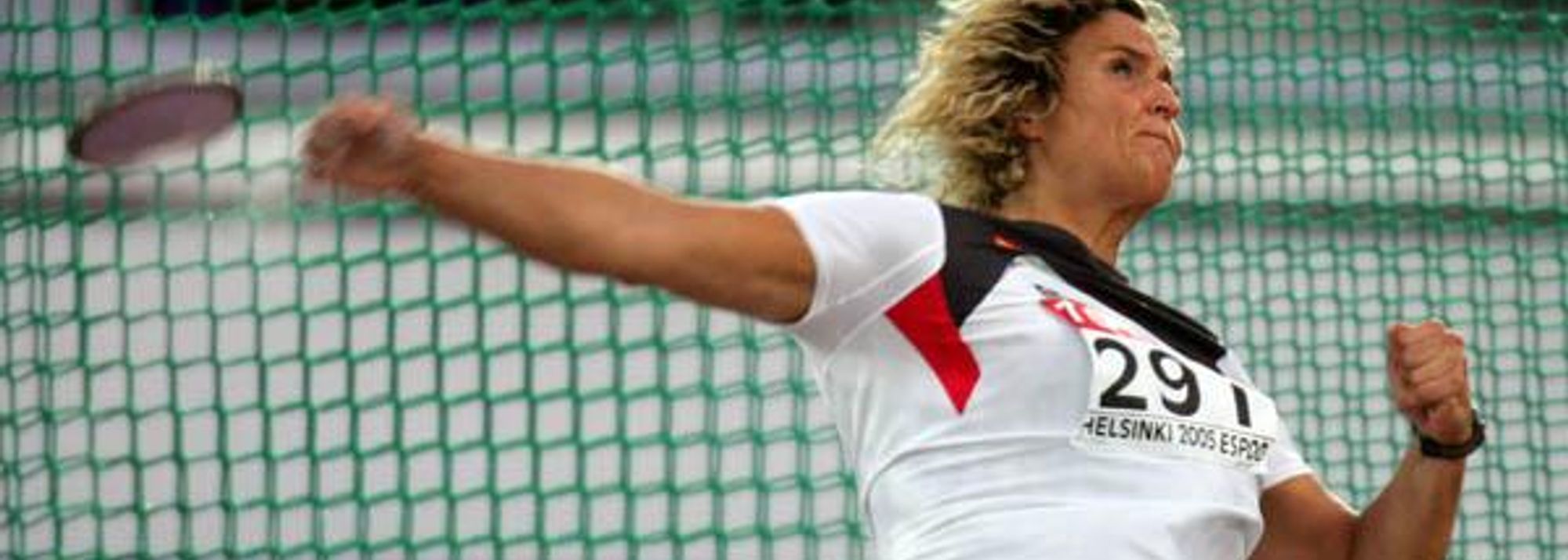


Franka Dietzsch of Germany takes gold in the Discus Throw (© Getty Images)
After her mastery of the strong winds in the stadium tonight, much the same as the erratic conditions which prevailed during the men’s Javelin final the previous night, Germany’s Franka Dietzsch has reconfirmed her place among the all-time greats of the women’s Discus Throw.
The greatest ever career record
Dietzsch had five throws in the final at the 10th IAAF World Championships in Athletics, and all but one of them would have been good enough for the gold, including her first which flew out to 64.89m. Ultimately that would have been good enough for victory but she improved later to 66.56 (fourth) and had another long effort on her fifth throw. In such company Russia’s Olympic champion Natalya Sadova, the next best on the night with 64.33m, was totally outclassed.
In dank, gusty weather conditions, this was never going to be a competition of long throws. However, it was from the beginning an evening just about the German, and from a statistical perspective so has been the last 20 years. Remarkably, that is the length of time that the now 37-year-old has managed to fly her discus past the 60m line. Dietzsch may not hold the actual World record distance for the discipline but her career consistency is a record in itself, and something which no other woman can match.
Neubrandenburg is the winner’s home town, incidentally the site of the World record (Gabriele Reinsch, 76.80m) in 1988, and what a town for throwing it has become, with Astrid Kumbernuss, the 1996 Olympic and three-time World Shot Put champion, also belonging to the same club, SC Neubrandenburg.
Dietzsch’s coach Dieter Kollark is also the trainer, and husband, to Kumbernuss, and it is through his influence that she has retained her consistency but also the ability to peak at the right time. Dietzch was World champion in 1999 and European gold medallist in 1998.
Low angle of attack
But how did Dietzsch cope in the wind this evening when her opponents failed?
Firstly, expecting bad weather she had applied a new type of sole to her shoes especially to cope with the possible wet and slippery conditions. Secondly, the low angle at which she attacked the throw of the discus meant that she was in better control of the flight.
“She (Dietzsch) is normally at a disadvantage against the other throwers because she tends to throw the Discus quite flat,” confirmed Kollark, “but in these winds tonight it became the key to her success.” The others in the competition were all throwing at a steeper angle and found their implements stalling in the strong winds.
And her longevity?
Kollark confirmed that her long career is due singularly to the fact that she has protected her body very well. “Since 1996 she has only trained once per day,” confirmed the coach. “She is motivated but not too highly motivated which means she has taken a relatively relaxed approach to the sport. She has retained a balance in her life which has meant that she has not pushed her body too hard.”
“This is in total contrast to Astrid (Kumbernuss) who was always driving her body hard in this sport.”
The postponement of the competition didn’t seem to have caused her any problems but what were Dietzsch’s thoughts at the time?
“At the time the final was delayed (Tuesday 9) I thought it was bad because I felt in good form but obviously now I couldn’t be happier,” confirmed Dietzsch. It is “impossible to describe how I feel,” she told her mother by mobile telephone from the athlete/media mixed zone.
“Thinking it might rain again, I put every effort on the first throw, and it happened (the win)….Winning was more important than the result today.”
Loving the rain!
Laughing she then continued, “I don’t care if it rains everyday in Helsinki from now on…. Normally I hate the rain but I think from this day on I will love it.”
As much as the full stadium of spectators admired and applauded Dietzsch’s brilliance, one senses that in this one aspect they would not have given her their full support!!!!
Chris Turner for the IAAF


