

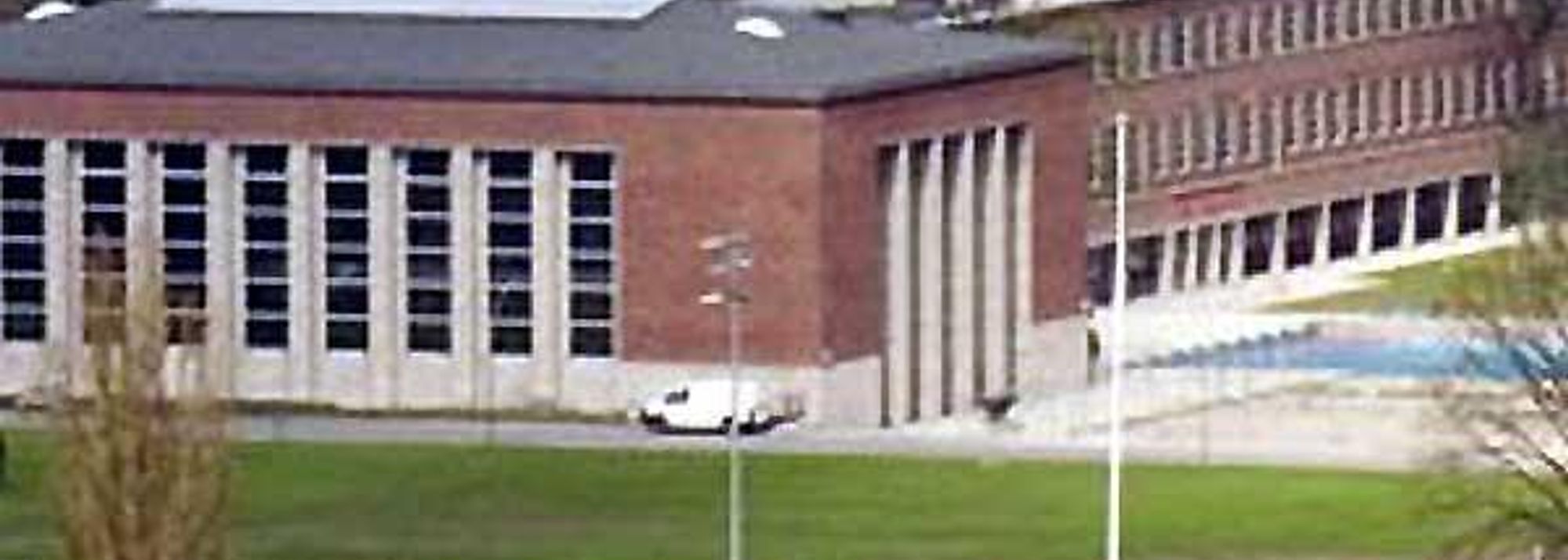


Berlin Sports Museum - natatorium wing at the Jahnplatz of the German Sports Forum in the Berlin Olympic Park (© 'The Friends of the Berlin Sports Museum')
Berlin, Germany 15years is a long time to wait for anything but after that many years of existence the Berlin Sports Museum, which incorporates the AIMS Marathon Museum of Running, has finally found a real home for its exhibits.
Hopping between 14 different venues in Berlin and Brandenburg for the past 15 years, resting in some of these locations for short and some for long periods of time, the 15th site is the natatorium wing at the Jahnplatz of the German Sports Forum in the Berlin Olympic Park.
Vast and varied collection
The Museum’s permanent venue was acquired in the late summer of 2005, with approx. 1500m² of space for its varied collections and archives which include 1300 pieces of sports equipment from running and track and field, rowing, cycling, bobsleigh, ice skating…, 3000 pieces of sportswear, 3000 banners and pennants, 10,000 medals, stickers and badges, 1200 cups, goblets, trophies, 1200 certificates and documents, 2100 posters (most of them are from races around the world), 1500 artworks (paintings, prints and sculptures), 1600 multimedia pieces, 1.6 Million, photos, 37,000 sports books!
Modern museum and research facilities
The interiors of two floors of the natatorium wing were cored out in 2003 and the wing has since been rebuilt as a sports museum according to current museum requirements. The renovations include the creation of acclimatised rooms for the photo archives and painting collection. The original facade of the building has been reconstructed with new windows created so that they also comply with the necessary safety and light specifications for museum venues.
For the first time, the staff members of the Sports Museum are able to catalogue and process the collection without time-consuming and cumbersome travel to the various depots. At the same time, it is now possible to host sport history events for up to 30 people in a seminar room, while the nearby lecture hall in the Haus des Deutschen Sports has capacities for about 200 people. For the first time, the expansive Sports Museum library can be viewed in its entirety.
Since the beginning of November 2006, the 500m² Lichthof (reception hall in the Haus des Deutschen Sports) can now be utilized as an exhibition space. Therefore the final museum task that had been missing - the one that in the public’s eye is the true duty of a museum - the presentation and sharing of the Collection has thus been realized.
The Berlin Sports Museum presented the first ten exhibition panels of the “Gallery of Names” on 19 November 2006 during a commemoration of German athletes on Remembrance Day in the Haus des Deutschen Sports.
Until the start of the 2009 IAAF World Championships in Athletics, this sport history exhibit will be presenting a sophisticated and extensive overview of all of the important people, terms, locations, and events that are tied to the Olympic Park. As soon as the renovation project in the Haus des Deutschen Sports is finished, the panel exhibit will be complimented with numerous objects pertaining to sport history - the glass cases have already been put in place and will be ready to be filled by around May of 2007.
Harbig honoured
The first four people to be presented in the “Gallery of Names” include two track and field athletes, Hanns Braun, three-time Olympic medallist ( 400, 800m, relay; 1908/1912), and Rudolf Harbig, 1938 European 800m champion, and the World record holder for 400m and 800m in 1939, and 1000m in 1941.
Harbig’s World record run in 1939 over 800m was of course the crowning glory of a career sadly cut short by the World War. He was sent to the Eastern Front on which he died in 1944. In Milan on 17 July 1939, up against his long time rival, the Italian Mario Lanzi, Harbig demolished the existing 800m mark of Britain’s Sydney Wooderson (1:48.4) with a time of 1:46.6 which was not to be surpassed until Belgian Roger Moens ran 1:45.7 in 1955!
In addition, to Braun and Harbig, gymnast and fitness pioneer Karl Friedrich Friesen, and Reich Mindt, founder of the Museum of Physical Exercise in the Olympic Park in the 1930s, are also honoured, as is the memory of several well known Olympians - from around the world - who died from acts of violence. Starting in the spring of 2007, there will be guidebooks and pedagogical materials available for the “Gallery of Names”.
Gerd Steins, Horst Milde, and Chris Turner for the IAAF

