

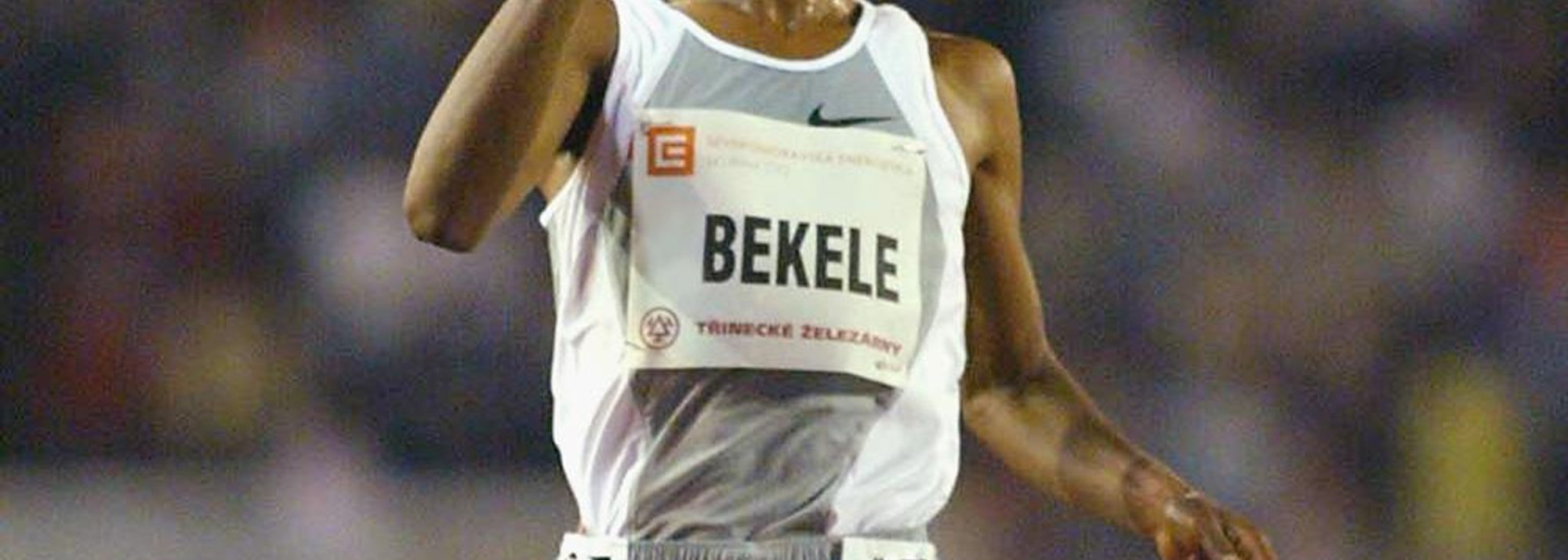


Bekele crosses the finish in a 10,000m World record in Ostrava (© Getty Images)
Kenenisa Bekele’s 2004 year of World record success seems like a dream to the 22 year-old a dream and he simply does not want to wake up.
Four years ago, a young Bekele was only in his second year of serious running and watched from a television set in Addis Ababa Haile Gebrselassie dramatically snatching victory from Kenyan Paul Tergat in the final strides of the Olympic men's 10,000m final in Sydney. "I still find it amazing that Haile [Gebrselassie] beat Tergat in Sydney," he recalls.
The Olympic dream began
Amidst the euphoria and nationalistic fervour that Haile’s "skin-of-the-teeth" win engendered amongst Ethiopians the world over, Bekele secretly wished that he would one day get the chance to represent his country at the Olympics.
"I wanted to be in Haile's shoes and be my country's hero," recalls Bekele. With this, he embarked on a mission that heralded his arrival on the world stage with a bang!
In the last two years, Bekele has grabbed virtually every major honour that has come his way. In March earlier this year, he showed that he is the undisputed king of the cross country by taking his third double World short and long course titles in the most scintillating fashion in Brussels. On the track, in 2003 he became the World 10,000m champion.
This summer, Bekele has demonstrated his mercurial talent by taking apart the World 5000 and 10,000m records in the space of nine day. In the winter season he had also broken the World Indoor 5000m record in Birmingham underlining his agility indoors, outdoors, and the cross country.
Highest ranked in the world
While his achievements within a short period of time make him a force to be reckoned with, Bekele, currently the top Overall IAAF World Ranked athlete in the world, remains modest about his triumphs. "I certainly did not expect to reach this stage so quickly," he says. "I am more than happy with what I have achieved so far."
Yet his country expects great things from him in August, and Bekele stresses the importance of winning Olympic Gold. "The Olympics are not just another tournament," he says. "They come once every four years and if you miss the chance to get gold when you are in form, there simply might not be another chance and you might regret it in the future."
Double in Athens
And it is his wonderful form and unbeaten record that now spans twenty races of all types that has convinced him and the Ethiopian Athletics Federation that he should go for both the 5000 and 10,000m gold medals in Athens.
This time there is no prevarication similar to the lead-in to all three of his successful World Cross Country doubles.
"After discussions with the Federation and the coaches, I have agreed to run both races in Athens," was Bekele's signal of intent.
There is no doubt that Bekele possesses all the credentials for such an Olympic onslaught, which was last achived by compatriot Miruts Yifter in 1980. Bekele has redefined the meaning of “great distance running” this year. The way he won his cross country double in Brussels in March seemed so effortless that he might as well have been taking a Sunday morning jog in the park.
At the World Championships in Paris last year, Bekele attempted the same double feat as he will do this summer in Athens. In the Stade de France he won the 10,000m gold and finishing a close third in the 5000m behind the champion Eliud Kipchoge of Kenya and Moroccan Hicham El Guerrouj.
It will be tougher than in Paris
This time around, however, Bekele believes that a double presents an entirely different prospect. "It is difficult to run in two races especially at the Olympics," a modest Bekele says. "The weather will be warmer than in Paris last year and the competition will also be a lot tougher."
Following his declaration of the double, Bekele is bound to be hyped in Ethiopia not only as the next Haile Gebrselassie, but also Yifter. And Bekele admitted that the prospect of equalling Yifter's feat in his Olympic debut this summer would be extraordinary. "It would be great," he said. "It makes me more determined because I know that if I achieve this now, I will have more to go on in the future since I am just only 22."
Even brighter than just mere track fortunes
The future does hold brighter things for Ethiopia's coveted youngster. After Athens, Bekele will marry his fiancée of three years in the new Ethiopian year 1997 (in E.C. this is from September 2004 to August 2005). While he admitted that his ceremony will not be like Haile Gebrselassie's own bonanza which was held at Bole International Airport when he returned from the Atlanta Olympics with his first Olympic Gold, Bekele believes that the time has come to tie the knot. "This is my obligation in life and a responsibility to commit to my fiancée," he says.
The obvious public question in Ethiopia remains- "Who is the lucky girl?" But Bekele has declined to reveal the identity of his future wife. "She is not the lucky girl, I am the lucky man" he says. "And that is why I am not announcing who she is."
For the next forty days at least, Bekele's attentions will be solely focused on the Olympic Games and his history-making double attempt. He has been dreaming for his moment in the limelight for the last four years and the whole of Ethiopia will be praying that he wakes up with a golden reality!
Elshadai Negash for the IAAF

