

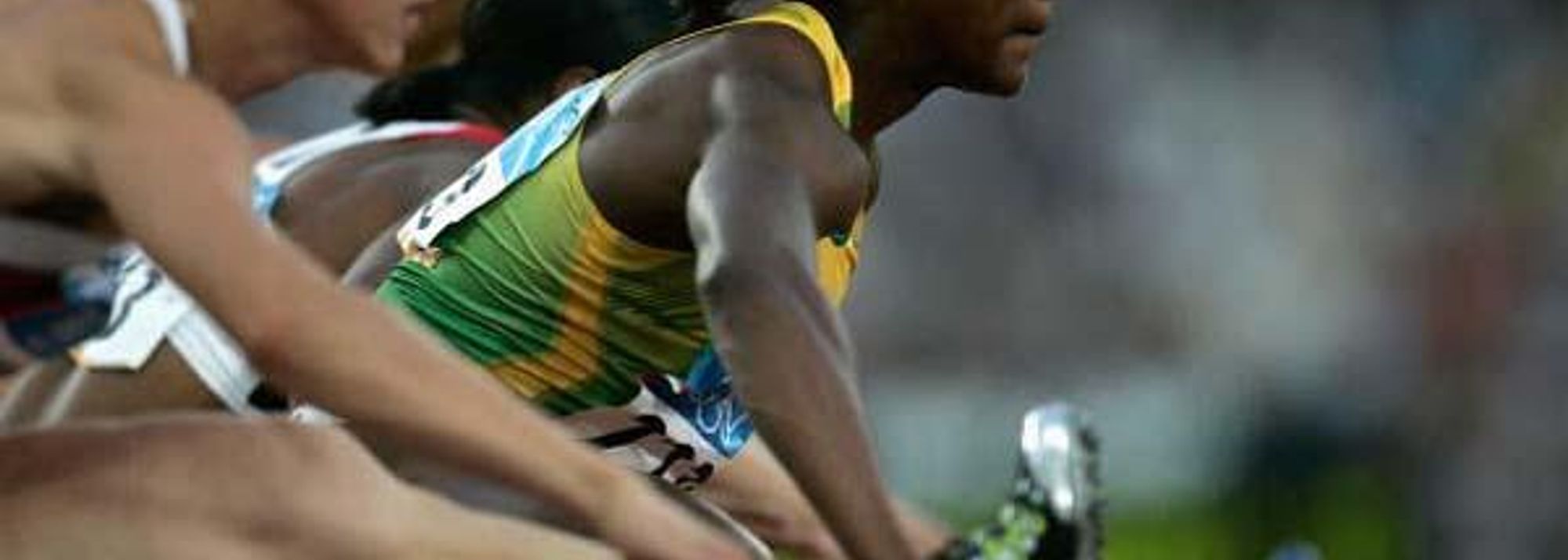


Lacena Golding-Clarke in the 100m Hurdles heats (© Getty Images)
When Davian Clarke and Lacena GoldingClarke left Athens last summer after reaching their respective finals, it marked a rebirth of sorts for the Jamaican couple. For Clarke, who finished sixth in the 400 metres, it was a renewal of the confidence that had also propelled him to the Olympic final in 1996. For Golding-Clarke, who clocked a near-PB 12.73, it provided the self-assurance she needed just two years after committing to the Hurdles full-time.
“It was great,” Clarke said. “At first, I wasn’t performing as well as I would have liked before the Games.” After opening his outdoor campaign with a 45.50 win at the Jamaica International in early May, his pre-Athens best was 45.11, with most of his races in the high 45 range. “But I still had confidence. It was a bit of a relief to advance to the finals. So in the finals, there was no stress. I ran a personal best (44.83), but I fell short of the main goal which was to medal.”
“The experience was wonderful,” Golding-Clarke said, speaking from the couple’s home in Opelika, Alabama, just outside of Auburn, where both train under the guidance of Auburn University head coach Ralph Spry. “My goal was to make the final. I gained so much confidence, because I’m still learning the Hurdles. So now, for Helsinki, hopefully I can win a medal.”
Post-Sydney wedding
The couple’s road to Athens - for each, their third Olympic appearance - began as high schoolers in Jamaica. Golding-Clarke was a standout at Vere Technical High School, Clarke at Kingston College High School. They met at 14, Golding-Clarke said, “and we’ve been friends ever since.” While she moved on to Auburn, he carved out his name at the University of Miami. They eventually wed after the Sydney Olympics.
“It’s an easy way to remember anniversaries,” Clarke said.
Multi-talented
Well before taking on the Clarke name, Golding-Clarke she was already establishing herself as Lacena Golding. A six-time All-American while at Auburn University, Golding ended a successful collegiate career in 1998 with bests of 13.00 in the Hurdles, and a 5750 point tally in the Heptathlon – still the university’s record - but was known primarily as a standout long jumper. She reached a PB 6.87 at the 1998 national championships in Kingston, was fourth at that year’s Commonwealth Games, and in 2000, made her second Olympic appearance in the horizontal leap. She continued to contest both events for a few seasons on the international circuit, but injuries, mainly caused by the Long Jump, forced her to drop that event permanently in 2002.
Commonwealth title
“When I’m hurdling, I’m not hurting,” she said.
Fully focused on the one event, her improvement was immediate. She lowered her PB from 12.93 she set in 2000 to 12.74 in the heats of the 2002 Commonwealth Games in Manchester before taking the title in 12.77. She’s remained a regular fixture in the world’s top meetings ever since. In 2004, she clocked a PB 12.69 on four occasions, including at the season-capping World Athletics Final where she finished third.
Yet despite reaching the Olympic final in just her third full year in the event, Golding-Clarke said she sees plenty of room for improvement.
Laughing, she describes her hurdling technique as one that “took a 360 degree turn from 2002 to 2004.”
“I’m not so technically sound coming of the hurdles. I have to learn to control my speed and technique.” A self-professed quick starter, her last five hurdles, she said, is where she needs most improvement.
Early international breakthrough
While Golding-Clarke’s immediate impact was in the collegiate ranks, her future husband’s presence was felt internationally early on. While his event was dominated by the exploits of Michael Johnson, Clarke made a strong debut on the global scene in 1996. Barely 20 years old, he won the NCAA title for the University of Miami in early June - he was also indoor champion two years later - took the Jamaican Trials title in 44.96, and reached the final at the Olympic Games in Atlanta, where he finished seventh in 44.99 after a PB 44.87 in the semi-finals.
I knew I couldn’t pass up staying in the sport
”That was a very successful season, and that confidence propelled me to the Olympics,” Clarke recalled, before adding that he let the emotion of the grand stage get the best of him. “But because of Michael Johnson and the hype of that race, I went out too fast. But I learned a lot in that race.”
Soon after Atlanta, Clarke said, he told his parents that he would become a professional athlete when he concluded his collegiate career at Miami. “That’s why I’m still running now. I knew I had the potential to do better. After a taste of that, I knew I couldn’t pass up staying in the sport.”
But injuries followed. A calf injury in the semi-finals in Sydney kept him from a second consecutive Olympic final appearance. His 2001 season was cut short by a hamstring pull at the Grand Prix meeting in Turin.
“But I didn’t give up,” he said. “I just knew I have to stay focused.”
Back from injury and World silver
After a few seasons with bests in the low 45s, 2004 signalled a comeback after his 45.92 dash in Budapest to claim World Indoor silver. In Athens, his eight-year-old PB would finally fall.
Clarke said he’s enjoying the attention his event has received in recent months, but he also thinks that the 400 remains more wide open than many believe.
“When I was starting out, the only guy anyone was paying attention to was Michael Johnson. Now there are 10 or 15 of us within a step or two of each other. Everyone has a shot. I’m just hoping to have a shot too.”
Preparing the right peak
Clarke said that in order to get his race rhythm more adequately in tune for Helsinki, he’s made a few training adjustments.
“Last year I peaked and ran my personal best at the Olympics, but I want to peak sooner this year. You need to know you can handle the pace, so I want to peak a little earlier.”
Clarke agrees with Olympic champion Jeremy Wariner’s assessment that it might require a sub-44 clocking to reach the podium in Helsinki.
“That’s also my goal. I wasn’t able to get them at the Olympics. In Athens, I went out a bit too conservatively and had a lot left. My goal now is staying closer to the field.”
No retirement plans
In her event, Golding-Clarke believes that performances similar to those in Athens, in the 12.3 to 12.4 range, will be required to reach the Helsinki podium. Despite a personal best of 12.69, Golding-Clarke knows she’s not that far away. She feels that her flat speed is more than adequate. “I just have to incorporate more technical work into my training.”
On 20 March, Golding-Clarke celebrated her 30th birthday; Clarke turns 29 on 30-April. Neither is giving any thoughts to retirement, leaving a repeat performance not only in Helsinki, but in Beijing as well a distinct possibility.
Clarke added, “I haven’t given (retirement) any thought. I figure I have at least three more years.”
Golding-Clarke echoed her husband’s sentiments.
“I’m feeling younger and younger each year,” she said. “I just feel young. It’s entirely up to my body to tell me when it’s time to stop.”
Both will make their season’s outdoor debuts at the Jamaica International in Kingston on 7 May.
Bob Ramsak for the IAAF

