

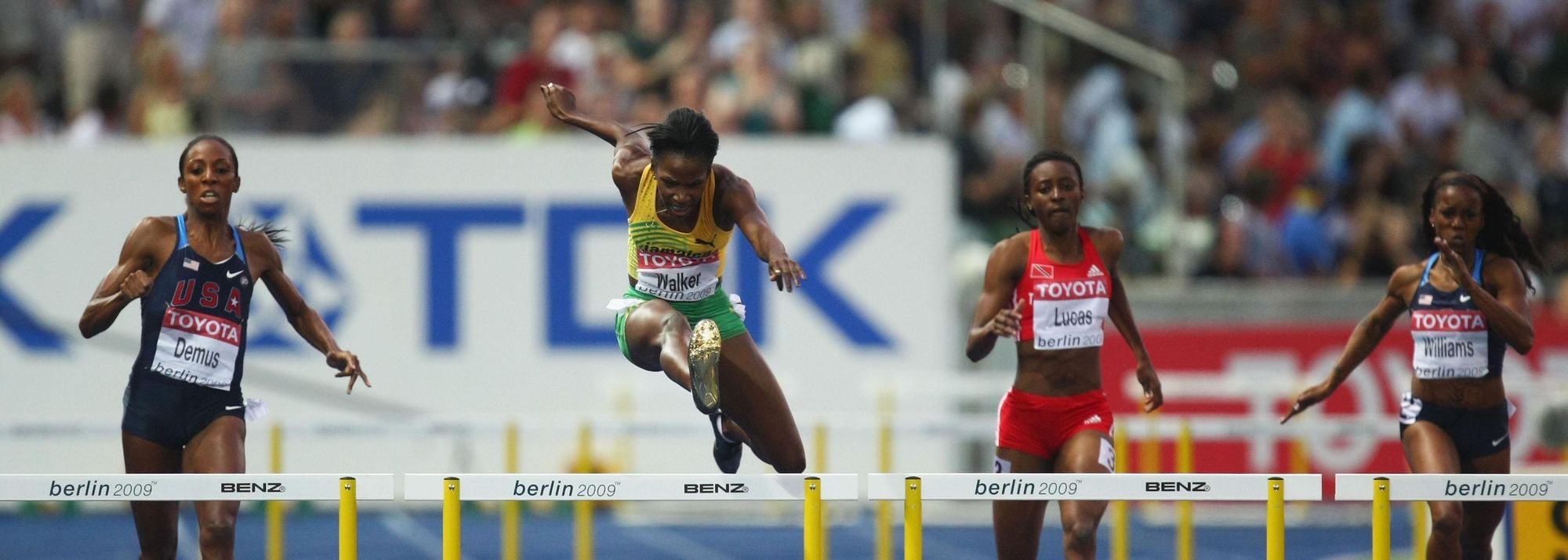


Olympic Champion Melaine Walker adds the World Championships title to her collection with the 400m Hurdles Championship Record and the second quickest time in history of 52.42 seconds (© Getty Images)
MonteCarloIn part four of their annual season review, Statisticians A. Lennart Julin (SWE) and Mirko Jalava (FIN) recall the season's action in the HURDLES.
MEN -
110m Hurdles
This event has a somewhat paradoxical structure. It has always been heavily dominated by the USA and 2009 was no exception in this way with the USA providing no less than 11 of the 15 runners dipping under 13.30 in legal wind. The paradox is that for the last five years they have despite this wealth of talent still not been able to claim the coveted No 1 position:
At the Olympic Games in Athens 2004 Liu Xiang of China won, in Helsinki 2005 Ladji Doucouré of France, in Osaka 2007 Liu Xiang again, in Beijing 2008 Dayron Robles of Cuba and now in Berlin 2009 – with both Liu and Robles injured – the USA still had to concede the gold medal. This time to Ryan Brathwaite of Barbados who just prevailed over Americans Terrence Trammell and David Payne.
For Trammell now age 30 there seems to have developed some kind of championship curse as this was his fifth silver medal in the last ten years at a global outdoor event (Olympics or Worlds)! One could, however, wonder if his choice not to compete at all between the US trials in late June and the Worlds in mid-August was the best preparation.
At least for the surprise champion Brathwaite the pattern was the complete opposite: Eight meets in the USA (collegiate season) in April and May, four meets at home in the Caribbean in June/July, five meets in Europe before Berlin and finally four meets in Europe after Berlin culminating in a triumph at the World Athletics Final.
Extensive competitive schedules have always been a tradition in this event and obviously Brathwaite has picked up on that although he, despite 22 meets in five months still wasn't the most prolific racer: A couple of US runners competed even more frequently. One of those was Dexter Faulk who at age 25 really came alive as a world class athlete in 2009.
He had an indoor season of (at least?) 15 meets between December and March then headed almost directly into an outdoor season of 23 meets stretching from April to September. The fascinating part was that Faulk apparently thrived on this schedule as he concluded his year on a high note with a narrow defeat by Brathwaite at the World Athletics Final. In the middle of the summer Faulk also had a couple of very close races with Robles.
The Cuban Olympic champion and World record holder tried hard to come back from injury and seemed well on his way to succeed as he came into Berlin undefeated from ten meets and with the two fastest time of the year. But unfortunately the injury problems returned and at the World Championships he barely got through from the first round to the semis where he then had to give up.
But Robles can take solace from the example of his predecessor as World champion and World Record Holder Liu Xiang. Despite reports that the injury that forced him to miss "his" Olympics was indeed career threatening, he did return to the starting line at the Shanghai Grand Prix meet in late September. And not only did he start, he ran, given the background, an absolutely sensational race -13.15 losing to Trammell only by a couple of thousandths!
So hopefully in 2010 we will have both Liu and Robles back in top form to face the new World champion Brathwaite and the USA army of top runners which then ought to include also David Oliver. He missed most of 2009 due to injury but still occupies the 2nd position on the World list with his 13.09 from Doha in early May.
It will also be very interesting to follow the further progress of Ronnie Ash who won the NCAA (USA Collegiate) title by over two tenths running 13.27 into a stiff headwind of 2.0 mps. Could Ash be the man to reclaim the No 1 position in the World for the USA?
400m Hurdles
This was very much a post-Olympic year where the event never seemed to really come alive. The world had to wait until the very last meet before the Worlds – Monaco – to see the 48-second barrier broken when South African L J Van Zyl and Bershawn Jackson of the USA dipped just under with 47.94 and 47.98 respectively.
Before that the European summer had belonged to Isa Phillips who had followed his 48.05 at the Jamaican Championships with four races between 48.09 and 48.18 in not always conducive weather conditions. But it turned out that Phillips had peaked too early and the rest of the summer he was a 48.5+ runner who even went out in the semis in Berlin. A destiny shared by the statistical world leader Van Zyl.
So this was a year were it seemed that anything was possible in this event and even though it would be wrong to call the final outcome in the Worlds "sensational" there were numerous just as plausible alternatives because there simple was a bunch of evenly matched runners that on a given day could finish in any order.
Now the gold medal was claimed by the Olympic champion Kerron Clement, who had happened to be 6th in the final tune-up meet (Monaco) with a time about a second slower than his new WL 47.90 in Berlin. The silver went to Javier Culson (Puerto Rico) who was able to cut two tenths away from 48.29 PB he hade recorded finishing 4th in Monaco.
In this strange year two athletes with yearly best marks around 49.5 reached the final: 30-year-old Periklis Iakovakis of Greece digging into his vast experience and still only 17 years old Jehue Gordon of Trinidad (the original home nation of winner Clement!) using his youthful enthusiasm.
Gordon's breakthrough was one of the major surprises of the World Championships. Last year he failed to reach the final in the World Juniors and coming into Berlin now he had just once dipped below 50 seconds (running 49.45 when getting the bronze in the CAC Championships in early July). In Berlin he ran 48.66 for 3rd in his heat, 48.77 for 5th in his semi (just nosed out Van Zyl for the last qualifier by time) and then 48.26 missing the bronze by a mere 0.03 in the final!
It will be very interesting to follow how Gordon will be able to build upon this for the future. Will he in a couple of years have developed into an athlete that completely dominates the event for a long period? And when will a new generation of US hurdles be challenging the establishment of Clement, Jackson and Angelo Taylor? 20-year-old Johnny Dutch ran in Berlin but after an intense spring of collegiate meets he had obviously not been able to keep that 48-low form until mid-August.
Looking a little deeper into the World lists there has been a noticeable regress since the early years of the decade. The number of sub-49 runners per year has dropped by a third from approximately thirty to twenty and the number of sub-50 runners from around ninety to seventy.
2009 World Lists - [110m Hurdles][400m Hurdles]
WOMEN -
The women’s hurdling season 2009 was an interesting one with good results in both the 100m and 400m Hurdles. In the shorter distance American Lolo Jones failed to bounce back from her Beijing Olympics disappointment and did not make it to the World Championships in Berlin. Instead a long wait ended for 35-year-old Jamaican Brigitte Foster-Hylton who won her first race of the season at the right place winning the World title in her fourth World Championships.
In the 400m Hurdles it was an exciting late season. A month before Berlin it seemed like anyone could win it. Then 26-year-old American Lashinda Demus set an unbelievable 52.63s personal best to move to fourth place in the world all-time list and becoming the only favourite in Berlin. But another 26-year-old, 2008 Olympic champion Melaine Walker of Jamaica hit back big time at the World Championships only missing the world record by 0.08 seconds to win the title in 52.42, the second fastest ever.
100m Hurdles
Lolo Jones didn’t get to the World Championships, but the 27-year-old did however have an impact on the season as she recorded a 12.47s world leading season’s best in July. The 100m Hurdles competition was extremely tight during the 2009 season with the first eight athletes inside just 0.09 seconds in the world list. The 2008 Olympic champion Dawn Harper was in good early form winning the US national championships in a super fast 12.36s wind aided result. Harper also recorded two good wins in July in Rome and Paris, but then dropped down a level in her last pre-Berlin competition in Monaco and could only finish in seventh place at the World Championships. Beijing bronze medalist Canadian Priscilla Lopes-Schliep seemed to time her form well winning in Stockholm in late July clocking a 12.51s personal best. Another Beijing medalist running well just before the World Champs was 23-year-old Australian Sally McLellan, who won in London and Monaco, where she also set an Oceania record 12.50s in July.
In Berlin the winner did not come from this group as 35-year-old Brigitte Foster-Hylton had other ideas. The Jamaican had run several good races including a 12.57s season’s best, but had not won any races during the season. In Berlin Foster-Hylton was decisive winning her heat in each of the rounds including a 12.54s season’s best in the semifinal. In the final Foster-Hylton set another season’s best 12.51s for the win with Lopes-Schliep a close second in 12.54s. Another seasoned Jamaican, 34-year-old Delloreen Ennis-London, took her second successive bronze medal at World Championships with a 12.55s season’s best.
Foster-Hylton went on to end the season in style winning an additional seven competitions after Berlin and clocking a world leading 12.46s season’s best in Zürich, just a mere 0.01 seconds off her 12.45s Caribbean record from 2003.
The United States has 28 athletes in the world top 100. Jamaica has nine for second and Russia eight for third.
400m Hurdles
The early 400m Hurdles didn’t suggest much. There was no promise of the good results that would come right before and during the World Championships. Even the usually high quality US championships weren’t very fast with the third and final Berlin spot going to Tiffany Williams with a lowly time of 55.18s. Even the commanding Olympic winner Melaine Walker from Jamaica wasn’t her usual self in the early season. Prior to Berlin Walker didn’t win any of her five races in Europe although the last one in Monaco gave promise about better results. Although she lost by almost two seconds to winner Lashinda Demus’ 52.63s in that competition, her 54.20s was very significant because of the way it came. Despite the fact that Walker had huge problems in the final curve almost falling down she still was able to finish the race with a season’s best.
In Berlin Walker was just brilliant missing the World record by less than 0.1 seconds adding another title in 52.42s. Surprisingly Demus could not challenge although she did finish in second place in another sub 53-second time, 52.96s. Josanne Lucas of Trinidad and Tobago was the surprise bronze medalist in a 53.20s national record with Kaliese Spencer of Jamaica also recording a big personal best 53.56s for fourth place.
Walker went on to win a few more races including the final World Athletics Final in a fast 53.36s, but she did lose her first race after Berlin in Zagreb where countrywoman Kaliese Spencer grabbed a meaningful win.
The United States has 21 athletes in the world top 100. Russia has 11 for second place and China is tied in third place with Germany both having six athletes in the top 100.
2009 World Lists - [100m Hurdles][400m Hurdles]
MEN -
110m Hurdles
This event has a somewhat paradoxical structure. It has always been heavily dominated by the USA and 2009 was no exception in this way with the USA providing no less than 11 of the 15 runners dipping under 13.30 in legal wind. The paradox is that for the last five years they have despite this wealth of talent still not been able to claim the coveted No 1 position:
At the Olympic Games in Athens 2004 Liu Xiang of China won, in Helsinki 2005 Ladji Doucouré of France, in Osaka 2007 Liu Xiang again, in Beijing 2008 Dayron Robles of Cuba and now in Berlin 2009 – with both Liu and Robles injured – the USA still had to concede the gold medal. This time to Ryan Brathwaite of Barbados who just prevailed over Americans Terrence Trammell and David Payne.
For Trammell now age 30 there seems to have developed some kind of championship curse as this was his fifth silver medal in the last ten years at a global outdoor event (Olympics or Worlds)! One could, however, wonder if his choice not to compete at all between the US trials in late June and the Worlds in mid-August was the best preparation.
At least for the surprise champion Brathwaite the pattern was the complete opposite: Eight meets in the USA (collegiate season) in April and May, four meets at home in the Caribbean in June/July, five meets in Europe before Berlin and finally four meets in Europe after Berlin culminating in a triumph at the World Athletics Final.
Extensive competitive schedules have always been a tradition in this event and obviously Brathwaite has picked up on that although he, despite 22 meets in five months still wasn't the most prolific racer: A couple of US runners competed even more frequently. One of those was Dexter Faulk who at age 25 really came alive as a world class athlete in 2009.
He had an indoor season of (at least?) 15 meets between December and March then headed almost directly into an outdoor season of 23 meets stretching from April to September. The fascinating part was that Faulk apparently thrived on this schedule as he concluded his year on a high note with a narrow defeat by Brathwaite at the World Athletics Final. In the middle of the summer Faulk also had a couple of very close races with Robles.
The Cuban Olympic champion and World record holder tried hard to come back from injury and seemed well on his way to succeed as he came into Berlin undefeated from ten meets and with the two fastest time of the year. But unfortunately the injury problems returned and at the World Championships he barely got through from the first round to the semis where he then had to give up.
But Robles can take solace from the example of his predecessor as World champion and World Record Holder Liu Xiang. Despite reports that the injury that forced him to miss "his" Olympics was indeed career threatening, he did return to the starting line at the Shanghai Grand Prix meet in late September. And not only did he start, he ran, given the background, an absolutely sensational race -13.15 losing to Trammell only by a couple of thousandths!
So hopefully in 2010 we will have both Liu and Robles back in top form to face the new World champion Brathwaite and the USA army of top runners which then ought to include also David Oliver. He missed most of 2009 due to injury but still occupies the 2nd position on the World list with his 13.09 from Doha in early May.
It will also be very interesting to follow the further progress of Ronnie Ash who won the NCAA (USA Collegiate) title by over two tenths running 13.27 into a stiff headwind of 2.0 mps. Could Ash be the man to reclaim the No 1 position in the World for the USA?
400m Hurdles
This was very much a post-Olympic year where the event never seemed to really come alive. The world had to wait until the very last meet before the Worlds – Monaco – to see the 48-second barrier broken when South African L J Van Zyl and Bershawn Jackson of the USA dipped just under with 47.94 and 47.98 respectively.
Before that the European summer had belonged to Isa Phillips who had followed his 48.05 at the Jamaican Championships with four races between 48.09 and 48.18 in not always conducive weather conditions. But it turned out that Phillips had peaked too early and the rest of the summer he was a 48.5+ runner who even went out in the semis in Berlin. A destiny shared by the statistical world leader Van Zyl.
So this was a year were it seemed that anything was possible in this event and even though it would be wrong to call the final outcome in the Worlds "sensational" there were numerous just as plausible alternatives because there simple was a bunch of evenly matched runners that on a given day could finish in any order.
Now the gold medal was claimed by the Olympic champion Kerron Clement, who had happened to be 6th in the final tune-up meet (Monaco) with a time about a second slower than his new WL 47.90 in Berlin. The silver went to Javier Culson (Puerto Rico) who was able to cut two tenths away from 48.29 PB he hade recorded finishing 4th in Monaco.
In this strange year two athletes with yearly best marks around 49.5 reached the final: 30-year-old Periklis Iakovakis of Greece digging into his vast experience and still only 17 years old Jehue Gordon of Trinidad (the original home nation of winner Clement!) using his youthful enthusiasm.
Gordon's breakthrough was one of the major surprises of the World Championships. Last year he failed to reach the final in the World Juniors and coming into Berlin now he had just once dipped below 50 seconds (running 49.45 when getting the bronze in the CAC Championships in early July). In Berlin he ran 48.66 for 3rd in his heat, 48.77 for 5th in his semi (just nosed out Van Zyl for the last qualifier by time) and then 48.26 missing the bronze by a mere 0.03 in the final!
It will be very interesting to follow how Gordon will be able to build upon this for the future. Will he in a couple of years have developed into an athlete that completely dominates the event for a long period? And when will a new generation of US hurdles be challenging the establishment of Clement, Jackson and Angelo Taylor? 20-year-old Johnny Dutch ran in Berlin but after an intense spring of collegiate meets he had obviously not been able to keep that 48-low form until mid-August.
Looking a little deeper into the World lists there has been a noticeable regress since the early years of the decade. The number of sub-49 runners per year has dropped by a third from approximately thirty to twenty and the number of sub-50 runners from around ninety to seventy.
2009 World Lists - [110m Hurdles][400m Hurdles]
WOMEN -
The women’s hurdling season 2009 was an interesting one with good results in both the 100m and 400m Hurdles. In the shorter distance American Lolo Jones failed to bounce back from her Beijing Olympics disappointment and did not make it to the World Championships in Berlin. Instead a long wait ended for 35-year-old Jamaican Brigitte Foster-Hylton who won her first race of the season at the right place winning the World title in her fourth World Championships.
In the 400m Hurdles it was an exciting late season. A month before Berlin it seemed like anyone could win it. Then 26-year-old American Lashinda Demus set an unbelievable 52.63s personal best to move to fourth place in the world all-time list and becoming the only favourite in Berlin. But another 26-year-old, 2008 Olympic champion Melaine Walker of Jamaica hit back big time at the World Championships only missing the world record by 0.08 seconds to win the title in 52.42, the second fastest ever.
100m Hurdles
Lolo Jones didn’t get to the World Championships, but the 27-year-old did however have an impact on the season as she recorded a 12.47s world leading season’s best in July. The 100m Hurdles competition was extremely tight during the 2009 season with the first eight athletes inside just 0.09 seconds in the world list. The 2008 Olympic champion Dawn Harper was in good early form winning the US national championships in a super fast 12.36s wind aided result. Harper also recorded two good wins in July in Rome and Paris, but then dropped down a level in her last pre-Berlin competition in Monaco and could only finish in seventh place at the World Championships. Beijing bronze medalist Canadian Priscilla Lopes-Schliep seemed to time her form well winning in Stockholm in late July clocking a 12.51s personal best. Another Beijing medalist running well just before the World Champs was 23-year-old Australian Sally McLellan, who won in London and Monaco, where she also set an Oceania record 12.50s in July.
In Berlin the winner did not come from this group as 35-year-old Brigitte Foster-Hylton had other ideas. The Jamaican had run several good races including a 12.57s season’s best, but had not won any races during the season. In Berlin Foster-Hylton was decisive winning her heat in each of the rounds including a 12.54s season’s best in the semifinal. In the final Foster-Hylton set another season’s best 12.51s for the win with Lopes-Schliep a close second in 12.54s. Another seasoned Jamaican, 34-year-old Delloreen Ennis-London, took her second successive bronze medal at World Championships with a 12.55s season’s best.
Foster-Hylton went on to end the season in style winning an additional seven competitions after Berlin and clocking a world leading 12.46s season’s best in Zürich, just a mere 0.01 seconds off her 12.45s Caribbean record from 2003.
The United States has 28 athletes in the world top 100. Jamaica has nine for second and Russia eight for third.
400m Hurdles
The early 400m Hurdles didn’t suggest much. There was no promise of the good results that would come right before and during the World Championships. Even the usually high quality US championships weren’t very fast with the third and final Berlin spot going to Tiffany Williams with a lowly time of 55.18s. Even the commanding Olympic winner Melaine Walker from Jamaica wasn’t her usual self in the early season. Prior to Berlin Walker didn’t win any of her five races in Europe although the last one in Monaco gave promise about better results. Although she lost by almost two seconds to winner Lashinda Demus’ 52.63s in that competition, her 54.20s was very significant because of the way it came. Despite the fact that Walker had huge problems in the final curve almost falling down she still was able to finish the race with a season’s best.
In Berlin Walker was just brilliant missing the World record by less than 0.1 seconds adding another title in 52.42s. Surprisingly Demus could not challenge although she did finish in second place in another sub 53-second time, 52.96s. Josanne Lucas of Trinidad and Tobago was the surprise bronze medalist in a 53.20s national record with Kaliese Spencer of Jamaica also recording a big personal best 53.56s for fourth place.
Walker went on to win a few more races including the final World Athletics Final in a fast 53.36s, but she did lose her first race after Berlin in Zagreb where countrywoman Kaliese Spencer grabbed a meaningful win.
The United States has 21 athletes in the world top 100. Russia has 11 for second place and China is tied in third place with Germany both having six athletes in the top 100.
2009 World Lists - [100m Hurdles][400m Hurdles]