

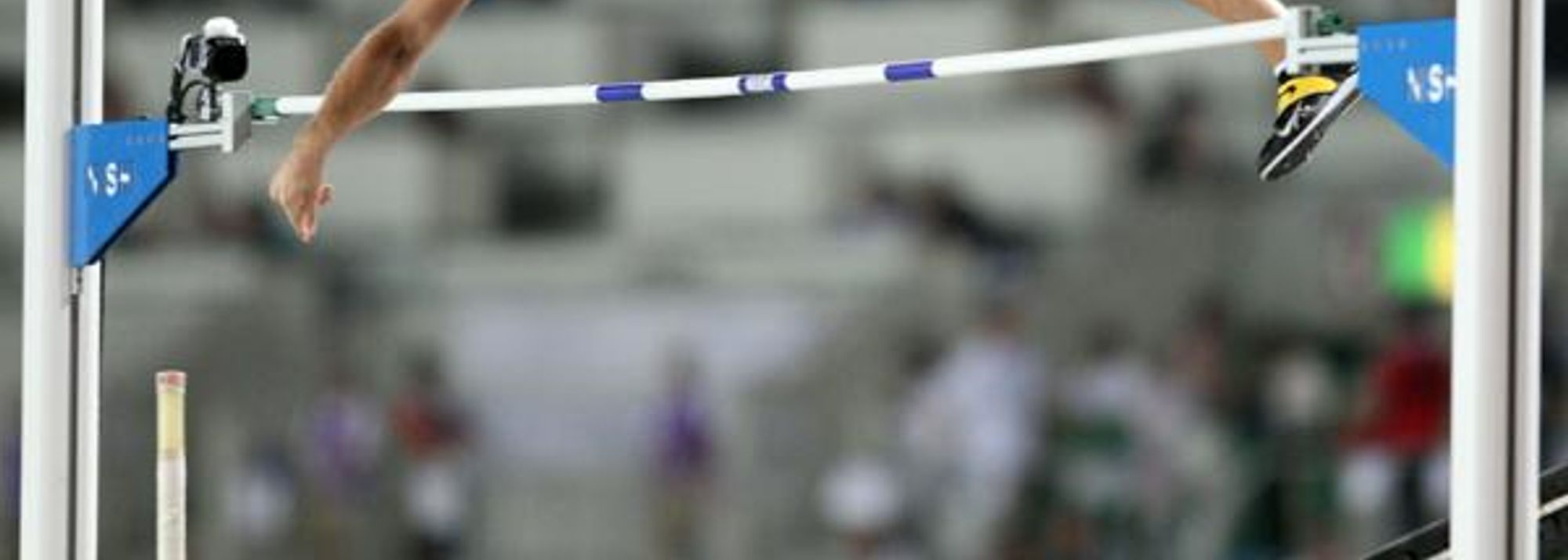


Brad Walker of USA on his way to gold in the Men's Pole Vault Final (© Getty Images)
MonteCarloIn the third installment of their eight edition review of the highlights of the 2007 Athletics year, A. Lennart Julin and Mirko Jalava browse over the JUMPS.
MEN - Jumps
High Jump
"Exceptional consistency" is – perhaps somewhat surprisingly given the nature of the event – the word for describing the men's High Jump statistically. If you look at the 100th mark on the outdoor World lists it has been 2.21 plus/minus 1 centimetre during the last decade and the number over 2.30+ has been 23 jumpers plus/minus 2!
Well, the latter fact has one exception: This year (2007) the number suddenly rose to 30 which is very close to the all-time high from the early 1990's. So even though the really outstanding heights were missing in 2007 – it is quite symptomatically that the world leading mark of 2.35 was achieved by four different jumpers – an underlying trend might have begun that will materialize itself in better marks at the very top in coming years.
But at the same time it must remembered that the event in recent years have seen a number of athletes emerging as would-be World dominators of consistently challenging the 2.40 level only to quickly disappearing again, mainly due to injury problems. People like Jacques Freitag or more recently Ivan Ukhov and Andrey Silnov. Obviously lifting your body to those monster heights takes a serious physical toll on the body.
But then there are of course the exceptions to that rule, the jumpers that seem to never be injured: Sweden's Stefan Holm and Russia's Yaroslav Rybakov.
Holm – 31 in 2007 – has the extraordinary (unique?) record of having competed in every indoor and outdoor championship (Olympic, World and European) for the full last decade. I.e. twenty straight championship starts. And he has not just started - he has been highly competitive: 6 gold, 3 silver, 1 bronze, 4 fourth places, 1 fifth, 1 sixth, 2 seventh, 1 tenth and one dnq (1998 indoors)!
And Rybakov – four years younger – is well on his way to a championship record of similar impressiveness. Beginning in 2001 he has competed in all but one of the championships (missed the 2007 European indoors) and has collected 2 gold, 6 silver, 1 bronze, 1 fifth, 1 sixth, 1 seventh and 1 ninth!
But this year these two ultra-consistent and technically extremely accomplished jumpers found themselves outshone by a jumper in many ways their opposite: the Bahamas’ Donald Thomas just begun high jumping at age 22 last year and despite a still quite rough technique which made him highly inconsistent (losing 6 of 9 international competitions) he still managed to out jump the world elite when it mattered most, in Osaka and in the World Athletic Final.
But it should be noted that he in Osaka was very close to being eliminated already in the qualification and in the final he had failures at 2.21, 2.26 and twice at 2.33 before that first time clearance of 2.35 suddenly turned everything around. So the big question for the future is whether Thomas will be able to improve his technique and thus his consistency. The physical potential ("lift") is certainly there to become a 2.40+ jumper but is it possible to acquire the necessary technical refinement at this stage?
Other jumpers of the same generation – like Cyprus's Kyriakos Ioannou, Russia's Andrey Silnov and Sweden's Linus Thörnblad – are much more advanced when it comes to technical consistency and historically this has proved to be the right concept for having a full and successful career.
As for the High Jump it should be noted that at the top the indoor season once more outshone the outdoor one: Indoors the top-5 read 2.39 – 2.38 – 2.38 – 2.38 – 2.36 while it outdoors was 2.35 – 2.35 – 2.35 – 2.35 – 2.34! To some extent this could be explained by the conduciveness of many bouncy indoor tracks but it is not the whole story as some of the marks (e.g. Holm's and Thörnblad's 2.38) were made on permanent "firm ground" identical to outdoors.
The lack of weather problems and the intimate setting (close to the crowd) and the fact that many of the marks came from special "High Jump Only" events probably are just as important reasons for many jumpers getting higher under roof than in open air.
High Jump - 2007 World Lists
Pole Vault
Statistically this event is quite similar to the High Jump in as much as the performance levels for the last decade have remained unchanged. The amplitude of the variations is little bit larger here but there has never been any real trend and over the period it all averages out the same. If one e.g. compares 2007 with 1999 (another pre-Olympic year) the number of 5.80+ jumpers is 17 vs 17, the number of 5.70+ jumpers 29 vs 38 and the top-100 cut-off is 5.45 vs 5.46.
Despite the fact that the first ever 6m-vault was made by a 21-years old Sergey Bubka as far back as in 1985 it remains an almost illusive barrier. In the 22 years that have passed since that first, only thirteen more have managed it and only six of them more than once. Since the new millennium started only one international championship title has seen a 6.00+ performance (Dmitri Markov 6.05 in Edmonton 2001) and the three most recent World Championships outdoors have been won with 5.80-5.90 and the three most recent World Indoor Championships all with 5.80!
Obviously that destroys the old sport psychologist theory that once someone breaks through a "mental barrier" that proof of its possibility leads to hoards of others to emulate the feat. 6m is apparently not just a mental barrier but very much a physical reality that few are truly capable of mastering.
That you have to go all the way down to position No 14 on the 2007 World list to find a vaulter under the age of 25 seems to indicate that it takes time to the learn the trade – or that the influx of new talent from the junior ranks has been rather sparse in recent years. In any case there is no indication for a rise in standards being imminent.
In Germany, one of the real top nations in Pole Vaulting, five of their top-6 in this year were born in the 1970's, i.e. in or very close to their 30's. Also in the US the experienced are dominating: The average age for their 14 vaulters clearing 5.60 or better in 2007 was 29.6 years. So the future appears much more promising for former powerhouse Russia with four of their five 5.70+ vaulters being between 20 and 22 years old.
Pole Vault - 2007 World Lists
Long Jump
This was a fairly low-profile year quality wise with the number of 8.00+ jumpers about sixty and the top-10 mark close to 8.30, i.e. much like the typical average year. The dominant figure just like last year was Panama's Irving Saladino who won all his meets and who was consistent around 8.50 if the weather conditions were at least decent.
The only time Saladino came under pressure was in the Osaka final were he was in an apparently safe lead (8.46, 2nd place in 8.30) going into the last round. There Italy's Andrew Howe suddenly flew to a new national record of 8.47 and Saladino had just one chance to respond. But he certainly proved his mettle as a competitor by pulling out his own new national record of 8.57!
But although he had to settle for the silver, Howe at the same time had proven that he now is beginning to live up to the enormous expectations that was created by his success as a junior a few years ago. He could very well be the man to push Saladino up towards the distances where even the World record might become seriously threatened. With Howe 22 and Saladino 24 their best years certainly must lay ahead of them.
World list leader Louis Tsatoumas of Greece started the year with a string of six straight meets at 8.10 or better including 8.66 and 8.54 in early June on home soil in Greece. But injury ended his season a few weeks later just when the main part of the summer season had begun to pick up pace.
Just like in the Pole Vault the US is mainly relying on experience from a generation of jumpers some five years older than the Osaka top-2 (Saladino and Howe) and headed by Dwight Phillips who turned 30 this autumn. Out of the top-10 Americans in 2007 only three set new PB's this year which further enhances the impression that current trend for US long jumping is not positive. However, we now from previously that new US talents always tend to burst onto the World scene when needed in Olympic years.
Long Jump - 2007 World Lists
Triple Jump
In the summer of 2006 Christian Olsson returned to the event after being out with foot injury since 2004 and he promptly reclaimed the position as the undisputed No 1 Triple Jumper in the World. In 2007, however, a recurrent hamstring problem cut his seasons short after just four meets both indoors and outdoors. When competing Olsson was still dominant with a 2 cm loss to Britain's Phillips Idowu in the outdoor opener being the only blemish to the record.
With Olsson having his last competition on 13 July the No 1 position was open for contest during the main part of the outdoor season including the World Championships. But no jumper was able to claim that vacant position. Rather it was a something of a different-meet-different-order situation among the leading jumpers:
Madrid: 1) Évora, 2) Lewis, 3) Wilson
London: 1) Wilson, 2) Sands, 3) Lewis,
Stockholm: 1) Oprea, 2) Wilson, 3) Lewis, 4) Sands
World Championships: 1) Évora, 2) Grégorio, 3) Davis, 4) Tosca, 5) Wilson, 6) Idowu, ... dnq) Sands
Zurich GL: 1) Davis, 2) Évora, 3) Wilson, 4) Grégorio
Brussels GL: 1) Davis, 2) Wilson, 3) Évora, 4) Grégorio, ... nm) Sands
Berlin GL: 1) Wilson, 2) Évora, 3) Grégorio, 4) Davis, 5) Sands, 6) Lewis
World Athletic Final: 1) Davis, 2) Wilson, 3) Évora, 4) Lewis, 5) Sands, 6) Grégorio
It should also be noted that the numbers at the top of the World list are not a very good representation of the relative merits and the normal level of the athletes. World list leader Jadel Grégorio had his 17.90 (and a 17.70) at home in Brazil, while he failed to reach even 17 metres in six of his eight competitions in Europe. And No 2 Nelson Évora (Portugal) with the Osaka winner 17.74 had only one more meet beyond 17.30.
So the kind of 17.50+ consistency shown by Olsson when fit is something other jumpers still haven't been able emulate. Consistency-wise 24-years-old American Aarik Wilson was the most impressive this summer: Coming into 2007 with a PB of 17.32 Wilson put together no less than eight meets – in eight different countries – at 17.26 or better.
Olsson was not the only top jumper missing the summer of 2007 wholly or partially due to injury. Romanian Marian Oprea, Britons Phillips Idowu and Nathan Douglas plus Russian Danila Burkenya all had seasonal records consisting of only a handful of competitions of varying quality. If they all return in full health we can look forward to a really memorable year of triple jumping in 2008, in contrast to 2007 which turned out "just another year".
Triple Jump - 2007 World Lists
WOMEN - Jumps
It was another extremely high standard season for women’s jumps, but in the end there was only one star rising above the others. 24-year-old Croatian Blanka Vlasic won the World Junior Championships in 2002, but it did take a few years for her to find a way to major championships glory. After a quiet indoor season she immediately struck gold in Doha setting a 2.04m national record and made her first tries at 2.10m world record height. She won 18/19 competitions during the season ending up with a 2.07m NR in Stockholm in August and no world record yet.
In the Pole vault Yelena Isinbayeva (RUS) extended her win streak to 22 competitions and had a perfect season win 18 wins in as many competitions. The Russian set 4.93m World indoor record in February, but like Vlasic in High Jump, could not find a way to clear 5.02m outdoors.
As usual, Russians were at the top of the Long Jump with Lyudmila Kolchanova leading the world with her 7.21m in May. Olympic Champion Tatyana Lebedeva beat Kolchanova in Osaka to grab another gold medal, but was then beaten by Yargelis Savigne (CUB) in the Triple Jump where she opened the World Championships final with a huge world leading jump of 15.28m which was enough for the win.
High Jump
Blanka Vlasic had taken the silver medal from the 2006 World Indoor Championships after a good indoor season, but her 2006 outdoor one did not match the indoor form and she finished fourth at the European Championships. In 2007 indoors did not go too well and she could only clear 2 metres once and finished a disappointing fifth at the European Indoor Championships in March.
The start of outdoor season however saw a new Vlasic. She cleared a 2.04m national record in Doha in May and although the next competitions were not spectacular including one loss in Oslo in June, she hit top form starting from the Paris Golden League meeting in start of July where she won with a 2.02m result. From that competition on there was only one favourite for the Osaka high jump and Vlasic cleared 2 metres in every of the 12 meets starting from Paris and made further tries at the 2.10m world record height in several meets.
Vlasic set four national records during the season and her 2.07m clearance in Stockholm takes her two equal second place on the world all-time list behind Stefka Kostadinova’s (BUL) 2.09m World record and tied with another Bulgarian Lyudmila Andonova.
The Croatian also handled the pressure in Osaka to take her first major championships medal outdoors winning with a 2.05m result before a strong challenge from Anna Chicherova (RUS) and Antonietta Di Martino (ITA) who were tied for the silver medal at 2.03m.
Russia is the best country in this event with 16 athletes on the world top 100 list. Ukraine is second with ten and USA has nine for third place.
High Jump - 2007 World Lists
Pole Vault
25-year-old Yelena Isinbayeva (RUS) continued her nearly perfect career during the 2007 season. The Russian broke the World indoor record with a 4.93m clearance in February in Donetsk, Ukraine, for a total of 20 World records (11 outdoors, 9 indoors) during career.
She won all of her 18 competitions during the season and successfully defended her 2005 World title in Osaka. Isinbayeva now has 52 career competitions at 4.70m or better and holds the competition record for all major championships, indoors and outdoors (Olympics, World indoor/outdoor Champs, European indoor/outdoor Champs). The only disappointment during the season was that she could not yet set another world record.
Fortunately the season was not just about Isinbayeva. American Jenn Stuczynski entered a new level with her 4.88m American record in New York in June, but an injury prevented her from making big things happen in Osaka. Monika Pyrek (POL) set a fine personal best 4.82m at the World Athletics Final in Stuttgart and former World record holder Svetlana Feofanova (RUS), who was third in Osaka, also cleared 4.82m in Stuttgart for her best result for more than three years.
Katerina Badurova (CZE) was the surprise silver medallist in Osaka setting a 4.75m national record in the process.
USA has the best depth in this event with 21 athletes on the world top 100 list with Germany second at 15. Poland and France are tied for third with seven.
Pole Vault - 2007 World Lists
Long Jump
28-year-old European Champion Lyudmila Kolchanova (RUS) started the 2007 outdoors season with a huge world leading personal best of 7.21m in May. And although she won the Russian Championships with another high standard result 7.17m, she only competed in her third outdoor final in Osaka and maybe because of lack of competition was well beaten by fellow Russian Tatyana Lebedeva. The triple jump specialist, only competing in her second outdoor major championships long jump competition in addition to the 2004 Olympics where she won, marked another win with a 7.03m jump.
Kolchanova managed 6.92m for the silver medal and Tatyana Kotova filled the third part of an all Russian sweep just two centimetres behind Kolchanova (6.90m). With Kolchanova finishing her season in Osaka, Lebedeva went on to win the World Athletics Final and was clearly the number one long jumper in 2007.
Russia has 20 athletes on the world top 100 list with USA second at 16 and Ukraine third with six.
Long Jump - 2007 World Lists
Triple Jump
Following a successful European Championships in 2006, Tatyana Lebedeva entered the 2007 season still as the best triple jumper in the world. Lebedeva, who has bettered 15 metres every year (didn’t compete in 2002) since 2000, only competed four times before Osaka, but 23-year-old Cuban Yargelis Savigne had a big surprise in her pocket. The Cuban jumped a huge 15.28m personal best, only her second career 15m jump, in round one to win the competition. Lebedeva surprisingly didn’t get even close and finished second with a 15.07m result.
2004 Athens Olympics phenomenon Hrisopiyí Devetzí is a good competitor. The Olympics silver medallist was able to produce her first legal 15m jump of the season to take the bronze in Osaka, her first medal in three World Championships.
Russia is the best country in this event with 17 athletes in the world top 100 list. China has 11 for second and Cuba is third with eight.
Triple Jump - 2007 World Lists
IAAF

