

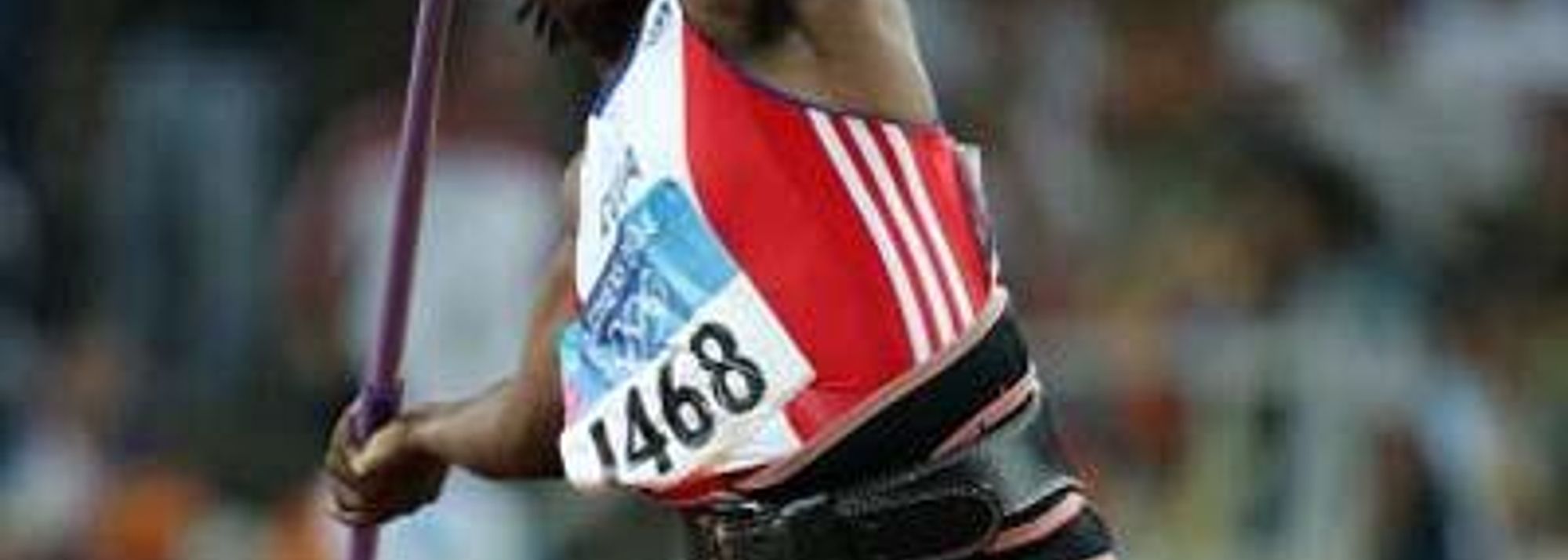


Osleidys Menendez of Cuba wins gold in the women's javelin (© Getty Images)
In the penultimate episode of their review of the 2004 Athletics year, statisticians A. Lennart Julin and Mirko Jalava reach the topic of the throwing events.
MEN - Throws
Shot Put
The difference that can occur between statistical lists and actual competitions was very apparent in the Shot Put in 2004. In the world list the US occupied all the top-4 positions but at the Olympics they were missing the list leader (Christian Cantwell) and had to be content with one medal (Adam Nelson, silver), one non-scoring finalist (John Godina, 9th) and one eliminated in qualification (Reese Hoffa, 22nd)!
It appeared that the intense national competition - including a series of prestigious head-to-head competitions - caused the US putters to hit their peak form in May and June. Out of the top-18 performances of the year 17 where by Americans, and 13 were set before the end of June! The most noticed “victim” of this was Cantwell who compiled the top-4 marks overall early on but who then missed the Olympics after finishing 4th in the US Olympic Trials.
The top European shot putters thus never reached the absolute levels of the Americans but on the other hand they timed their peak form much better to the major international encounters: Yuriy Bilonog had his top mark (21.16) when winning the Olympic title, and Joachim Olsen had his two best marks at the World Athletics Final (21.46, won) and the Olympics (21.07, 3rd)!
As for the general standards of the event, the Olympics – held in the scenic setting of the ancient Olympia – was the third straight global championships where it took 20+ to reach the final: In Edmonton ’01 the cut-off was 20.13, in Paris ’03 it was 20.06 and now in Athens ’04 we had 20.04.
Looking at the world lists the number of 21+ seems to have stabilised around ten, while the number of 20+ has been growing steadily from 2001 onwards: 34 – 38 – 42 – 49!
Shot Put - IAAF WORLD RANKINGS - as of 13 Dec 2004
Position - Name - DOB - Country - Points
1. Joachim OLSEN 77 DEN 1335
2. Adam NELSON 75 USA 1327
3. Christian CANTWELL 80 USA 1323
4. Manuel MARTÍNEZ 74 ESP 1316
5. Reese HOFFA 77 USA 1284
6. Janus ROBBERTS 79 RSA 1274
7. Carl MYERSCOUGH 79 GBR 1266
8. Yuriy BILONOG 74 UKR 1251
Discus Throw
Thanks to the TDK Golden League status this year the Discus Throw season contained many more direct high profile encounters between the main contenders than a normal year. But that didn’t stop Virgilijus Alekna from once more dominating the event, accumulating two competitions at 70m, six at 69m and three at 68m.
The only real challenge to his supremacy came once more from Robert Fazekas who didn’t compete as extensively but who finished just 16 cm behind Alekna’s 70.97 in Rethymno, 76 cm behind Alekna’s 68.42 in Rome, and then 56cm ahead of Alekna’s 69.21 in the final pre-Olympic encounter - Zurich.
When Alekna opened the Olympic final with the new Olympic record 69.89 it appeared that the gold medal was decided, but in the second round Fazekas hit 70.93 and although Alekna tried hard in the remaining rounds he never managed to reclaim the lead position. However, that was not the end of the story as it turned out that Fazekas failed to supply a doping test according to the rules after the competion so the Olympic gold still went to Alekna.
Despite Alekna’s continued dominance, 2004 appeared to signal that a new group of throwers were rising towards the top to replace the “old guard”. 5-times World champion Lars Riedel had to be content with a 7th place in Athens. The most prominent of the “young” (born 1978/79) generation were Hungarian Zoltan Kövago (Olympic silver), Esthonian Gerd Kanter (Olympic bronze), and Spaniard Mario Pestono (missed Olympic final but won World Athletics Final) who all showed consistency at 66/67 metres.
That the Discus Throw is an event where it usually takes at least until your mid-twenties before you establish yourself in the international elite, is illustrated by the fact that there was only one single athlete in the 2004 top-25 – South African Hannes Hopley – who was born in the 1980’s.
Discus Throw - IAAF WORLD RANKINGS - as of 13 Dec 2004
Position - Name - DOB - Country - Points
1. Virgilijus ALEKNA 72 LTU 1414
2. Róbert FAZEKAS 75 HUN 1316
3. Zoltán KÕVÁGÓ 79 HUN 1312
4. Aleksandr TAMMERT 73 EST 1300
5. Mario PESTANO 78 ESP 1299
6. Frantz KRUGER 75 RSA 1277
7. Gerd KANTER 79 EST 1273
8. Lars RIEDEL 67 GER 1240
Hammer Throw
Traditionally hammer people are the most consistent of all throwers and Koji Murofushi must be one of the most consistent hammer throwers ever: This year he had all his seven meets within a little over one metre (between 81.92 and 83.15!) despite competing on three different continents during four and a half months.
And he won all of them although the Olympic title came with some delay as Adrian Annus – who on the day in the Athens Olympic Stadium threw 28 centimetres further – was retroactively disqualified due to infringing doping regulations.
So although Murofushi’s top mark only gave fourth place on the World list there was no doubt concerning his status as the No 1 thrower of 2004. Olympic silver medallist Ivan Tikhon had his top-4 meets (all on home soil) at 82.87-84.46 but then 80.78 was his top mark in international competition, and he was clearly defeated by Murofushi in both their encounters.
Tikhon also lost the World Athletic Final, where Finn Olli-Pekka Karjalainen partially compensated for his Olympic failure (just 15th in the qualification after throwing some seven metres shorter than his PB). Concerning the qualifying round, the rise in standards during the last major championships seems to have come to a halt: After 76.61 in Sydney, 76.72 in Edmonton and 77.78 in Munich (European Championships), it was 76.56 in Paris and this year 76.69 in Athens.
The 24 years old Karjalainen - despite his Athens failure - definitely belongs to the group of rising stars in the event. But he stands the risk of soon being overtaken by two throwers that are two years younger: Hungary’s Krisztian Pars and Turkey’s Esref Apak who have progressed almost parallel in recent years. In 2003 they were on the fringes of the elite with marks at 77/78 metres. This year they were on the 81m-level and in their first-ever appearance in a world-wide senior championships they finished 3rd (Apak) and 5th (Pars) at the Olympics!
The event continues to be kept in a very firm grip by Europe which had 11 out of the 12 Olympic finalists with the – brilliant – exception to the rule being the winner Murofushi.
Hammer Throw - IAAF WORLD RANKINGS - as of 13 Dec 2004
Position - Name - DOB - Country - Points
1. Koji MUROFUSHI 74 JPN 1325
2. Ivan TIKHON 76 BLR 1300
3. Olli−Pekka KARJALAINEN 80 FIN 1261
4. Krisztián PARS 82 HUN 1254
5. Adrián ANNUS 73 HUN 1253
6. Vadim DEVYATOVSKIY 77 BLR 1249
7. Esref APAK 82 TUR 1229
8. Primož KOZMUS 79 SLO 1224
Javelin Throw
Throwers like Jan Zelezny and Steve Backley seem to have been around forever – some 15 years is almost “forever” in sports – but 2004 was probably the year when they and their generation finally had to give way. But their successors still have some serious catching up to do as no one surpassed 88 metres this year for the first time in 15 years. Also, Aleksandr Ivanov’s world leading mark of 87.73 only would give him 20th place on the All-Time list.
But perhaps the most encouraging fact is that four out of the top-8 – including the gold and silver medallists – at the Olympics were born in 1982, i.e. are just 22 years old. The top-2 – Andreas Thorkildsen and Vadmis Vasilevskis – also both achieved new personal best marks in the Olympic final. The other two top throwers born that year are Ivanov and from the traditional Javelin power Finland, perhaps their greatest hope for the future Tero Pitkämäki.
Although turning 28 this year American Breaux Greer looks like a thrower with an exciting future if he can manage to avoid the serious injuries that have beset him for several years. Greer had the best set of marks (four at 86.83 - 87.68) but a painful knee injury made him alternate top with mediocre performances. This was very apparent in the Olympics where a very impressive 87.25 in the qualification round was followed by a 74.36 in the final finishing 12th and last.
The Javelin remains the favourite event of small (population wise) nations in northern Europe. They contribute more than 50% of the top-15 of the World list - three throwers from Finland, two from Latvia, two from Norway and one from Estonia!
Although the top end of the world lists were somewhat mediocre compared to previous year the standards beneath the “surface” were close to the all-time high with 49 throwers beyond 80 metres. This compares favourably with the two most recent Olympic years: 51 in 2000 and 47 in 1996.
Javelin Throw - IAAF WORLD RANKINGS - as of 13 Dec 2004
Position - Name - DOB - Country - Points
1. Andreas THORKILDSEN 82 NOR 1294
2. Breaux GREER 76 USA 1291
3. Sergey MAKAROV 73 RUS 1269
4. Aleksandr IVANOV 82 RUS 1262
5. Eriks RAGS 75 LAT 1210
6. Tero PITKÄMÄKI 82 FIN 1196
7. Vadims VASILEVSKIS 82 LAT 1195
8. Andrus VÄRNIK 77 EST 1188
WOMEN - Throws
It was the Hammer Throw that was in the spotlight in the women’s throwing events in 2004. While the Shot Put continued to go further down in quality, it was the Hammer which continued in the other direction with standards up for another year again. The Javelin had a better season too with Osleidys Menendez (CUB), the World record holder, coming as close as possible to her record in the Olympics, missing it by 1cm. Her 71.53m winning mark was naturally also her best since her 2001 World record of 71.54m.
Shot Put
The women’s Shot Put suffered badly during the Olympic season of 2004. Although the world list shows four athletes, two Russians and two Belarussians, over the 20m limit, the reality was different in the major championships. World list topping Irina Korzhanenko (RUS) was stripped off her Olympic gold medal because of a doping violation. Also another top Russian, Svetlana Krivelyova, who entered the ancient fields of Olympia with a season’s best of 20.69m, only managed 19.49m in the Olympic final to grab the bronze.
Yumileidi Cumbá (CUB) took a surprise Olympic gold with an extremely low performance of 19.59m, Nadine Kleinert (GER) in the silver medal position was only 4cm behind the Cuban with 19.55m. Nadezhda Ostapchuk (BLR), the silver medallist from the 2003 World Championships in Paris, lost her stride in Olympia finishing fourth with just 19.01m. Her qualification topping 19.69m would have been enough for the gold medal in the final.
However, although Ostapchuk suffered in the Olympics, she finally found her form shortly after the Olympics winning in Berlin with a personal best of 20.36m and also with 20.02m in Yokohama, both in September. These two 20m performances were the only ones of that rank made outside any shot putter’s native country in 2004.
19m limit seems to be harder and harder to achieve. During this Olympic season there were only nine athletes over this limit, 2003 had 10, there were 10 in 2002 as well, 13 in 2001 and 14 in 2000. USA heads the list with 17 athletes in the world top-100, China was second with 15 and Russia third with 9.
Shot Put - IAAF WORLD RANKINGS - as of 13 Dec 2004
Position - Name - DOB - Country - Points
1. Svetlana KRIVELYOVA 69 RUS 1249
2. Yumileidi CUMBÁ 75 CUB 1248
3. Nadezhda OSTAPCHUK 80 BLR 1246
4. Nadine KLEINERT 75 GER 1206
5. Irina KORZHANENKO 74 RUS 1204
6. Krystyna ZABAWSKA 68 POL 1193
7. Natalya KHORONEKO 82 BLR 1185
8. Cleopatra BOREL 79 TRI 1159
Discus Throw
Reigning World champion, 39-year-old Irina Yatchenko (BLR), also a bronze medallist from the Sydney Olympics in 2000, topped the world lists before the Olympics with a big personal best of 69.14m which was thrown in her home country in July.
Natalya Sadova (RUS), who has entered many recent major championships as a favourite was probably relieved at not being the only favourite this time. In a very even competition the 32-year-old Russian won with a throw of 67.02m, just edging the Greek Anastasia Kelesidou to the disappointment of the home crowd (66.68). Yatchenko took her second successive bronze medal from the Olympics throwing 66.17m in the final.
Depth in the event took a turn for the better. There were 22 athletes over the 63m limit, much improved on the 16 in both 2003 and 2002. USA had the most athletes in the world top-100 with 18, China had 12 and Russia, 9.
Discus Throw - IAAF WORLD RANKINGS - as of 13 Dec 2004
Position - Name - DOB - Country - Points
1. Natalya SADOVA 72 RUS 1286
2. Vìra POSPÍŠILOVÁ−CECHLOVÁ 78 CZE 1256
3. Irina YATCHENKO 65 BLR 1220
4. Aretha HILL 76 USA 1212
5. Olena ANTONOVA 72 UKR 1207
6. Anastasia KELESIDOU 72 GRE 1198
7. Franka DIETZSCH 68 GER 1192
8. (8.) Beatrice FAUMUINA 74 NZL 1190
Hammer Throw
The women’s Hammer Throw has been progressing more and more quickly lately, but the Olympic year of 2004 was the best.
Since the Olympics in Sydney 2000, this event has taken long strides forward. There were a total of 19 performances over 70m in 2000, in 2001 there were 20 over the 70m limit, then in 2002 there were 28, but the real start of the fast-forward was in 2003 when there were 71 performances at 70m or better.
This season however, was a totally different story – 115 performances over 70m which reflects the huge progress going on in this event now.
This progress naturally affected the top marks as well, in Athens a 73.16m throw was needed for the medal podium (bronze by Yunaika Crawford, CUB). As usual, Yipsi Moreno topped the world lists, her best mark came during the early season, when the 24-year-old won the Cuban National Games with a Caribbean and Central American record of 75.18m, and backed that up in the summer as well. She won a meeting in Padua, Italy, with 75.06m in July.
But in the Olympics, it was not Moreno who won, but rather Olga Kuzenkova (RUS), who it had seemed at a world level was destined to be second forever because of her previous multiple silver medal finishes at major championships. The 34-year-old Russian won the Olympics with an impressive season’s best of 75.02m, her best since a national record of 75.68m in 2000. Moreno was well beaten taking the silver with a 73.36m effort.
Even the depth in this event continued its good progress. There were a total of 86 athletes over 65m this season compared with 70 last year (2003), 44 in 2002, 39 in 2001 and 36 in 2000. United States was the clear number one country in this event with 17 athletes in the world top-100, China, Germany and Russia all have 7 athletes.
Hammer Throw - IAAF WORLD RANKINGS - as of 13 Dec 2004
Position - Name - DOB - Country - Points
1. Yipsi MORENO 80 CUB 1283
2. Olga KUZENKOVA 70 RUS 1275
3. Kamila SKOLIMOWSKA 82 POL 1216
4. Betty HEIDLER 83 GER 1211
5. Manuela MONTEBRUN 79 FRA 1204
6. Irina SEKACHOVA 76 UKR 1203
7. Olga TSANDER 76 BLR 1201
8. Yunaika CRAWFORD 82 CUB 1198
Javelin Throw
After a disappointing 2003 season, when she finished only fifth at the Paris World Championships, Osleidys Menendez came back stronger than ever. She suffered only two losses during the season, and showed what her season was going to be about when throwing her javelin 68.23m in Havana way back in March.
Although that Havana distance stood as the world lead until the Olympics, she also recorded several competitions at a better level than her competitors including two 67m+ ones in July. And she did not disappoint in the Olympic final either, 71.53m was something no other athlete in the competition could dream of and Steffi Nerius (GER), who took the silver medal, finally lost by nearly six metres despite recording a fine personal best of 65.82m. It was really a one woman show with Mirela Manjani (GRE) finally overcoming her big injury problems in the Athens qualification, to take the Olympic bronze in the final round - ahead of Nikola Brejchová - with a 64.29m season’s best, but never coming close to her usual form.
Overall there were 37 athletes over the 60m line, plenty more than 26 in 2003. In 2002 there were 29, 23 in 2001. There were also 37 in the previous Olympic season of 2000. Germany had the most athletes in the world top-100 with 11, ahead of eight from China and seven by Russia.
Javelin Throw - IAAF WORLD RANKINGS - as of 13 Dec 2004
Position - Name - DOB - Country - Points
1. Osleidys MENÉNDEZ 79 CUB 1353
2. Nikola TOMEÈKOVÁ−BREJCHOVÁ 74 CZE 1270
3. Steffi NERIUS 72 GER 1209
4. Sonia BISSET 71 CUB 1203
5. Laverne EVE 65 BAH 1148
6. Noraida BICET 77 CUB 1147
7. Felicia TILEA−MOLDOVAN 67 ROM 1138
8. Valeriya ZABRUSKOVA 75 RUS 1132

