

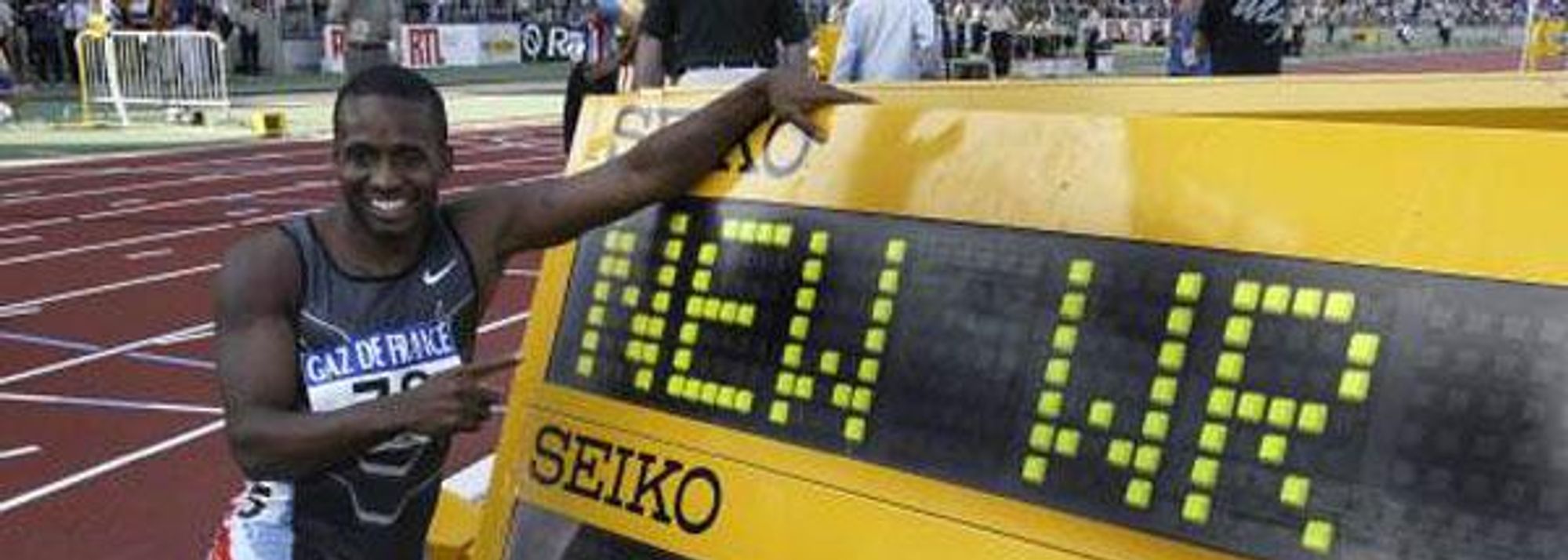


Tim Montgomery 9.78 (© Getty Images Allsport)
In the run up to the end of the year, the renowned track and field statisticians, A. Lennart Julin and Mirko Jalava begin the first of a series of eight end of season reviews covering all Athletics disciplines, highlighting the best performances which have taken place across the world of athletics in 2002.
Here they begin with the Sprint highlights of 2002.
MEN - Sprints
100m
The 100m year got off to an extraordinary good start, with no less than six legal-wind sub-10 second runners by mid-May - equalling the total number for the whole previous year! However, rather than heralding a 100m-summer never yet seen, this start turned out to be an oddity, as only one of those six runners managed to repeat his feat during the main part of the international season.
But on the other hand that particular runner not only dipped under 10 seconds several times - he also capped his year in September with something very special indeed: a new 100m World record at the IAAF Grand Prix Final in Paris. Tim Montgomery (USA) certainly provided the sprint moment of the year, when he took advantage of the extremely favourable weather conditions during the very 10-second time slot that the men’s 100m race at the Charlety Stadium in Paris occupied.
Good use was also made of the same conditions by the runner-up in Paris, Dwain Chambers (GBR) who improved his PR to 9.87, a time which equalled legend Linford Christie’s British and European record! This was Chambers’ fastest race of the year but not necessarily his best. e.g. his 9.96 into a headwind on a cool Munich evening, when demolishing all opposition at the European Championships, certainly wasn’t any less impressive.
Over the course of the year, Chambers was 2-2 verses Montgomery, and 4-1 verses former world record holder Maurice Greene (USA), who after dominating the event for the last four years seemed to have lost that extra edge in 2002. That the sub-par Greene still managed to notch up five legal sub-10 races, tells something about the brilliance shown earlier by a “vintage” Greene.
If the reason for Greene’s regress was waning motivation, the world elite would be very unwise to write him off for 2003, because what better motivation could there be, than to have lost the world record, and thereby the unofficial title of “World’s Fastest Human”?
It is worth noting that the average age of the top-10 100m-runners of 2002 is 27.8 years and that one has to go down to No.14 position on the list to find a runner born in the 1980’s! This is a very different picture than the historical one, when the top sprinters normally left the sport at age 22 or 23. In 1982 - just two decades ago - the average age was 21.6 years and to find someone 28 or older, you had to go all the way down to No.20!
USA’s Bob Hayes, who after long illness sadly passed away this year, is viewed by many historians as the greatest sprint talent ever. When Hayes ended his sprint career with his emphatic Olympic triumph in 1964 - running 10.06 on a rain-soaked and chewed up lane 1 on a cinder track - he was just 21!
Only one athlete of that age or younger managed to run faster in 2002, but still the big breakthrough expected for former world youth and junior champion Mark Lewis-Francis didn’t materialise. The Briton of course is still very much a name for the future.
Much is also expected from the man who followed him on the World Youth and Junior thrones - Trinidadian Darrel Brown - who after his 10.09 at age 17, looks like an almost certain bet to relieve Dwain Chambers of the World Junior record which has stood at 10.06 since 1997.
As for the USA, the traditional “sprint market leader”, no obvious choice of heir apparent to Greene & Montgomery has yet been identified in the new generation, but one can rest assured that someone will appear when necessary. At the moment USA’s Justin Gatlin, with his suspension from international competitions ended - appears to be a world leading sprinter in the making but he might to be more of a 200m-man.
100m - IAAF WORLD RANKINGS - as of 17 Dec 2002
Position - Name - DOB - Country - Points
1. Tim MONTGOMERY 75 USA 1438
2. Maurice GREENE 74 USA 1409
3. Dwain CHAMBERS 78 GBR 1393
4. Bernard WILLIAMS 78 USA 1355
5. Kim COLLINS 76 SKN 1344
6. Francis OBIKWELU 78 POR 1342
7. Coby MILLER 76 USA 1323
8. Jon DRUMMOND 68 USA 1320
9. Uchenna EMEDOLU 76 NGR 1312
10. Mark LEWIS-FRANCIS 82 GBR 1308
200m
Talking about the 200m, almost another year has been lost to the event due the lack of competitive opportunities outside of the championships. In the days of Michael Johnson, every meet organiser wanted to stage the 200m, but since he retired it has almost become a non-event on the circuit. This is a factor which ‘forces’ even those who are more apt for the 200m, to train for and compete in the 100m.
On the uppermost level of invitational meets - the Golden League - only Rome and Brussels staged the 200m and there it was mainly contested by those athletes not being serious contenders for the 100m glory and prize money, i.e. no Montgomery, no Chambers, no Greene and no Collins.
The best season belonged to a rejuvenated veteran, Namibia’s Frank Fredericks, who racked up seven races between 19.99 and 20.29, winning all but the last one - the IAAF World Cup - where Europe’s (Portugal) Francis Obikwelu managed to out lean the Namibian by two hundredths of a second.
Apart from Fredericks, there were basically just two more athletes who seriously attempted to compile a real “season” of 200m-running, American Darvis Patton and Briton Marlon Devonish. But to accomplish that they had to look for meets on the second-tier of the circuit. However, especially Patton’s second part of the summer was quite impressive with a string of times in the 20.10-20.30 bracket.
But still “the 200m performance” of the year belonged to the championships specialist Constantinos Kenteris of Greece. His competitive record was as always, quite restricted as his 2002 season consisted of just three meets: The Greek Championships and the European Cup in June, and the European Championships in August. Of course, he won all three and capped his year in the most extraordinary fashion with his 19.85 in the continental final in Munich.
Despite taking both the Olympic gold in 2000 and the World title in 2001, Kenteris did not get full acclaim as a “great” 200m runner because he achieved those titles without ever having dipped under the “greatness benchmark” of 20 seconds. He took care of that criticism in the most emphatic way in Munich, as his 19.85 came in weather conditions far from conducive to sprint times.
200m - IAAF WORLD RANKINGS - as of 17 Dec 2002
Position - Name - DOB - Country - Points
1. Frankie FREDERICKS 67 NAM 1345
2. Francis OBIKWELU 78 POR 1329
2. Shawn CRAWFORD 78 USA 1329
4. Darvis PATTON 77 USA 1301
5. Constantinos KENTERIS 73 GRE 1296
6. Marlon DEVONISH 76 GBR 1294
6. Christian MALCOLM 79 GBR 1294
8. Ramon CLAY 75 USA 1283
9. Bernard WILLIAMS 78 USA 1269
10. Abdul Aziz ZAKARI 76 GHA 1258
400m
When Michael Johnson retired he left a big void not just in the 200m but also in the 400m. The first non-Michael year 2001, didn’t produce any athlete capable of establishing himself as the new undisputed No 1 of the 1-lap event. Avard Moncur (BAH) won the World title and had the best year overall, but not by a very big margin.
So in 2002 the event was still open for grabs for anyone aspiring to become the ruler of the “quarter-mile”, but the year ended very much like the previous one. i.e. with a sizeable group of contenders fairly tightly bunched at or just below 45.0, of whom anyone could win or lose to any of the others, on any given day.
The best mark of the year came early in the season in May, when USA’s Leonard Byrd ran 44.45 at the GP meet in Belém, Brazil. The best set of times belonged to Alvin Harrison who had three at 44.48-44.62. While the best competitive record of 2002 was that of Jamaica’s Michael Blackwood.
After an average first half of the summer, Blackwood really finished the year well by taking the Commonwealth title and winning both the IAAF Grand Prix Final and the World Cup. This clearly outshines everything Blackwood had accomplished before but at the age of 26, he is far from a young upstart, rather he is the sort of athlete who with dogged persistence has gradually managed to raise his level.
So the search for the new emperor of the 400m will go on for at least another year. However, the very strong shadow cast by Michael Johnson will eventually fade away, and there just ought to be some sub-44-talents out there somewhere! The last new inductee into that exclusive society was Johnson himself and that happened almost ten years ago in 1993!
400m - IAAF WORLD RANKINGS - as of 17 Dec 2002
Position - Name - DOB - Country - Points
1. Michael BLACKWOOD 76 JAM 1349
2. Fawzi Dahash AL SHAMMARY 79 KUW 1316
3. Leonard BYRD 75 USA 1315
4. Greg HAUGHTON 73 JAM 1311
5. Avard MONCUR 78 BAH 1296
6. Ingo SCHULTZ 75 GER 1290
7. Felix SÁNCHEZ 77 DOM 1285
8. Antonio PETTIGREW 67 USA 1284
9. Alvin HARRISON 74 USA 1278
10. Daniel CAINES 79 GBR 1270
WOMEN – Sprints
Although women’s sprints did improve during 2002, there was a certain lack of real competition between the world’s top stars. 2002 was not a worldwide major championship year which became apparent by the results recorded during the season.
Zhanna Pintusevich-Block (UKR) only had a couple of competitions against Marion Jones (USA) and despite strangely running fast times in smaller European meets, the Ukrainian was of no real threat to Jones when they raced together.
In 200 metres there were plenty more world class times, but very few races had more than one fast runner taking part, and really fast times under 22 seconds were completely missing.
The 400 metres had the best quality, with Mexican Ana Guevara rising to a new level. Guevara dipped seven times under 50 seconds, also once running 50.00 exactly, and Lorraine Fenton (JAM) was a good opponent many times in the Golden League meetings. Altogether it was a good year, women’s sprinting in 2003 can await on even better outlook because of the boost the World Championships should give.
100m
Marion Jones was the leading figure in the women’s 100 metres as usual. Although the season ended with Zhanna Pintusevitsh-Block at the top of the world list, it was Jones who clearly was the number one runner. The two did not run against each other for most of the season but when they did, Pintusevitsh-Block was quite far from winning their races together.
In fact it was Jamaica’s Tayna Lawrence, who came closest to beating Jones during 2002. Lawrence lowered her PB to 10.93 and raced well during the long season. Lawrence has a very good first half of the race and has a good possibility of becoming the world’s leading sprinter, if she can also find similar speed at the end of the race too.
Six women went under 11 seconds this season, with Veronica Campbell (JAM), the double World Junior Champion from 2000 running 11.00. Campbell had some trouble after winning two titles in Chile, but came back early in the season with fast headwind times in Odessa, Texas, in May. She ran 11.17 and 22.39 to win the US Junior College Championships and showed that she is a real candidate to top the world in the near future.
Depth in the event was quite good with 15 athletes under 11.10. In 2001, there had only been 12 – but of course the Olympic year of 2000 had still been much better with 20 runners at 11.07 or faster.
100m - IAAF WORLD RANKINGS - as of 17 Dec 2002
Position - Name - DOB - Country - Points
1. Marion JONES 75 USA 1400
2. Zhanna PINTUSEVICH 72 UKR 1342
3. Tayna LAWRENCE 75 JAM 1339
4. Chryste GAINES 70 USA 1332
5. Debbie FERGUSON 76 BAH 1313
6. Chandra STURRUP 71 BAH 1311
7. Muriel HURTIS 79 FRA 1301
8. Kellie WHITE 77 USA 1289
9. Susanthika JAYASINGHE 75 SRI 1286
10. Mercy NKU 76 NGR 1284
200m
The 200 metres has been a weak event for women lately. In Edmonton, even the 2001 World Championships offered very modest quality, but in 2002 the event did improve a bit. After the very good years of 1999 and 2000, this last year was not nearly as good, but much better than 2001.
One of the continuing problems is that as 100 metres was the Golden League event, the 200m did not attract more than one major star per race. There were many fast times, but only in the Brussels meeting, with both Zhanna Pintusevich-Block and Marion Jones running, did any race contain many elite runners.
However, some athletes like Debbie Ferguson (BAH), Veronica Campbell (JAM) and French 200m specialist Muriel Hurtis showed signs of bigger ambitions and their future performances could threaten even Marion Jones next season.
Overall, the season was quite poor in terms of depth. There were only 40 athletes under 23 seconds – last season 44 went under this limit and again the Olympic year of 2000 produced 58 runners under 23.00. However, overall it has to be said that there were many more top results in 2002, than last year, and this is obviously a good sign for the future.
200m - IAAF WORLD RANKINGS - as of 17 Dec 2002
Position - Name - DOB - Country - Points
1. Muriel HURTIS 79 FRA 1332
2. Debbie FERGUSON 76 BAH 1312
3. Kellie WHITE 77 USA 1293
4. Juliet CAMPBELL 70 JAM 1281
5. Marion JONES 75 USA 1275
6. Karin MAYR 71 AUT 1252
7. Gabi ROCKMEIER 73 GER 1250
7. Susanthika JAYASINGHE 75 SRI 1250
9. Léonie Myriam MANI 77 CMR 1240
10. Kim GEVAERT 78 BEL 1238
400m
Ana Guevara was the queen of the 400 metres without a question. She started 12 finals during the season and won them all and also got her share of the IAAF Golden League Jackpot. The Mexican entered the season having only gone under 50 seconds three times - 49.70 at high altitude at Mexico City and in both the Sydney Olympic (49.96) and Edmonton World (49.97) finals.
Guevara competed twice in the early season in her native Mexico having only 51.02 as her season best when she came to Europe, for the first Golden League meeting in Oslo. A convincing win with 50.45 at the cold and windy Bislett stadium started a great season, in which she lowered the Caribbean and Central American record twice, first to 49.25 in Monaco and then 49.16 at Zürich.
Guevara dipped under 50 seconds 7 times during 2002. Falilat Ogunkoya (NGR) was the last to duplicate such a performance with her equal 7 runs under 50.00 in 1998, which curiously was also not a major worldwide championships year.
However, despite the good performances by Guevara and also Lorraine Fenton (JAM) who produced a National Record of 49.30 in Monaco, the season was of a low standard for the rest of the world. Only those two runners were able to record a time under 50 seconds, and only 17 women raced the one lap distance under 51 seconds. In 2001, there were 20 athletes who completed that feat, and in 2000, 32 athletes ran under 51.00.
17-year-old Jamaican born Sanya Richards, who started to represent USA this year, is the most promising athlete in the event. She won the National Junior Championships in 50.69.
400m - IAAF WORLD RANKINGS - as of 17 Dec 2002
Position - Name - DOB - Country - Points
1. Ana Gabriela GUEVARA 77 MEX 1395
2. Lorraine GRAHAM-FENTON 73 JAM 1351
3. Olesya ZYKINA 80 RUS 1321
4. Jearl MILES-CLARK 66 USA 1317
5. Michelle COLLINS 71 USA 1308
6. Kaltouma NADJINA 76 CHA 1301
7. Grit BREUER 72 GER 1294
8. Monique HENNAGAN 76 USA 1272
9. Natalya ANTYUKH 81 RUS 1270
10. Sandie RICHARDS 68 JAM 1263

