

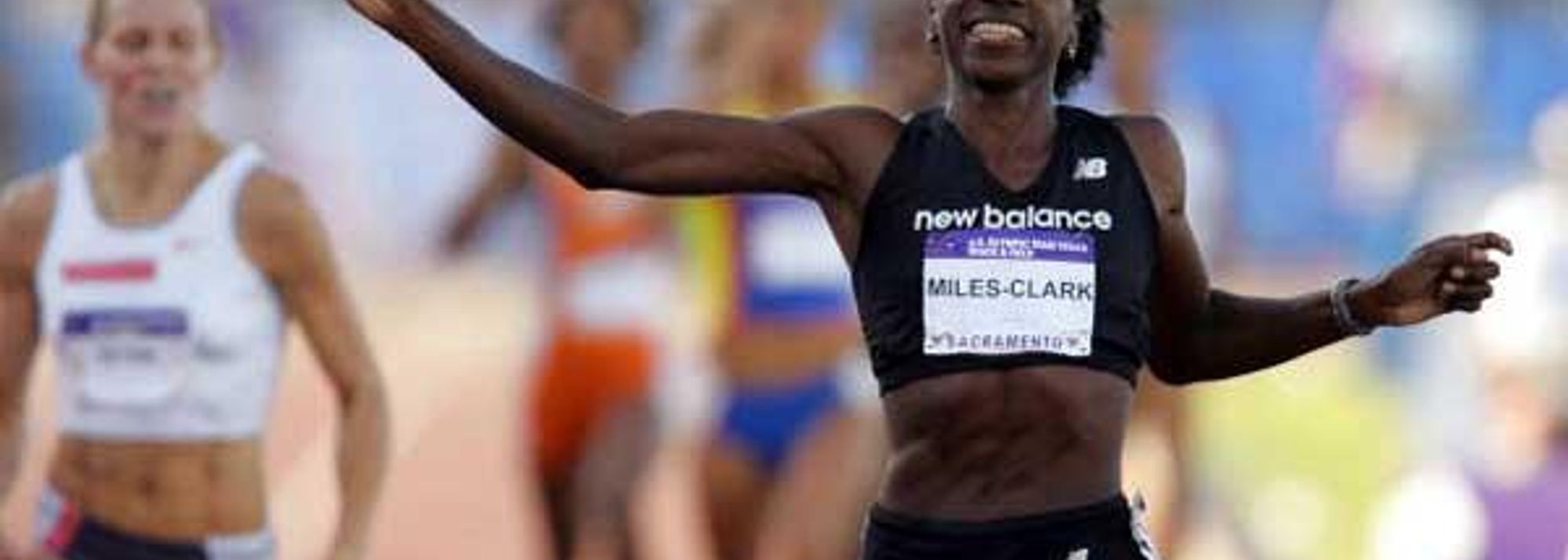


Jearl Miles Clark wins the women''s 800m - US Trials (© Getty Images)
After her fifth place finish in the 800 metres at August’s Olympic Games, veteran Jearl Miles-Clark said she had no regrets.
I didn’t get the medal,” she said, “but I’m not going to cry about it. I ran hard.”
Fifth Olympics!
“Running hard” was a common theme for the U.S. champion in 2004, a season in which she would compete in her fifth Olympic Games, and one which proved to be her finest since she set her still-standing national record 1:56.40 in 1999. In Athens, she clocked 1:57.27, her fastest performance since her U.S. record, remarkably just two weeks before celebrating her 38th birthday.
When it was clear that no one wanted the lead in the Athens final, Miles-Clark took matters into her own hands, assuming the lead at the break to lead the field through the first half in 56.37.
“I wanted to make it an honest, fast race,” she said. “If no one wanted to take it out, I would. It went well until the last seventy metres. I tried for the gold medal, but I got bumped. Those are the breaks. It may be the last [Olympics] and I wanted to go out with a bang.”
In many ways, her Athens performance was a rerun of her race tactics in Zurich’s Weltklasse Golden League meeting, where she finished second to then-reigning Olympic champion Maria Mutola. Immediately moving to the front to shadow pace setter Irina Vashentseva, the American maintained the lead until the final 50 meters when she was passed by Mutola.
"I tried to make the race honest," Miles-Clark said in Zurich where she clocked 1:58.03. "It [was] my third 800 of the year, so I’m just working one step at a time."
Unlike her 1:59.46 win in Stockholm’s DN Galan Super Grand Prix ten days earlier, where she followed the leaders before testing her kick, "This time I tried to go out a little harder and follow the rabbit," she said in Zurich. "I felt really good. I’m pleased because I went out and was aggressive and went for the win."
She capped her season with another front-running effort at the World Athletics Final, leading the field until Olympic bronze medallist Hasna Benhassi outkicked her in the final 60 metres, winning 2:01.42 to 2:01.73.
“I didn’t want to take the lead, but no one else did and it was really slow,” Miles-Clark said in Monaco, echoing her “honest race” philosophy. “I didn’t feel anyone until the last 30 meters, and then I just tried to stay with her.”
The transformation from one lap to two
Her ability to challenge from the front or sit-and-kick comes from her decade-long experience at or near the top of the world’s one and two lap scene, a record nearly unrivaled in recent years.
The 1993 World Champion in the 400m, Miles-Clark arrived in Athens as the only competitor with gold medals from the previous two Olympic Games as part of the victorious 4x400 relay quartets in Atlanta and Sydney.
While making her name in the shorter event, her full transformation in 1997 to the two-lap distance made an immediate impact as well. Beginning that year winning the 400 metres at the World Indoor Championships, she collected another World Outdoor 400 bronze medal before ending the season as the national record holder in the 800 after a 1:56.78 clocking at the Van Damme Memorial. She lowered her record on two more occasions, both in Zurich: 1:56.43 in 1998, and her current 1:56.40 in 1999.
In all, she’s collected five World and Olympic gold medals and three silvers in the 4x400, along with eight national outdoor titles, four each at 400 and 800 metres.
“I'm now an 800 metre runner who can run a really good 400,” Miles Clark admits. “I’m enjoying it [the 800] a lot more now. Before, I just ran as fast and as hard as I could, following different individuals on the track. Now I can get out there and run fast by myself. I'm learning how to position myself in different races. I'm learning the event and starting to enjoy it.”
Longevity powered by common sense
She attributes her success and longevity in the sport to both her passion for athletics and a strong dose of what she sees as simple common sense.
“I love the sport, I love running,” she said prior to her races in Athens. “The fact I take care of my body helps. A lot of kids will train hard for one year, then they don't want to do it the next year. I train hard, I sleep well, I don't put junk stuff in my body, I don't do drugs, I don't drink,” and, she adds, “I get to bed on time.”
Miles-Clark is trained by husband J.J. Clark, a personal and professional match that began when they met in 1989 during a meeting in Fairfax, Virginia. They were married shortly after the 1996 Olympic Games. Like other husband-wife coach-athlete relationships, the couple manages to separate the personal from the professional.
“When we're at home, we try to separate that,” Miles-Clark said. “But it's what he does for a living, what I do for a living. Of course it's going to cross over into home.”
“Jearl's very smart,” J.J. adds. “She doesn't like to have to repeat a workout, she doesn't like to be yelled at, so she tends to do things right. That alleviates things.”
Another Games?
Even at 38, Miles-Clark doesn’t discount the possibility that she may compete in Beijing.
“I don't dwell on it being my fifth Olympic Games. I just take each one, one at a time,” she said. “The fact this may be my last one, I try to savour the moment.”
Bob Ramsak for the IAAF
Note - Jearl Miles-Clark is currently number four in her Event in the IAAF World Rankings.

