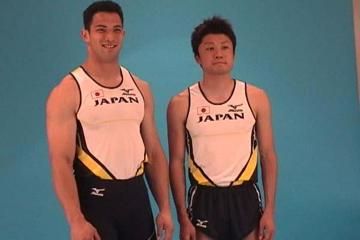


Koji Murofushi presents Japan's new uniform (© Mizuno)
Hello everyone, how are you all doing?
The outdoor season is in full swing now, and in Japan where I live, the national championships were held from 6 to 8 June. As it is appropriate for the World Championships qualifying meet, many great performances were witnessed during the championships. From my perspective, the most impressive performances were two national records, 20.03 200m by Shingo Suetsugu, my team-mate at Mizuno Track Club and 5.75m PV by Daichi Sawano, a graduate of my alma mater Narita high school. They are both still young, and I think their future is very bright.
As for me, I won my ninth straight national title, having won my first championships in 1995. This year I was able to improve my own championships record by over 4m from 79.15m to 83.29m. I am very happy to have thrown over 83m for the third time in my career. My series were also great. Except for my first throw, which was 78.60m, all my other throws were over 80m. The surface of the throwing circle in Yokohama International Stadium where the national championships took place was relatively slick because it is made from quite smooth (less grainy) concrete. Because I had to adjust to this slick throwing surface, my first throw was less than 79m. So I do not consider my first throw a failure.
Since I mention topic of the hammer throwing circle, I would like to elaborate on its various characteristics and their origin. The surface of the throwing circle is concrete; however, because of differences in various factors which determine the composition and hence the texture of the concrete surface, no two throwing circles are alike. These variations are derived from the factors such as: quantity of moisture in concrete, quality and quantity of sands in concrete, the temperature and the humidity during the drying phase of the concrete and the workmanship of the plasterer who smooth out the concrete surface before the drying phase. The quality of sands as well as the weather during the drying phase, of course, varies from one geographical location to another, thus contribute to the variation of the surface.
In my opinion, the throwing circle has a life of its own. Although the ability to adapt to any throwing circle is a testament of a great thrower, it is also true that extremely rough surface of higher friction is disadvantageous to good throwers. On any given surface, the friction is proportional to the normal force (the force applied by throwers onto the throwing surface. Note that this is different from gravity) and the normal force is usually larger for good throwers (as compared to the mediocre throwers) because of their greater strength. For this reason, good throwers had to work with larger frictional force, which hinder the rotation during the third and fourth revolution.
As the following analogy between the accelerating automobile and the rotating hammer thrower in the throwing circle will illustrate, too much friction is not a good thing, but insufficient friction also causes problems. Initially when a car is starting, the friction between the tires and the road is static/sliding friction, which is relatively large compared to rolling friction. Without the frictional force between the road and tires, it is impossible for the automobile to move forward.
Just imagine accelerating a car on slick frozen surface during the winter. Relatively large frictional force is advantageous during this phase. Similarly, during the initial rotational phase (first two rotations) of the hammer throw, relatively large frictional force is necessary to start the rotation, and thus slick throwing surface will cause problem during this phase. Once the tires start to roll, the rolling friction, which is much less in magnitude than static or sliding friction takes over. During this phase, larger frictional force would hinder the motion of the automobile. This phase is similar to the stage of third and fourth rotation in the hammer throw. Larger frictional force during this phase of rotation is disadvantageous. Thus it may be said that one of the most important contributing factors for longer throws is an appropriate throwing circle.
A day after the national championships, the Japanese national team uniform for the World Championships team for Paris was unveiled in Yokohama. The uniform designed and manufactured by my company Mizuno is designed for efficient movement in mind, and thus is very functional. When I tried out the uniform, I could imagine myself throwing at the World Championships in Paris.
My next competition is Josef Odlozil Memorial meet in Prague, Czech Republic on 29 June followed by the Rethymno meet in Greece on 6 July. I am excited because this is my first competition in Europe since last fall. It is also my first visit to Czech Republic, so I am looking forward to seeing its historic towns after my competition.
Koji Murofushi