

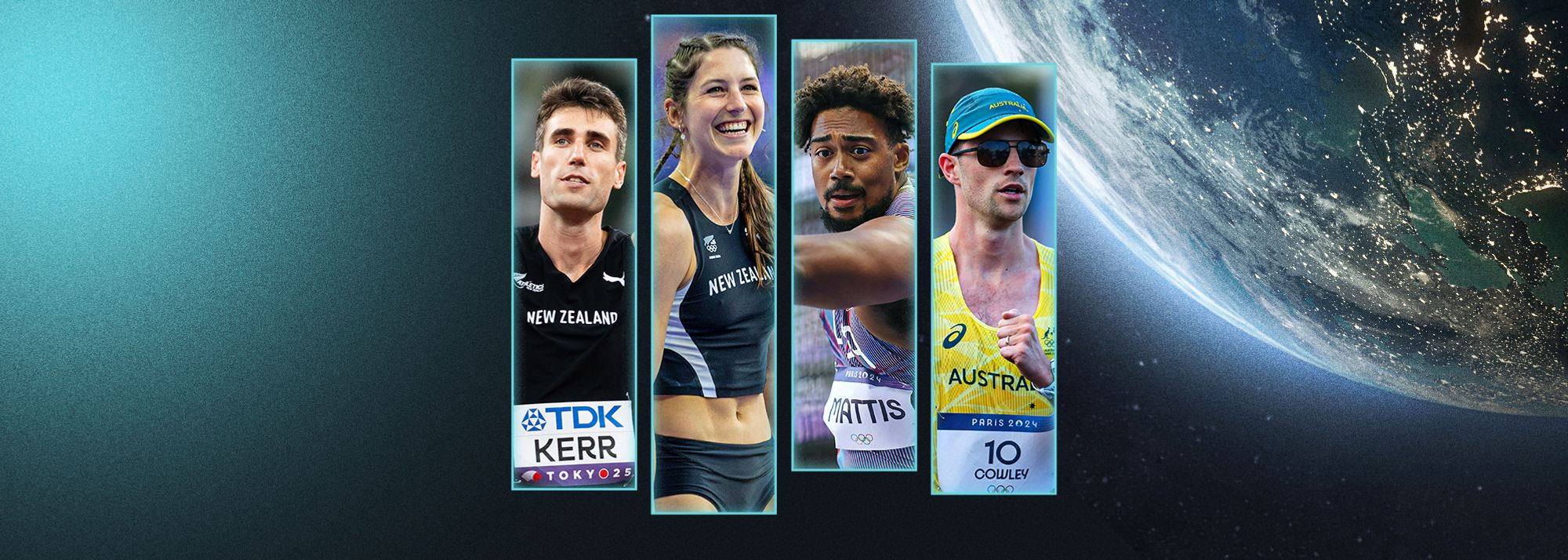


Hamish Kerr, Eliza McCartney, Sam Mattis and Rhydian Cowley
More than 120 professional athletes across many athletics disciplines and sports have joined the groundbreaking Sport One, Carbon Zero (SOCZ) fund. SOCZ provides elite athletes with a credible, research-backed means to take climate action while linking it to their performances throughout the season.
Athletes contributing to the initiative include New Zealand’s Olympic high jump champion Hamish Kerr, who has pledged to donate $1 for every centimetre he clears during the 2026 season.
Kerr’s commitment to climate action has been forged by Auckland’s extreme flooding in 2023 and increasingly having to compete in extreme heat.
“There are more instances where we're actively having to try and decrease our body temperature to avoid heat stroke and feelings of overheating, which is obviously a performance detriment,” Kerr says. “Every year it feels like we have to do that more and more, and that's no place we want to be.”
Other athletes joining SOCZ include several World Athletics Champions for a Better World. Discus thrower Sam Mattis, who recently broke the US record in the event, has pledged 25 cents for every metre he throws, New Zealand pole vaulter Eliza McCartney has pledged $1 for every 200km flown to compete, and Australian racewalker Rhydian Cowley has pledged 10 cents for every kilometre walked on Strava.
Launched by High Impact Athletes in November 2025, SOCZ is guided by independent researchers at Giving Green to identify the highest-leverage systemic climate solutions across organisations and sectors that are most responsible for sport’s largest carbon footprint: aviation, energy and infrastructure. Giving Green's research suggests that every $1 donated to SOCZ prevents one tonne of carbon dioxide equivalent (CO2e), making it approximately 50 times more cost-effective than planting trees and 10 times more cost-effective than high quality offsets.
“Nobody is perfect, but that doesn’t mean we should stay quiet and do nothing. We should be normalising imperfect action,” says McCartney.
Cowley acknowledges the internal conflict many athletes feel, noting that while “the lingering worry about being a hypocrite never fully goes away”, taking action through SOCZ “helps build the confidence to make climate action a more regular talking point”.
“I spend a lot of time on planes every year. That’s just the reality of my job,” says Kerr. “I’d rather acknowledge that and do something with my platform than pretend it’s not happening.” While Mattis also acknowledges that he travels more than the average person, he believes that his “responsibility to do something about climate is greater as well”.
When sport is impacted by extreme weather, climate change becomes more tangible for people who might otherwise feel that the problem doesn’t affect them or will only matter in the future. As climate impacts such as heatwaves, wildfire smoke and damaged venues increasingly affect sport, SOCZ positions climate action as a matter of survival, not a political issue.
“People around the world care about sport and connect with athletes in a deeper way than they do with politicians or climate scientists,” says Cowley, who adds: “athletes have a responsibility to communicate about climate change and climate action, help decarbonise sport, and engage sports fans to take and support climate action themselves.
“Nobody is born an Olympic medallist. So, to me it’s self-evident that imperfect action is better than doing nothing, and we can improve along the way, just like athletes gradually master their sport on their way to competing and performing at the highest level.”
Kerr says that his primary high jump ambition is jumping 2.46m – a mark that would surpass the long-standing world record of 2.45m set by Javier Sotomayor in 1993, but he aims to scale his positive climate impact alongside taking his athletics performance to new heights.
“I think it ties in really nicely with this (SOCZ),” he says, “because climate change can be quite overwhelming and seems very far away, but when we start breaking it down into action points, it becomes more manageable and about what you can control right here and now.”
“I think everyone has a responsibility to make their little corner of the world better if they can,” says Mattis, while Cowley adds: “The faster we can shift to a decarbonised future, the better it will be for athletes and sports fans.”
McCartney says: “How we spend our money is one of the most important individual actions we can take. I hope to encourage people to contribute to SOCZ and, in doing so, feel that they are doing something of meaning to protect sport and the planet.”
Many athletes involved in SOCZ will share updates on their campaigns throughout the season via social media, encouraging fans and fellow athletes to pledge and contribute alongside them.
George Timms for World Athletics

