

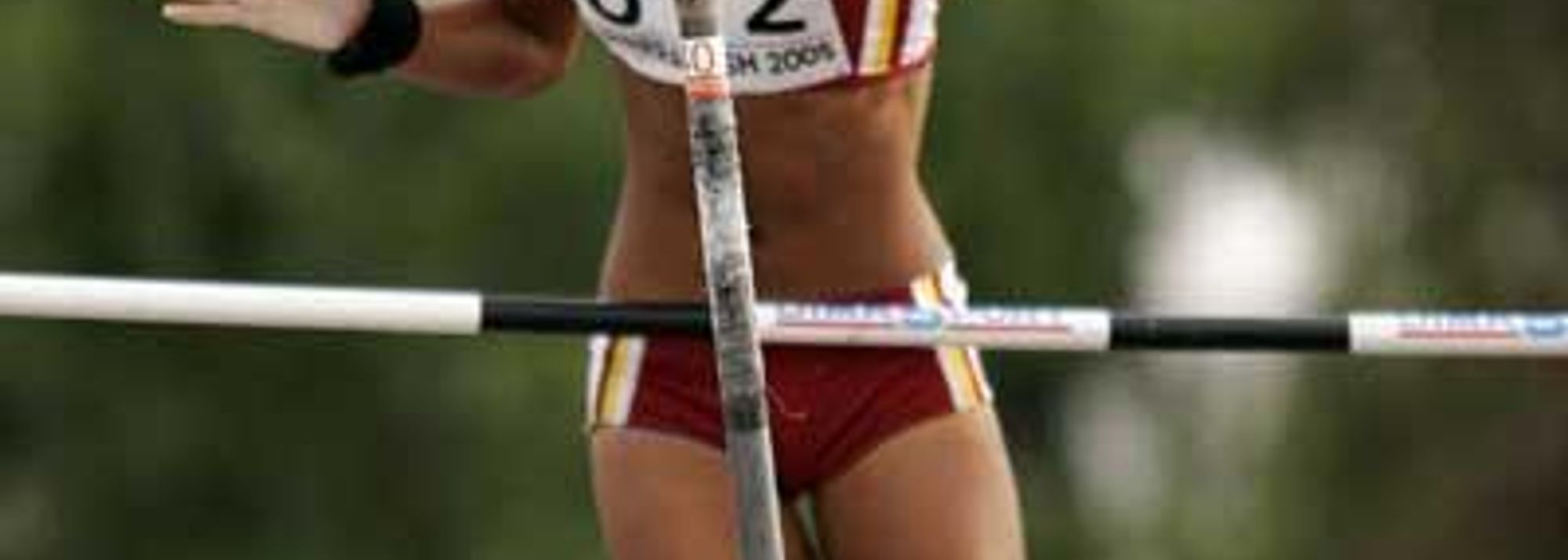


Keisa Monterola of Venezuela in action during the Girls' Pole Vault at the World Youth Championships (© Getty Images)
Winner of Venezuela’s first ever World Championships medal, 18-year-old Keisa Monterola is now looking to build up on her 2005 successes to improve to gold at the Beijing World Junior Championships. Eumar Esaa reports
In 2001, a cry from Yoisemil Fuentes saved the lives of her colleagues in the Venezuelan athletics team when she realised that the driver of the coach they were travelling on to Ambato to take part in the Bolivarian Games had fallen asleep at the wheel.
What Yoisemil could not save over the ensuing years were her national Pole Vault records from the voracious grasp of young Keisa Monterola, a former gymnast who, in 2005, secured Venezuela its first medal at a World Athletics Championships.
Keisa grew up in a sports-obsessed family, thanks to the passion of her father, Israel, who had been a gymnast during his university days. Leyda, her mother, soon discovered that the only way to control little Keisa’s boundless energy was swimming.
Shortly after, when she turned five, Keisa took up gymnastics and her speciality apparatus was the vault where her aerial prowess came to the fore. She was on the verge of making the national team, but at 12 years old she had grown too big for gymnastics and injuries were beginning to take their toll.
This was when Alexander Radchich appeared on the scene. Born in Turkmenistan, he had been hired in 1998 to coach in Venezuela and had already coached Ricardo Diez to the Venezuelan Pole Vault record of 5.35m, which stands to this day. Radchich suggested that the young Keisa should change to the Pole Vault, a discipline she was not familiar with, and thus began the partnership that has given Venezuelan athletics its best results over the last five years.
In 2000, at the tender age of 12, Monterola cleared 2.70m in her first ever competition. “Jumping made me scared and excited at the same time, but the latter emotion won through as I was even beating the male vaulters way back then,” she recalls.
Radchich coped with the criticism from those who thought it was wrong to have such a young athlete undergo such specific training, and Keisa continued to improve at each meet.
In 2001, she took part for the first time in an official competition and recorded a 3.20m vault at the National Juvenile Championships in San Cristóbal, and ended the year having cleared 3.40m, which represented her first championship record and her entry to the national team.
“My first competition with the national team was the 2002 South American Games in Brazil,” she points out. That year she again cleared 3.40m and this marked the beginning of a difficult three-year period when her home stadium, the Brígido Iriarte, was closed for repairs and the Memorial Competition of the same name had to be held in Barquisimeto, 350km from Caracas.
Throughout this period, Keisa was continually on the lookout for somewhere to train and yet she did not let the situation get the better of her.
In 2003, she could go no higher than 3.20m at the National Senior and Junior Championships, both held in May. A month later she returned to San Cristóbal and captured all the national records still available to her when she cleared 3.70m to equal Yoisemil Fuentes in the all-time national standings. Her success was made all the sweeter as she also beat Fuentes for the first in her career.
Since then, Keisa has lost only one competition in Venezuela, the Máximo Viloria National Competition in 2005.
Her performance in San Cristóbal saw her qualify for the first time for a World Championships, the World Youth Championships in Sherbrooke. Aged 15, Keisa produced a modest vault of 3.35m to finish last of the 19 competitors in what was a straight final.
On 16 April 2004, adorned in the colours of her club Olimpia, she exceeded everyone’s expectations at the first meet of the newly formed National Athletics League. With all her rivals already eliminated, and using her old poles and sporting an old pair of spikes, she cleared 3.80m to break the senior, junior and youth national records she had hitherto shared with Yoisemil Fuentes. She then took a breather before returning to clear 3.85m at the first attempt to secure a further three records, before going even higher to leave the national records at 3.90m.
She was only 16 years old and could not officially participate at the Under-23 South American Championships held in Barquisimeto. She settled for a first-attempt clearance of 3.80m out of competition, which would have placed her second behind the eventual winner, Colombia’s Milena Agudelo. In July 2004, she travelled to the second World Championships of her career, the World Junior Championships held in Grosseto, where a 3.85m clearance at the third attempt was not enough to qualify her for the final as she eventually finished seventh in her qualification group.
In September of the same year, a 3.80m clearance saw her win the South American Youth Championships in Guayaquil.
2005 got off to a good start when the Venezuelan Athletics Federation finally managed to recover from a military base the sports equipment found inside a container which had gone missing in 1999 at the maritime customs in La Guaira during the series of landslides that had destroyed the city. The equipment included the new poles Keisa had been waiting for all her career. In her fist competition with them, the Máximo Viloria Memorial Competition, she was eliminated after three no jumps and, with that, she relinquished her two-year unbeaten record in Venezuela. However, she asked that the bar be set at 4.35m out of competition and stunned everyone in the stadium when she cleared it. Thus began the road towards the silver medal in Marrakesh.
A month later, on 28 May, she increased her national record by 30 centimetres in a single attempt, taking it to 4.20m at the National League’s first meet of the season in Maracaibo. She thus equalled the South American junior and youth records held by her friend and arch-rival, Milena Agudelo. A week later, at the League’s second meet in Barquisimeto, she assumed exclusive ownership of these records with a 4.22m clearance which also secured her the Under-20 and Under-18 Central American and Caribbean records. Two weeks later, at the National Youth Championships in San Carlos, she secured her third set of records in a month with a clearance of 4.25m to install her as one of the favourites for the title at the World Youth Championships in Marrakesh.
In Marrakesh, she experienced a few difficulties in the qualifying round, but eventually qualified in fifth place on countbacks after all the twelve finalists had cleared 3.90m. In the final itself, everything went according to plan. She cleared 3.90m, 4.05m, 4.20m and 4.25m at the first attempt, and only needed two attempts at 4.15m and 4.30m, which secured her 10 records at once: three national, two South American, two Central American, two Pan-American and one Championship record. The only downside was that the Greek vaulter, Ekaterini Stefanidi, had cleared 4.30m at her first attempt to pip Keisa for the gold medal. They both subsequently failed at 4.35m, which would have broken the World Youth record.
Two weeks later, Keisa also won the Pan-American Junior Championships in Windsor, Canada, with a clearance of 4.10m. However, her poles went missing on the flight back home, which meant that she was unable to train for three weeks. This disruption to her training schedule saw her fail to make a single clearance at the Bolivarian Games in Armenia and Pereira where she had been favourite to lift the title. She ended the year with a 3.60m clearance to lift the South American Junior title in Rosario, despite the fact that, only three days earlier at the Indoor Pole Vault Festival in Santa Fe, she had sprained her take-off foot, which almost saw her miss her final international competition of the year.
2005 was a dream year for Keisa, in which she was recognised as one of the leading sports figures in Venezuela when she was the highest-placed female finalist in the voting for the Athlete of the Year 2005, won by Carlos Coste, the holder of two free-diving World records.
In December, she got back to the business of breaking records when she won the gold medal at the Nationals Sports Games with a clearance of 4.00m to set a new competition record, which was a timely boost after the injury scare in Santa Fe.
She began this year by spending 45 days training in Sao Paulo as she turned her attention to her next objective: the podium at the World Junior Championships in Beijing.
Her return to competition following her training spell in Brazil has not been easy: she was eliminated without making a single clearance in three of the five official competitions she has taken part in, including the Ibero-American Championships in Ponce and the IAAF Grand Prix in Belem, Brazil.
She has attempted to restore her flagging confidence by competing in minor events, such as the Miranda State Championships, where she won with a clearance of 3.95m. A week later, she won the Brígido Iriarte Memorial Competition, the South American Grand Prix in Caracas, with the same height, after failing to clear 4.05m.
“The important thing is for her to recover physically and emotionally for the World Junior Championships, which she is on the way to doing,” says her coach Radchich. “She needs to be left alone to get on with her training.”
First, though, Keisa must endure the pressure of one more competition, the Central American and Caribbean Games in Cartagena, where Venezuelan athletics is confident that she can put her poor showing at the Bolivarian Games behind her.
“I would prefer to focus on the World Junior Championships, as the other countries are doing, but Keisa is looking forward to the challenge,” says Radchich.
Published in IAAF Magazine Issue 2 - 2006

