

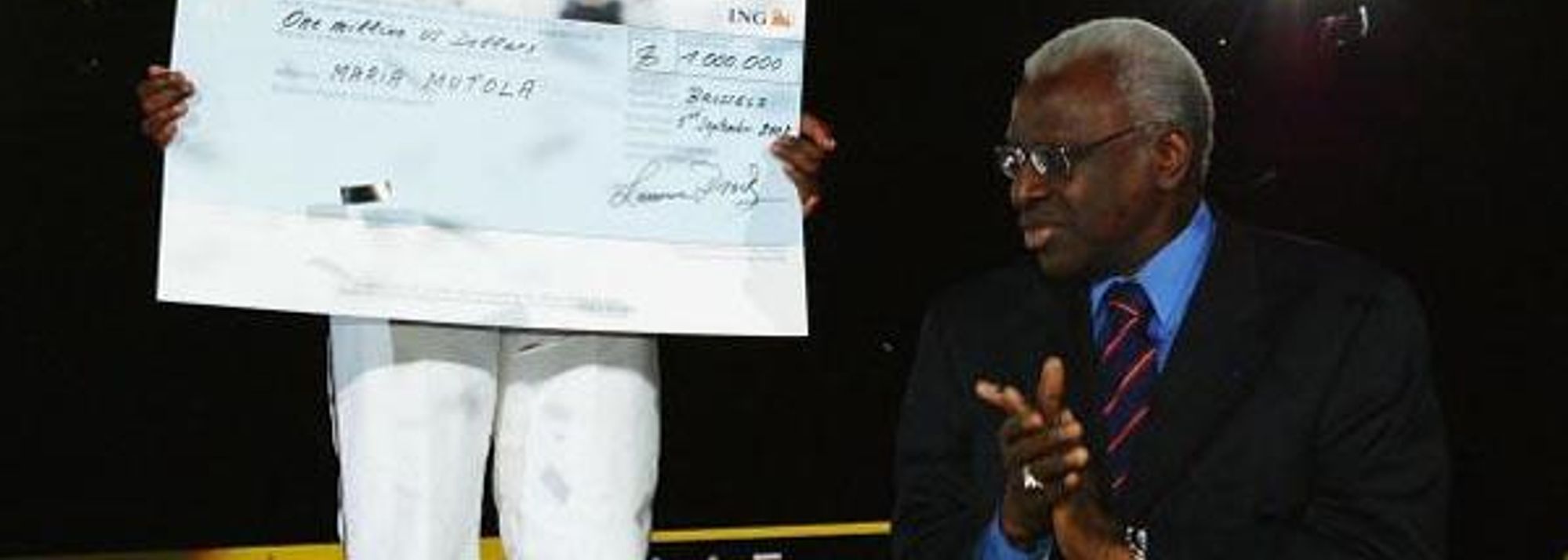


Maria Mutola receives a one million dollar cheque from IAAF President Lamine Diack (© Getty Images)
MEL WATMAN of “Athletics International” recalls the highlights of the six Golden League meetings in 2003.
Click here to go to the 2003 Golden League site for full meeting reports
27 June, Exxon Mobil Bislett Games, Oslo, Norway
Bislett Stadium’s imposing list of world records came very close to being extended at the first of six Golden League meetings. World half marathon and indoor 3000m champion Berhane Adere had Jiang Bo’s 5000m figures of 14:28.09 as her target, and fell only just short.
Following intermediate times of 2:53.77, 5:49.30, 8:43.24 and 11:39.96, she needed a final kilometre of 2:48.12 to break the record. In fact she ran 2:49.36 to match Olga Yegorova’s time of 14:29.32 for second place on the World all-time list and a new African record. Three other Ethiopians followed: Worknesh Kidane clocked 14:33.04, Tirunesh Dibaba (of whom we would hear much more) a World junior record of 14:39.94 and Mesaret Defar 14:43.46.
The men’s 5000m was won in equally brilliant fashion by an Ethiopian. Kenenisa Bekele had already proved himself a phenomenal cross country runner but, until this race, his track credentials had been far less glowing.
Injury had virtually wiped out his summer season last year and so his fastest 5000m time stood at 13:13.33 from 2001, but in Oslo he revealed the true extent of his youthful talent. Following a swift pace and producing a killer finish, he came home in 12:52.26.
“He has all the skills,” enthused his manager Jos Hermens. “It looks like he can follow any pace and he can lead and he can kick. He can follow any tactic.”
In a thrilling finish Sammy Kipketer placed second inches behind in 12:52.33, while four other Kenyans broke 13 minutes. World junior cross country champion Eliud Kipchoge finished third with a World junior record of 12:52.61, Abraham Chebii fourth in 12:52.99, James Kwalia (who had recently set a World junior mile record of 3:50.39) fifth in 12:54.58 and Albert Chepkurui - soon destined to change his name and nationality - sixth in 12:56.27.
In view of what would happen later in the summer, the oddest result came in the women’s High Jump. Nothing strange about Inga Babakova, on her 36th birthday, winning with 2.01m and thus improving on her own world masters (over-35) record.
But it was surprising that World indoor champion Kajsa Bergqvist placed only sixth at 1.95m and quite shocking that Hestrie Cloete, at the start of a momentous European tour, fared no better than tenth with 1.92m…this the woman who would go on to retain the world title, jump 2.06m and win the IAAF’s female “World Athlete of the Year” award!
Bekele and Babakova joined the winners of the other ten designated Golden League events in the quest for a share of the million dollar jackpot: Mark Lewis-Francis (10.12 100m), Mbulaeni Mulaudzi (1:44.11 800m), Stanislav Olijar (Latvian 110m Hurdles record of 13.14), Nick Hysong (5.70m Pole Vault), Sergey Makarov (85.61m javelin), Chandra Sturrup (10.96 100m), Maria Mutola (2:00.62 800m), Iryna Lishchynska (4:04.62 1500m), Jana Pittman (54.42 400m Hurdles) and Yamilé Aldama (a Central American & Caribbean Triple Jump record of 15.11m).
4 July, Meeting Gaz de France Paris Saint-Denis, Paris, France
Astonishingly, ten of the 12 jackpot contenders had dropped out of the reckoning by the end of the meeting staged in the stadium which would shortly host the World Championships. Mark Lewis-Francis, Mbulaeni Mulaudzi, Stanislav Olijar, Nick Hysong, Sergey Makarov, Jana Pittman, Inga Babakova and Yamilé Aldama were all defeated, while Kenenisa Bekele and Iryna Lishchynska did not take part. That left just Chandra Sturrup and Maria Mutola to fight it out.
As befits a former World indoor 60m champion, Sturrup was quickly into her running and had close to a metre to spare over Kelli White (11.09) in an 11.01 100m. As for Mutola, she was content to shadow Jolanda Ceplak in the 800m until kicking past halfway along the finishing straight to win by 1:57.58 to 1:57.84.
The performance of the meeting, watched by a crowd of over 55,000, was Allen Johnson’s 12.97 110m Hurdles, the world’s fastest for three years and a record ninth sub-13 clocking by the 32 year-old American. Johnson has made no secret of his desire to break the now retired Colin Jackson’s World record of 12.91 (he has twice run 12.92) and this performance encouraged him to keep trying. It is his intention to continue through to the 2008 Olympics!
Gail Devers (36), who has been at the top even longer than Johnson, was also in sparkling form as she beat Brigitte Foster, who topped the world 100m Hurdles list at 12.45, with her own season’s best of 12.49.
In addition to Johnson, three other athletes produced world-leading marks at that stage of the season. Mehdi Baala delighted the home fans by winning the 1500m in a French record of 3:30.97, holding off Bernard Lagat (3:31.40) throughout a 54.2 last lap. Gabriela Szabo opened what would prove to be her most disappointing season with a thrilling 8:34.09 3000m win, making up a 20m deficit on Zhor El Kamch on the final lap; and Tatyana Lebedeva edged past Aldama, 15.12m to 15.08m, in the last round of the Triple Jump.
Still running as a Kenyan, Stephen Cherono was on sub-8 minute steeplechase pace for the first two-thirds of his race before slowing down and being content to use his finishing powers for victory over Paul Koech in 8:06.41. Close behind in third place, Bob Tahri not only broke the French record which had stood at 8:07.62 by Joseph Mahmoud for 19 years but equalled Simon Vroemen’s European record of 8:06.91.
The other Kenyan triumph came in the 5000m, which featured Haile Gebrselassie’s first appearance at the distance for three years. He had won 16 consecutive races at 5000m but that sequence came to an end when he was decisively outkicked by Abraham Chebii, 12:53.37 to 12:54.36, with the winner covering the final 200m in a spectacular 25.0.
11 July, Golden Gala, Rome, Italy
Ironically, several of the outstanding marks in Rome were served up by athletes who would not be contesting those particular events at the World Championships.
Finishing ahead of such apparent medal prospects in the 100m as Bernard Williams, Maurice Greene and Dwain Chambers in 10.04 was John Capel, selected only for the 200m in Paris.
Conversely, the 200m was won in what would survive as the year’s fastest time of 20.01 by Williams, who would contest solely the 100m title.
Similarly, Olga Yegorova won the 1500m in 4:01.00, with her compatriot destined to become world 1500m champion Tatyana Tomashova placing only 11th in a race of remarkable depth, but she was picked to defend her 5000m title in Paris.
At least those three had the chance to compete in the World Championships. The author of the finest performance of all in Rome, Yamilé Aldama, was deprived of that opportunity. A former Cuban international, she was not yet eligible to represent her new country of domicile, Britain.
This time she outclassed even the formidable Tatyana Lebedeva. It was close for five rounds, Aldama leading 14.90m to 14.86m, but with her final effort Aldama landed at 15.29m for the longest leap of 2003. That was the sixth time this season she had improved the Central American & Caribbean record (if still considered eligible) and her fifth consecutive contest of 15m or more.
Meanwhile, the only remaining jackpot contenders reached the halfway mark unscathed. Chandra Sturrup clocked the swiftest 100m time thus far in the season with a dynamic 10.89 in windless conditions, a full metre ahead of Kelli White, while Maria Mutola (1:57.21) continued on her merry way by shrugging off the challenge of Jolanda Ceplak in a cracking 800m which saw four women inside 1:58.
There were mixed results for the two men who have dominated the longer track events for so long.
Rome’s Olympic Stadium holds happy memories for Hicham El Guerrouj; it was there that he set the current World records of 3:26.00 for 1500m in 1998 and 3:43.13 for the mile in 1999. Nothing that fast this year, but his 3:29.76 1500m, winning by 20m, was the season’s first sub-3:30 time.
For Haile Gebrselassie the outcome of the 5000m was another indicator that his days as the supreme kicker were over. Already outsprinted by Kenenisa Bekele in Hengelo over 10,000m and by Abraham Chebii in Paris over 5000m, he was unable to match either of them for finishing speed. Chebii came out on top in 12:57.14, his 26.4 last 200m taking him a stride ahead of Bekele, with Gebrselassie 20m down.
The Italian fans did not have any victories to celebrate, but they did have plenty to enthuse over in the Pole Vault where Giuseppe Gibilisco, whose previous best was 5.71m, enjoyed a magical evening by clearing 5.72m and then Italian records of 5.77m and 5.82m. Romain Mesnil was the winner, though, at 5.92m.
10 August, ISTAF, Berlin, Germany
Although she clocked her fastest 100m time of the season, a wind assisted 10.88, that was scant consolation for Chandra Sturrup whose dream of winning or sharing the million dollar jackpot came to an end in the Friedrich-Ludwig-Jahn Sportpark.
She and Chryste Gaines (10.86) fought it out for most of the race, but a strong finish following a poor start enabled Kelli White to overtake both of them in 10.84. That left just Maria Mutola still in the hunt, and she had to work harder than anticipated to hold her old rival Stephanie Graf at bay in the 800m in 1:59.01.
The most imposing track performance came from Sürreya Ayhan in only her second race of the summer. Taking over from a superfluous pacemaker in the 1500m on the third lap, she stretched her lead to over 50m by the finish, covering the last lap in 60.5.
Her time of 3:59.58 was the first sub-four minute mark of the season and she remarked: “I know that in general a pacemaker is seen as being advantageous, but since I’m usually better than most pacemakers I probably could have run a faster time alone today.”
The one other world-leading performance was the USA’s 4x100m relay team’s 37.77, the quickest recorded since 2000. The squad was Jon Drummond, Bernard Williams, Darvis Patton and Maurice Greene.
Earlier, the individual 100m had been notable more for its close finish than its blazing speed. The first three were all awarded the same time of 10.23 into a 1.6m wind as Frank Fredericks and John Capel were given a dead-heat for first with Drummond third.
The fluctuating wind made conditions less than ideal for the high jumpers although that did not faze Hestrie Cloete. She had no failures up to and including 1.99m and after ensuring victory with a second time clearance at 2.01m she asked for the bar to be raised to the new African and Commonwealth record height of 2.05m…and promptly soared clear at the first try to move to equal fourth place on the world outdoor all-time list behind Stefka Kostadinova (2.09m), Lyudmila Andonova (2.07m) and Kajsa Bergqvist (2.06m), while Heike Henkel has cleared 2.07m indoors.
As she was wearing the number 210 it was appropriate that she attempt a new World record at that height, but it was one bar setting too many on this occasion. “I’ve tried three times this year to jump 2.05m and I’m surprised it happened today because my legs were so tired,” she said.
Upset of the meeting was Allen Johnson’s defeat in the 110m Hurdles. Previously unbeaten in 11 races this year, he placed third behind Stanislav Olijar (wind assisted 13.15) and Duane Ross. It would remain the only blot on an otherwise perfect season.
15 August, Weltklasse Zürich, Switzerland
As in Berlin five days earlier, Maria Mutola attracted the most publicity by keeping alive her jackpot hopes but was outshone in terms of performance quality by Sürreya Ayhan. Mutola again found Stephanie Graf her closest opponent in a slowly run 800m before comfortably brushing off the Austrian’s challenge for success in 1:59.93.
Five down, one to go. Mutola’s remarkable high level consistency over such a long period became apparent when it was revealed that this was her eleventh consecutive victory at the self-proclaimed “one day Olympics”, the Weltklasse.
Ayhan won the 1500m by over 30m after following the pacemaker through laps of 60.35 and 2:05.92. The Turk reached 1200m in 3:11.54 and a 59.5 last lap carried her to a national record of 3:55.60, the world’s quickest since 1997.
The men’s 1500m featured the return of Hicham El Guerrouj after a five-week absence from racing due to a back problem. The lay-off did him no harm as he improved the year’s world-leading mark to 3:29.13.
Those 1500m times apart, there were other new world bests for 2003 by the new Qatari Saïf Saaeed Shaheen with an 8:02.48 steeplechase, Ana Guevara with a Central American 400m record of 49.11, and Gabriela Szabo with 8:33.95 for 3000m, while Chryste Gaines decisively beat Chandra Sturrup in a personal best equalling 10.89 to match the fastest wind-free mark of the season.
The men’s 100m in Zürich is traditionally a highlight, and this year was no exception as the “B” race saw Mickey Grimes clocking 9.99. Dead-heats are very rarely called with the sophisticated photo finish equipment available at this level, but for the second Golden League meeting in less than a week the judges could not separate first and second. Again, John Capel was involved but this time his name was bracketed with Justin Gatlin as both reduced their personal bests substantially to 9.97.
Qatar’s controversial financial investment in two of Kenya’s finest runners paid immediate dividends. Both Shaheen, formerly Stephen Cherono and the world’s fastest 5000m runner of 2003 at 12:48.81 as well as being the no 1 steeplechaser, and Abdullah Ahmad Hassan, the former Albert Chepkurui, a 12:56.27 and 26:50.67 10,000m performer, decimated the existing Asian records. Shaheen took the steeplechase in 8:02.48 by 1/100th of a second in a desperate finish with Ezekiel Kemboi that would be replayed in Paris, while Hassan placed seventh in 13:04.65 in a 5000m won by John Kibowen in 13:01.01.
In the field, the women’s High Jump was of a particularly high standard. Hestrie Cloete won with 2.03m and for the first time ever four women cleared 2m-plus as Vita Palamar and Blanca Vlasic (with a Croatian record) made 2.01m at the first attempt and Amy Acuff at the third. The men’s discus was notable too as Robert Fazekas overhauled Virgilijus Alekna’s opener of 68.95m with a second round throw of 69.14m.
Crystal ball gazers would have had to look very hard at some of the Zürich results to divine events in Paris.
No problem with the likes of El Guerrouj, Felix Sánchez (47.82 400m hurdles), Guevara, Mutola and Cloete … but what about Giuseppe Gibilisco (11th pole vault, 5.50m) and two athletes deemed good enough only for the “B” races in Djabir Saïd-Guerni (1:44.60 800m) and Perdita Felicien (12.67 100m hurdles)? Could they ever have dreamt of what awaited them in the Stade de France?
5 September, Memorial Van Damme, Brussels, Belgium
The three weeks since Zürich had been a period of acute anxiety for Maria Mutola. While in Paris she could concentrate on the job in hand, and she did successfully defend her world title. But on completion of that task she was confronted again by the thought that the richest prize in athletics hung on the outcome of her next 800m race.
She sharpened up three days before Brussels with a 1:23.13 600m in Liege, the third fastest time ever, and everything pointed to victory. After all, she hadn’t lost all year.
Nevertheless, the uncertainties persisted in Mutola’s mind. As she remarked afterwards: “It wasn’t easy to stay calm and I was obviously very nervous coming into this competition. I know I have been very strong this year but you always have doubts until the race is actually over. Anything can happen so I never really thought I had the jackpot until I actually crossed the finish line.”
To the onlooker, though, there never appeared to be any problem. Mutola ignored the fast pace (56.15 400m) offered by Letitia Vriesde and ran with the pack before moving well clear along the finishing straight to score in 1:57.78 with Paris bronze medallist Natalya Khrushchelyova second in 1:58.53. She had become the first athlete to scoop the entire jackpot.
It was appropriate that the 800m and 1500m, the late Ivo Van Damme’s events, should produce a series of memorable races for the delectation of the 47,000 spectators.
Süreyya Ayhan bounced back immediately after her setback in Paris to lower her Turkish 1500m record to a dazzling 3:55.33, the fastest time by a non-Chinese athlete since Hassiba Boulmerka won the 1992 Olympic title. Trailing pacemakers through 400m in 60.90 and 800m in 2:05.33, she struck ahead to reach 1200m in 3:09.47 and win the race by some 30m.
The men’s 1500m was much more competitive even though Hicham El Guerrouj produced the year’s quickest time of 3:28.40. Following the hare’s splits of 54.80 and 1:51.64, El Guerrouj covered the third lap in a searing 56.09 (2:47.73 at 1200m) but still he couldn’t shake off Mehdi Baala. A 54.7 last lap carried him to victory, while Baala’s reward for his persistence was to regain the French record with a magnificent 3:28.98, just 3/100ths away from Fermin Cacho’s European record.
The men’s 800m brought together all the world’s elite except for the unexpected winner of the world title, Djabir Saïd-Guerni, and for only the second time ever six men broke 1:44 in the same race. Wilfred Bungei, unable because of illness to bid for Kenya’s World Championships team, ran out the winner in the year’s best time of 1:42.52.
Brussels has long been a happy hunting ground for 10,000m runners in search of fast times and this year’s race proved one of the very best ever. No fewer than 13 men finished inside 27:30, a record, and never before has anyone run 26:30.03 and lost. That was the fate of the astonishing 19 year-old Nick Kemboi (previous best of 28:19.77), whose time elevated him to third on the World all-time performer list behind Haile Gebrselassie (26:22.75) and Paul Tergat (26:27.85).
Following pacemaker Leonard Mucheru through halfway in 13:15.58, Gebrselassie ran the second half slightly quicker, finishing furiously with laps of 59.7 and 56.7, to record 26:29.22 for the third fastest ever time.
Qatar’s new recruit, Abdullah Ahmad Hassan, smashed the Asian record with 26:38.76 to rank sixth on the all-time list.
There was an Asian record also for Saïf Saaeed Shaheen (8:00.06), who was involved in another extraordinary steeplechase duel against an erstwhile Kenyan compatriot, this time Paul Koech (8:00.42).
There were so many other notable exploits in this worthy climax to the Golden League series. Among them, Asafa Powell, the “other man” in the Jon Drummond false start drama in Paris, took the 100m in 10.02; Justin Gatlin clocked 20.04 in the first 200m race he had completed this year; Cédric Van Branteghem broke a 27 year-old Belgian 400m record with 45.02; Ali Saïdi-Sief narrowly beat teenage world 5000m champion Eliud Kipchoge in a 7:30.79 3000m; Kelli White was run to inches in a speedy 100m (10.87-10.88) by Chryste Gaines; Derartu Tulu, who had to drop out of the 10,000m in Paris, won the 5000m in a personal best of 14:44.22; Hestrie Cloete put on another magnificent high jump display (2.03m); and Tatyana Lebedeva got the better of Yamilé Aldama in another superb triple jump duel, 15.14m to 15.00m.

