

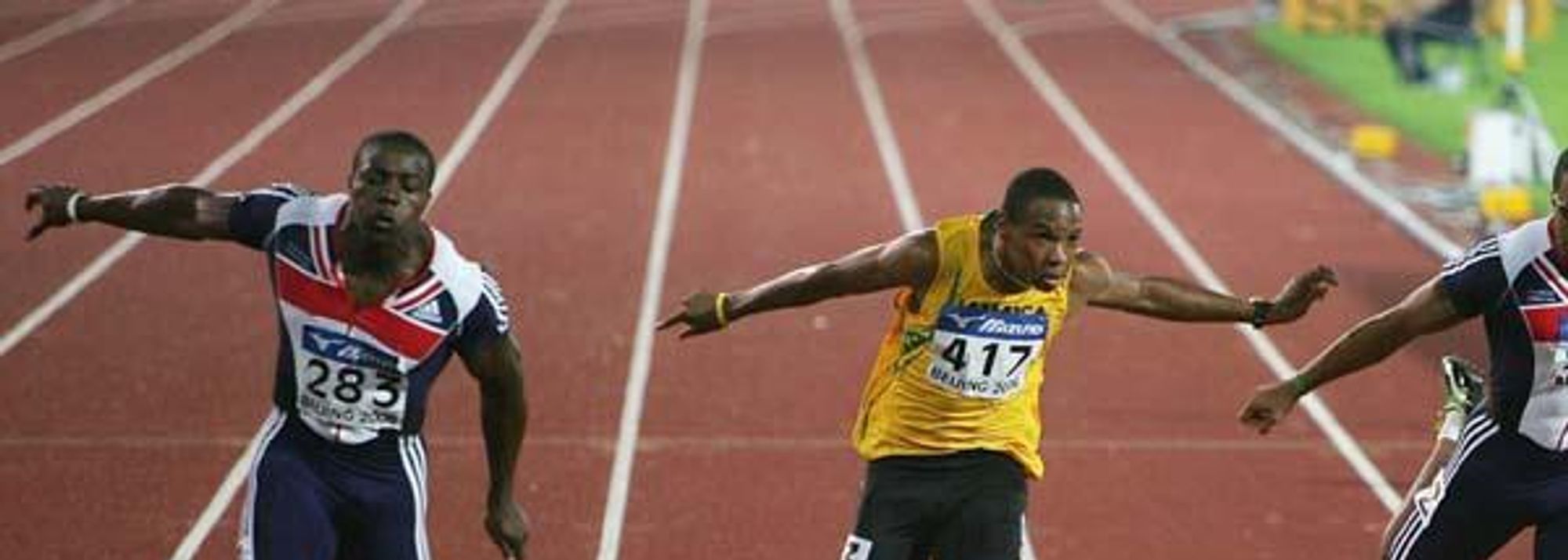


Harry Aikines-Aryeetey of GBR wins the men's 100m final at the 2006 World Juniors in Beijing (© Getty Images)
There were no fewer than 11 finals on offer on a hot afternoon in Kaunas as the European U23 championships entered day two (17).
Harry Aikines Aryeetey of Great Britain returned to the scene of his World Youth triumph in 2005 to capture the European U23 100m title in 10.15. But the good news did not end there for Britain as Leevan Yearwood and Rion Pierre, swooped to snatch bronze and silver.
It was Pierre in lane four alongside the winner in three who got the better start, leaving Aikines Aryeetey with it all to do as he trailed by half a metre after 30m. But Aikines Aryeetey had no intention of being upstaged by a team-mate and he hauled his compatriot in. Meanwhile in lane six Yearwood – with a windy 10.10 from Bislett this year - was closing fast enough to grab silver by 0.02 from Pierre who clocked a PB 10.28.
In the women's 100m final it was the athlete who produced closest to her PB who won the day as Lithuania’s Lina Grincicaite was borne along on a crescendo of noise from the home crowd and held her nerve to take the title in 11.37. Second was Ukrainian, Natalya Pohrebnyak, in 11.45 and getting up in the last few metres to snatch bronze was Poland’s Marika Popowicz (11.50). The big disappointment was the favourite, Ezinne Okparaebo of Norway, who had run 11.29 this summer. The Norwegian got an explosive start and led after 30m, but wilted under the pressure that was applied mid-race by first the Ukrainian to her right and then the winner, who, once she grabbed the lead, never looked like relinquishing it.
One jump and it was all over in the Triple Jump as Greece’s Paraskevi Papachristou leapt 14.34m to pocket gold. It was that simple. Silver went to Romania’s Cristina Bujin with 14.26m in the final round, though her second effort of 14.13m would have sufficed. The Ukraine’s Lilya Kulyk found 13.88m good enough for bronze. Both gold and silver medallists set lifetime bests.
As expected, Denise Hinrichs of Germany collected Shot Put gold with her fourth round heave of 19.18m. Her superiority was such that any of her five valid throws would have sufficed. In silver was Russia’s Irina Tarasova with 17.90m while bronze went to Belarussia’s Alena Kopets with her final throw of 17.72m. That broke the deadlock with the Netherland’s Melissa Boekelman who had two throws measuring the same distance as Kopets’ second best of 17.37m.
The predictions were confirmed in the 400m with Yannick Fonsat of France winning in 45.68, the first five finishers all registering PBs in a pulsating race. Britain’s Nigel Levine took silver 0.10 down, while bronze went to Poland’s Jan Cipiela just 0.03 further back. Starting in lane four, it was the Briton who took the initiative, immediately closing down the stagger on Petros Kiriakidis of Greece on his outside and opening up a lead over Fonsat. If Levine was to pull this off, it would be no more than he deserved for the aggression he has shown in all his races here. Fonsat has an old head on his shoulders, though, and he refused to be drawn by the Briton’s audacious tactics. At the 200m mark the Frenchman made his move but Levine was refusing to give ground and dug in. With 60m to go it was still Levine’s race, but Fonsat, realising the situation was serious, used all his strength to forge a lead which brought him gold.
One shoe Popkova
Natalya Popkova running with only one shoe for the last 5 laps took the women's 10,000m on a gruelling afternoon for distance running in 33:37.31 with Hungary’s Zsofia Erdelyi collecting silver and Serbia’s Azra Erminovic in bronze. The silver and bronze medallists both set lifetime bests. Sviatlana Kudzelich of Belarus towed the field round the early stages of the race in laps varying between 81 and 83secs until Russians Natalya Popkova and Natalya Puchkova took over the pace. Without noticeably increasing their cadence, suddenly the leading group was reduced to five who would fight it out for the medals: the two Russians, Kudzelich, Erminevic and Erdelyi.
With 10 to go it was Kudzelich who started to show signs of struggling with the heat and the pace, but she continued to hold on. With two kilometres to go, the Belarussian finally let go and a gap quickly opened up between her and the leading four. With the Russian duo still at the front it was the turn of Erdelyi and Erminovic to appear to struggle, but the Hungarian responded by splitting the Russians and moving into second. With two to go, Erdelyi suddenly pressed the accelerator, followed by Erminovic with Puchkova detached. Now the three were swopping the lead until at the bell it was down to a Hungary- Russia duel. Popovich took the bell in the lead with Erdelyi in attendance. With 300m to go the Hungarian closed on the Russian but Popkova responded and started to inexorably move away. At the 200m she kicked for home and the race for gold was over.
In an exciting Long Jump final where the medals changed hands several times, Latvia’s Janis Leitis left it late to jump 7.90m with his final effort to clinch gold. Russia’s Pavel Karayev snatched silver from Finland’s Mikko Kivinen by just 1cm, 7.86m to 7.85m. Daniel Ecseki of Hungary had held on to silver with his second round leap of 7.80m until the fifth round but was relegated to fourth in the last two rounds.
Topping the rankings is one thing, but winning an international title in the discus with Russians and Ukrainians in the final is entirely different. But that is what Britain’s Eden Francis did with her third round 57.29m. Second was Russia’s Vera Karmishina (54.48m) while Britain picked up another medal with Jade Nicholls taking bronze just 4cm down in a lifetime best 54.44m.
Kseniya Ustalova of Russia claimed 400m gold in 51.74 but for 350m it looked as though Sorina Nwachukwu would upset the script as she shot off from the gun to open up a huge lead on the powerful Russian trio. Ustalova was on her outside, but by 250m the German had already gobbled up the stagger and flew past her. As she came into the straight, Nwachukwu still looked in control, but that was when she started to tread water. On her inside, Russia’s Kseniya Zadorina was first to come past, but Ustalova was not favourite for nothing. She left it late, though, just managing to scoop gold in by 0.02 with Zadorina winning silver in 51.76 and Anna Sedova making it a clean sweep for the Russians in 52.59, an agonising 0.01 ahead of the struggling German.
The Decathlon three and three quarter lap man-killer made no difference to the standings coming into the race as Eelco Sintnicolaas held onto his lead to win gold for the Netherlands with 8112 points. In silver was Mateo Sossah of France on 7885 while Serbia’s Mihail Dudas took bronze with a total of 7855. Both gold and bronze were won with lifetime bests.
The first final of the day, staged at eight in the morning was the 20km Race Walk. The three fastest women in the field were left to fight it out for the medals alongside the Oak Wood that surrounds Kaunas’ stadium. Fastest coming into the championships was Yelena Shumkina of Russia and she was first across the line in 1:33.05. At the half-way point in 47.16, the medals were already decided. It was just a question of how they would be handed out. Shumkina, compatriot Tatyana Shemyakina and Zuzana Schindlerrova of the Czech Republic were locked together until Shumkina made the definitive break, opening up a six-second gap at the 14km mark. Initially, it looked as though it would be a one-two for the Russian School of Walking, but Schindlerlova stuck to her task and eventually prevailed over the defending champion, Shemyakina, crossing the line 37sec down on the winner with Shemyakina a further 31sec in arrears.
Michael Butcher for the IAAF
Click here for RESULTS

