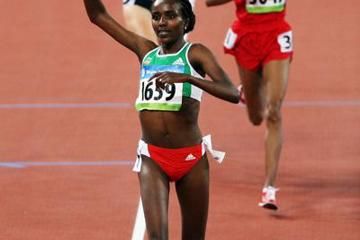


Tirunesh Dibaba records the second fastest time in history to win the women's 10,000m Olympic title in Beijing (© Getty Images)
Any doubts that weather conditions in Beijing would prove uncomfortable for distance runners were swept away on the first evening of athletics in the Bird’s Nest national stadium.
After a gorgeous day, the best of the Olympics so far, the women raced in 26C and slight cloud, and favourite in the 10,000 metres, Tirunesh Dibaba of Ethiopia raced to victory with her trade-mark last lap sprint, relegating long time leader, Elvan Abeylegesse to second place. But both women broke the 30 minute barrier, only the second and third in history to do so, following, appropriately enough a Chinese, Wang Junxia.
Four years ago, in Athens, another Chinese Xing Huina surprised Tirunesh’s elder sister, Ejegayehu with a last lap sprint to victory. There were those who claimed that Ejegayehu though that Xing was a lapped runner re-passing her, and let her go. True or not, her younger sister made no mistake this time, and restored family honour with gold in 29:54.66, for an Olympic and African record.
Abeylegesse won silver with 29:56.34, a European record. While a surprise to some, but not those who have admired US moves to combat African domination of distance running, by setting up sponsored altitude training camps, Shalane Flanagan took the bronze with 30:22.22, an American record. For the record, Linet Masai of Kenya in fourth set a World junior record of 30;26.50, and five of the next eight women set personal bests.
All of that was due in large part to the efforts of Lornah Kiplagat and Abeylegesse to run the legs off the field. Kenyan born Kiplagat, running for the Netherlands admitted afterwards that not being a track runner, she had to try something “differently”. That ‘something’ was to take the field out at 30 minute pace for 16 laps. Unfortunately for her, it didn’t work. When Abeylegesse took over, she gradually dropped back and finished eighth.
Abeylegesse, born in Ethiopia, but a long-time Turkish national, gradually pulled Dibaba away from the rest, with penultimate kilometres of under three minutes, setting up the grand finale, which everyone who has watched Dibaba in recent years demolishing opposition on the last lap, was to come. Sure enough, following tactics that have become a virtual Ethiopian trade-mark since the days of Olympic 5000/10,000m champion, Miruts Yifter in Moscow 1980, ie wait and wait and wait and….. pounce, Dibaba launched her sprint just after the bell.
Abeylegesse gave close chase for 50 metres, but it was a lost cause. Dibaba ran the last kilometre in just over 2min 48sec. And she had an Olympic gold to add to the four World titles, two each at 5000 and 10,000 metres over the last five years. By some oversight, she only took bronze in the shorter distance in Athens, But, having set an extraordinary World record of 14.11.15 in the Golden League in Oslo earlier this summer, she may improve on later this week, after, she says, “discussions with my coach”.
Abeylegesse was more forthcoming on the race itself. “I really wanted to win, I consider I did a good job. But I am still satisfied with second, the gold medallist is a great runner.”
Around ten years ago, Professor Bengt Saltin, the expert on muscular biology rebutted claims that East Africans would dominate distance running forever, thanks to any genetic advantage that they might have accrued from living for thousands of years at altititude.
“That will not happen,” said Saltin, who has conducted extensive research of differences in muscle structure in East Africans and non-Africans. “The Kenyans (and Ethiopians) will move out, go to other countries, inter-marry. So all these genes will be spread out”. With a Kenyan Netherlander setting up the pace throughout the first half, and an Ethiopian Turk ensuring an ultra-rapid second half, that process appears well underway. Yes, an Ethiopian won. But that’s because she happened to be the best one in the race.
Pat Butcher for the IAAF