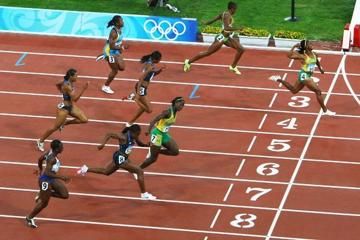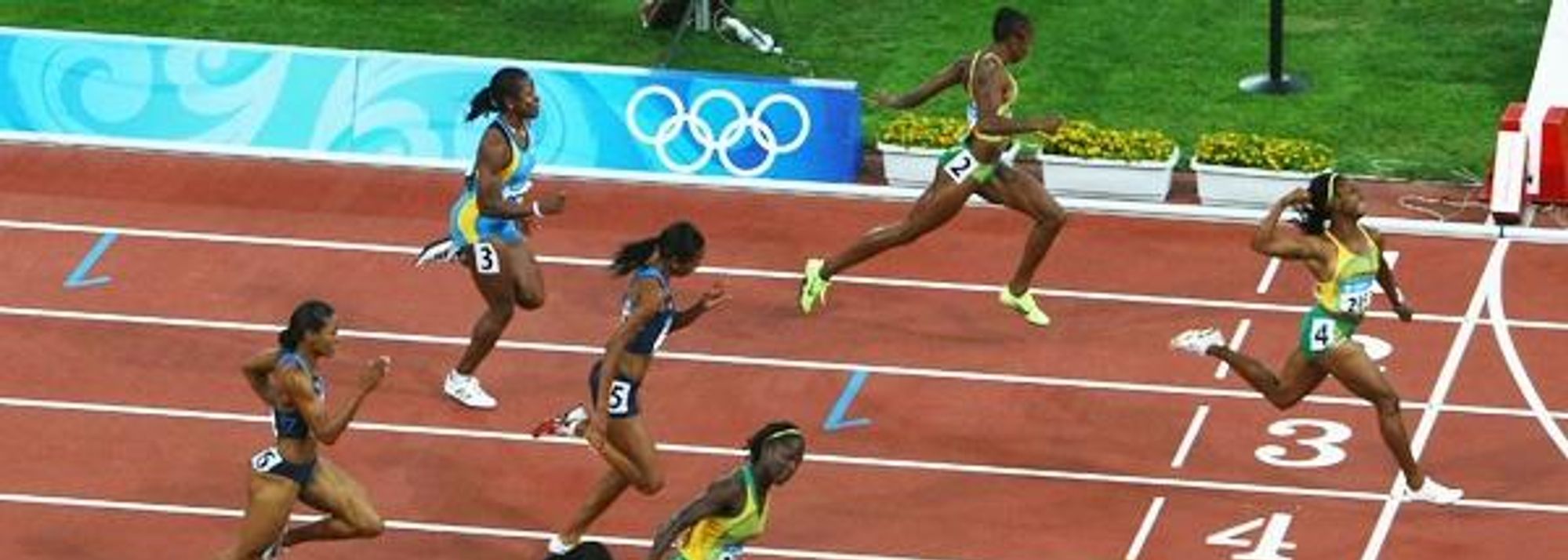


Shelly-Ann Fraser wins the 100m by more than two metres to lead a Jamaican medal sweep with Sherone Simpson and Kerron Stewart sharing the silver (© Getty Images)
The women's Steeplechase was destined to be historic before it even started on Sunday evening at Beijing's National Stadium, the third day of athletics competition at the 29th Olympic Games.
On the 80th anniversary of women first competing in the Olympic Games, a new women's event would be run for the first time, establishing a first Olympic Record and bringing women's events to parity with men's on the track. Then Gulnara Galkina-Samitova dug in, taking the lead almost immediately and pushing hard from the gun.
The World record holder split 2:58.63 for the first 1000m of the 3000m race with a big pack still on behind her, then pulled away as the race approached the second thousand (which Galkina-Samitova reached in 6:01.20). Accelerating into the last third of the race, she went to a flat out sprint after getting over the final barrier and crossed the line in 8:58.81. Pending ratification, that mark will be a new World record (the second of the Games) and the first women's steeple ever under 9:00.
Behind her, it was a melee for the lesser medals. Hard-charging Marta Dominguez of Spain was actually in position for bronze and moving up for silver when she tumbled hard over the 33rd barrier and hit her head on the track. Dazed, she took some seconds to get up and tried to resume the race, but was unable to stay standing without the help of an official for several seconds. Meanwhile, Eunice Jepkorir (KEN) fought off Ekaterina Volkova (RUS), 9:07.41 to 9:07.64, establishing a new African record in the process. National records were set by Cristina Casandra of Romania (9:16.85), Zemzem Ahmed of Ethiopia (9:17.85) and Jennifer Barringer (USA, 9:22.26, an AR for North America).
A sweep for Jamaica
History was made in the women's 100m as well, as Jamaica produced its first Olympic gold medal just as it had in the men's 100m, but also swept all three medals for the first time in the women's event. The last time the men's 100m medals were taken by the same nation in 1912, London, by the USA.
The first start was the live one and Shelly-Ann Fraser made the best of it, getting a slight lead by halfway and building it to the finish line. She won in 10.78, ecstatic, but then had to wait while teammates Sherone Simpson and Kerron Stewart awaited their results.
Stewart and Simpson were so closely matched that both were clocked in 10.979 and rounded to 10.98. With nothing to distinguish them, both will be awarded silver medals.
Athens silver medallist Lauryn Williams was left out of the medals along with the rest of Team USA.
Bekele waits until bell to attack
The men's 10,000m did not feature a sweep (though Ethiopians took gold and silver and had three runners in position to medal with a lap to go), nor was a World record set, but with 1996 and 2000 champion Haile Gebrselassie as his domestique, Ethiopia's Kenenisa Bekele successfully won his second gold at that distance in an Olympic Record time of 27:01.17.
Much of the early pacemaking was handled by Eritreans, first Kidane Tadesse and then former World Cross Country Champion Zersenay Tadese. They set a brisk pace which made the Olympic record possible, but they couldn't shake three Ethiopians, three Kenyans, and the odd Kenyan-born Qatari. There were six men in contention at the bell, and it was only Bekele's 53.42 last lap that gave him the victory over teammate Sileshi "Mr. Silver" Sihine (27:02.77, also under the old Olympic mark). Micah Kogo of Kenya took bronze in 27:04.11; Gebrselassie was sixth in 27:06.68.
Mbango retains with African record
Bekele wasn't even the first to successfully defend an Athens gold medal. As the 10,000m was getting started, the last attempts of the women's Triple Jump confirmed that Francoise Mbango Etone of Cameroon had defended her title, Cameroon's second-ever Olympic gold medal. She did it with a 15.39m leap in the second round, a new Olympic and African record. Tatyana Lebedeva in second was 1cm away from the old record with 15.32m, and Hrysopiyi Devetzi won bronze with a 15.23m leap, also in the second round.
Dita's front running prevails at last
Early Sunday morning the women's Marathon started in Tiananmen Square. Constantina Tomescu Dita of Romania has been a major-marathon stalwart for years, with her trademark being an early breakaway and all cards on the table very early.
She played exactly to form this morning, breaking away from the pack after a relatively slow first half and building a lead of as much as a 80 seconds in a much faster second half.
The pursuit pack, which numbered up to twenty including 2004 silver medallist Catherine Ndereba of Kenya when Dita made her move, decided not to risk covering the move, and thereby conceded the gold medal: this time, Dita was not coming back.
Ndereba and China's Chunxiu Zhou bided their time as the chase pack dwindled to eleven, then ten, then six. Zhou would surge to drop another few runners, then back off short of mounting a campaign to close Dita's lead. Only when Ndereba finally came to the front and joined battle did Zhou commit fully, and together they trimmed Dita's lead to 22 seconds at the finish. Dita won gold in 2:26:44, with Ndereba fighting off Zhou in the last 50m for silver in 2:27:06, Zhou taking bronze in 2:27:07.
Other pre-race favorites fared less well, with 2004 bronze medallist Deena Kastor (USA) dropping out with an apparent foot injury just shy of the 5km mark, and World record holder Paula Radcliffe (GBR) struggling with a calf cramp late in the race and falling to 23rd in 2:32:38. Osaka World Championships bronze medalist Reiko Tosa of Japan also did not finish, and Great Britain's Mara Yamauchi, the Osaka Marathon champion last winter, was 6th in 2:27:29.
Slovenian first
Lest we forget, the men's Hammer Throw produced yet another first: the first athletics gold medal ever for Slovenia. Primusz Kozmus heaved the hammer out to 82.02m in the second round and was barely approached afterward, with Vadim Devyatovsky and Ivan Tsikhon of Belarus at 81.61m and 81.51, respectively.
Parker Morse for the IAAF
Click here for comprehensive event by event reports