

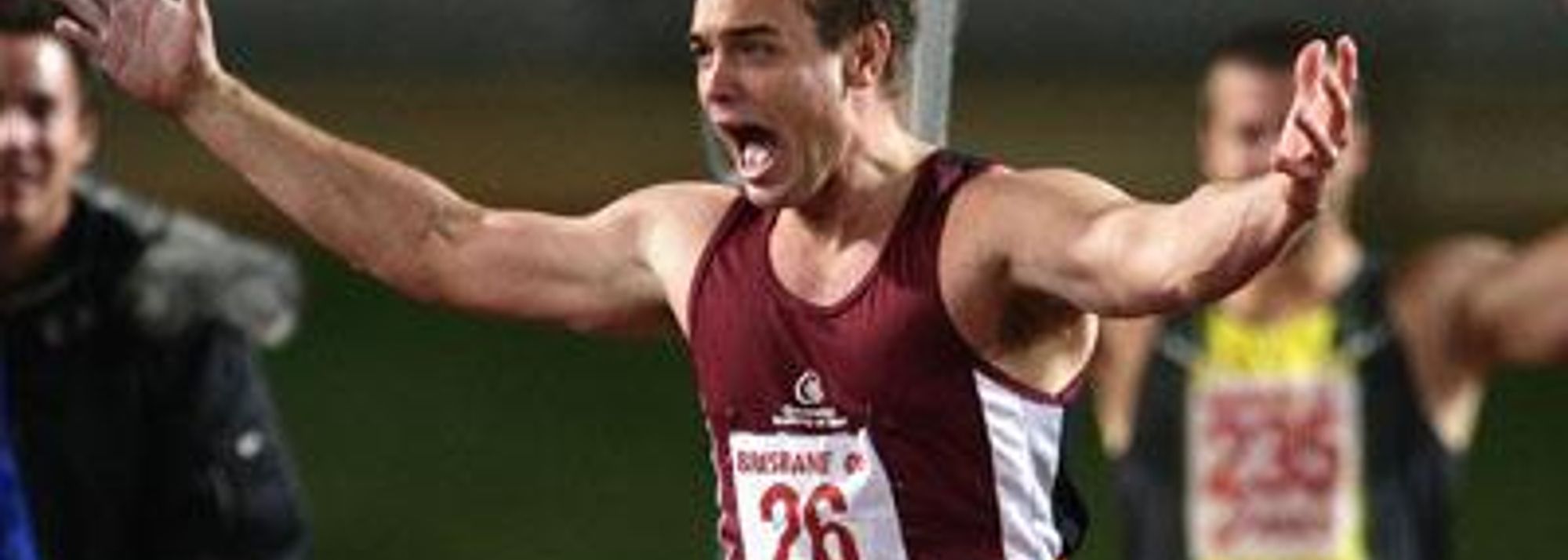


Jarrod Bannister celebrates his Australian record in the javelin (© Getty Images)
When Australia's Jarrod Bannister let rip on 29 February during the national championships at Queensland Sport and Athletics Centre in Brisbane, Australia, it marked the culmination of a long rise to the top. Launching the javelin 89.02m to a new national and Area record, it was clear that at 23, Bannister had finally arrived on the world stage.
What is just as surprising is that towards the end of June with the European outdoor season in full swing that Bannister remains the season’s furthest thrower.
Beginning athletics at age 11, Bannister went straight to the Javelin Throw. "I wasn't big enough for Shot Put or Discus," explains Bannister. A young Bannister split his time between javelin and state level cricket. It was only at 14 that he made the commitment to athletics - a commitment which paid off, as only three years later he would place fourth at the 2002 World Junior Championships in Jamaica.
Melbourne 2006 refired the motivation
In the next few years Bannister would drop off the athletics scene. A chronic elbow injury forced him out of competition, and resulted in his loosing motivation, to the point where he did not record a throw in 2004. But the arrival of the 2006 Commonwealth Games changed all that; the thought of a home Commonwealth Games was enough to give Bannister the desire to compete. "I was always in the gym," says Bannister, "so it was easy enough to get back into competition." Bannister went on to throw a personal best 78.06m to claim sixth in Melbourne that year - and he was back for good.
2007 looked promising in light of Bannister's return to international competition. He claimed his first Australian open championship title, and broke the 80m barrier for the first time, throwing 83.70m. In doing so he qualified for the IAAF World Championships in Osaka. Despite some injury troubles during his preparation, Bannister was confident; "we went into Osaka wanting a medal," he says. Which is why he was so disappointed to bow out in the qualifying round, with a mediocre throw of 77.57m.
But the disappointment of 2007 did little to unsettle Bannister - rather it fuelled his desire for success in 2008. And it was with this in mind that he came out at the National Championships in Brisbane, ready to cement his place in javelin throwing history. "I had been training well," he says, "so we were expecting something in the 86m or 87m range; but it all came together really well!"
Bannister was throwing consistently during the competition, but it was in his last throw that he really let the javelin fly. Having already secured the national title and nomination for Beijing, he charged in for his sixth and final throw with nothing to lose, and came away with a personal best by over five meters.
Bannister seems to rise to the occasion for the Australia titles, also throwing his personal best there in 2007. "It's the national championships," says Bannister, "so you have to throw well! Before you can be the best in the world, you have to be the best in Australia." His throw was all the more amazing as he did it with a niggling injury which he had nursed throughout the domestic season.
Now with all eyes on Beijing, Bannister has learnt from parallels with last year for his 2008 Olympic preparation. Being troubled by injury in the early parts of both 2007 and 2008, he's learnt how to best handle recovery and prepare for the European season and a major championship.
"I injured myself at start of the domestic season," says Bannister, "so I had been throwing injured throughout it. In that way, last year was similar to this year. But now that it's healed, I don't want to make any predictions, but I'm hoping I can throw further."
Needing extra strength
Bannister started training under javelin legend Uwe Hohn in April of this year. Hohn famously was the first to throw the old-style javelin over 100m, when he threw 104.80m in 1984. Bannister is excited about working with Hohn; "He brings the whole package," says Bannister. "He's a World record holder, so he's done it all before."
Bannister’s comment that as a child he “wasn't big enough for Shot Put or Discus" holds true in some ways for his adopted event even today. Hohn’s appraisal of his pupil is that his body has yet to develop sufficient strength to provide an adequate platform on which to throw long consistently and most importantly without injury.
It's Hohn’s experience and guidance that Bannister hopes to harness for Beijing. Indeed there's no doubt Bannister will try his best to be in form and eager come the Games, such is the importance of the Olympics to him.
"Not many people get to compete in an Olympics," he says, "so it's an honour. It has such a rich history, and I would love to add to that history, to leave my name in the record books."
"I want to throw a personal best - that's all you can ask." But he knows that his best may well earn him a spot on the podium.
Bannister has followed Hohn to Europe for the main outdoor season and so far his technique has fallen away with his three competitions - 81.76m, 2nd, Halle, GER 24 May; 78.79m, 8th, Berlin 1 June; 76.87m, 8th, Bislett Oslo 6 June - against much of the world’s existing Northern European especially Nordic elite proving an awe inspiring experience.
Hohn remains confident in the long term. “He (Bannister) has all the necessary qualities, and he is ambitious, he was the one to approach me to be his coach. But throwing in Australia and here in Europe are different worlds, and since he’s been in Europe his technique has fallen apart a little. First we must work on his body’s strength.”
Keeping their powder dry
That Bannister remains at the top of the world list in late June is as surprising as his Area throw itself. After a couple of seasons during which 90m throwing has once again become a reasonably regular occurrence one currently senses that the established men like World champion Tero Pitkämäki and Olympic title holder Andreas Thorkildsen are keeping their powder dry ahead of their Olympic encounter.
In any case it seems Bannister has chosen the right sport to succeed in; he appreciates the solo aspect of the event, and enjoying challenging himself. "In athletics, you're competing against yourself as well as others," he says. But although the personal aspect of the sport - and striving for personal bests - appeals to him, there's no doubting Bannister will be fiercely competitive for the gold in Beijing.
Edward Ovadia and Chris Turner for the IAAF


