

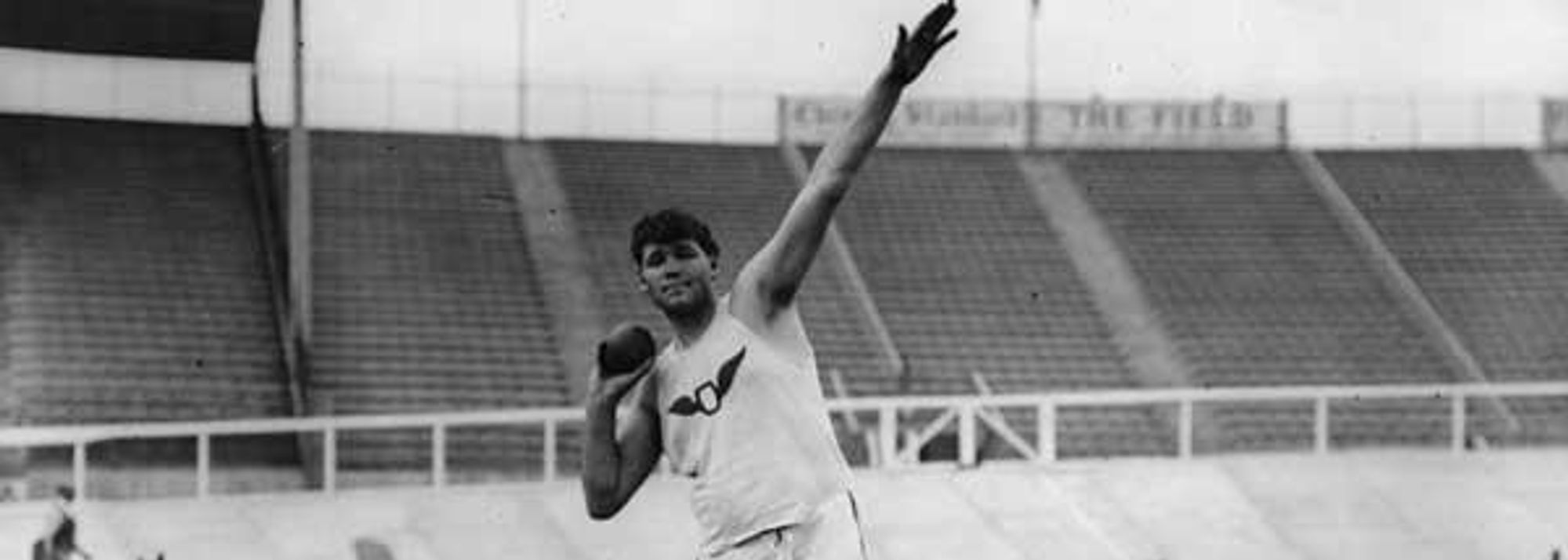


Ralph Rose (USA) - Shot (© Getty Images)
Olympia will play host to an important piece of sporting history when the Athletics celebrations of the XXVIII Olympic Games of the modern era whose centre is the Greek capital Athens, commence on Wednesday 18 August 2004.
The qualification and finals for both the men’s and women’s Olympic Shot Put competitions will take place on that day in the original Olympic stadium.
Continuing our series of lead-in stories to this momentous occasion for our sport, we now bring you the first of a two part history of Olympic Shot Putting.
--------------------------------
For previous features in this series click on the titles below –
"Athletics prepares to return to its roots in Olympia"
- a short history of the ancient Olympic Games
"Views of Olympia"
- What they have to say - The athlete, the coach and the historian
--------------------------------
Men's Shot - American dominance
The men’s Shot Put was one of the original events of the 1896 modern Olympic revival in the Athens and has since been part of every celebration, while as an event for women it made it’s first appearance in the London Olympics of 1948.
1896
American Robert Garrett’s 11.22m win in the inaugural men’s competition was greeted with vociferous disappointment by the local Greek crowd who had expected and desired a Greek winner. Their hopes had been Miltiades Gouskos who finished second with 11.20m, and his colleague Yorgos Papasideris, third with 10.36m, in a field of just seven competitors. This was Olympic competition in its infancy in every respect.
There have been starkly contrasting fortunes for the two nations since that first Olympic outing.
While the USA has gone on to win another 16 Olympic men’s gold medals plus 18 silvers and 11 bronze in the event, Greece has never again come close to a medal, with a couple of fifth places (1900 & 1906 Interim Games) their nearest approach to the podium.
Even with the promising talents of 23 year-old Panayiotis Baharidis (19.06 – 97th in the world and best Greek in 2003) and 22 year-old Mihaíl Stamatóyiannis (18.74 – 123rd in the world 2003) in the wings, there is little hope for the 2004 hosts that the historical script will re-write itself in time for this August’s Games.
This season Baharidis has improved his PB to 19.33m, while Mihaíl Stamatóyiannis has increased his PB to 19.98.
Limited remaining Olympic spoils
Behind the USA’s dominance of men’s Olympic Shot Put history, the limited remaining spoils have principally been shared by three other nations.
Germany has had three wins, thanks to Hans Woellke in 1936, and two GDR wins via Udo Beyer (1976) and Ulf Timmerman (1988). Finland is next best with two gold medals, a win to Ville Pörhola in 1920, and of course the reigning Olympic champion from Sydney 2000, Arsi Harju. The Finns have also taken two silver medals, while the Germans have four bronze to their credit.
The former USSR/EUN teams have accounted for one gold, Vladimir Kiselyov’s win at the US boycotted 1980 Olympics. They can also boost two silver and three bronze places.
Emphasising the USA’s hegemony over this event, only two other nations have set foot on the top rung of the podium. Poland’s Wladyslaw (1972) and Italy’s Alessandro Andrei (1984 – Eastern block boycott) are the other Olympic men’s winners.
1904- 1912 – Ralph Rose and ‘Both Hands’
In 1912, for the first and only time, there was a ‘Both Hands’ competition in 1912 (the winner having the highest aggregate score calculated from the best distance put by each hand) which was won by American Ralph Rose, with compatriot Pat McDonald in second and Finland’s Elmer Niklander in bronze.
Rose was also the first real Olympic Shot maestro with normal competition wins in 1904 and 1908, as well a silver in 1912 to go with his “both hands” win of that year.
1920 - 1928
Rose was the first recognised World record holder of the IAAF era (the world governing body of the sport was founded in 1912), with his 15.54m best which he set on 21 August 1909 lasting as the world’s standard until 1928, when Germany Emil Hirschfeld’s 15.79 put became the first ratified improvement of the American’s mark.
Niklander, the third place finisher in the 1912 'Both Hands' competition had to settle for silver in the 1920 Olympics to his compatriot Ville Pörhola. Niklander had been the outright favourite having dominated the Finnish national title on 11 occasions to Pörhola’s one! However, Olympic competition is not always a respecter of form books, as so many athletes have found in the course of the last 108 years.
The 1924 Olympics saw the title restored to America with Bud Houser leading a medal sweep for the USA.
Though Rose’s 14.81 win in the 1904 Olympics had matched his own world best of the time, the first real World record set in Olympic competition was by American John Kuck in 1928. An all-rounder, who topped the world list for the javelin in 1926, Kuck produced his 15.87 put in the fifth round to upset the hopes of among other Hirschfield, whose record he superseded.
Though Hirschfield was to recapture the World mark later the same year, his bronze in Amsterdam was his best ever finish at the Olympics.
1932 - 1948
The 1932 title went to Leo Sexton in an Olympic record (16.00m), and the next month he established a short lived World record of 16.16m, which was improved upon by the Czech Frantisek Douda (16.20), who had taken the Olympic bronze behind the American (15.61).
The Berlin Olympics in 1936 brought the first non American winner since 1920, as Germany’s Hans Woellke won in an Olympic record (16.20) from Finland’s Sulo Bärland (16.12). However, more significantly with Germany’s Gerhard Stöck taking the bronze this was the first time America had been kept off the medal podium in the history of the event! Not until 1976 would the USA again suffer such a disaster.
As if to make amends the USA led by Wilbur Thompson swept the medals in 1948 at the next celebration after the long Olympic gap caused by World War II. Even the worst of the American finishers was almost a metre ahead of the rest of the world in those post-war London Games.
Parry O’Brien
Most athletics disciplines can point to an athlete who has revolutionised the event, and in the men’s Shot Put’s case it is USA’s Parry O’Brien who the event can largely thank for it’s modern development.
To quote the great Athletics historian Roberto L. Quercetani (‘Athletics’, pub 1990), “O’Brien set a record of consistency and durability that still stands among the greatest in the history of athletics.”
O’Brien won the Olympic titles in Helsinki (1952) and Melbourne (1956), and the silver in Rome (1960). He advanced the World record from 18.00m (1953) to 19.53 (1959). Undefeated in 116 consecutive Shot contests from June 1952 to June 1956, he was also a leading discus thrower.
His technique utilised the full diameter of the Shot circle, so increasing the arc that the Shot had to travel before leaving the athlete, and as a result distances grew dramatically
In four editions of the Olympics between 1948 and 1960, the Americans won eleven out of the twelve medals at stake.
Bill Nieder headed O’Brien with a third round 19.68 Olympic record to take the 1960 Rome win, and USA victories followed in 1964 and 1968 thanks to Olympic records by Dallas Long (20.33) and Randy Matson (20.54) respectively. Both men were also multiple World record breakers in their careers with the latter taking the event to a 21.78m high by the end of the 1960’s.
1972 – Polish win
1972 brought a win for Poland’s Wladyslaw Komar whose 21.18 was an Olympic record, one of 20 valid attempts over Matson’s old Games mark achieved by the top six throwers in the final! Komar’s margin of victory over silver medallist George Woods was just 1cm.
A total of just five centimetres separated gold from bronze in Montreal 1976. East Germany’s Udo Beyer won ahead of Russia’s Yevgeniy Mironov (URS) and Aleksandr Baryshnikov (URS). Gold 21.05, Silver 21.03 and Bronze 21.00!
Beyer lost out to Baryshnikov four years later but both men were bested by Ukraine’s Vladimir Kiselyov (21.35 Oly rec) in the American boycotted Moscow Games of 1980. When the East didn’t turn up in a 'tit for tat' cold war gesture four years later, it was Italy’s Alessandro Andrei who dominated (21.36) ahead of three Americans.
1988 – highest quality
The highest quality competition in Olympic history took place in Seoul in 1988 with East German Ulf Timmerman, who had taken the World record past 23 metres for the first time in the May of that year (23.06), won a 22m duel, 22.47 to 22.39. The silver medallist was USA’s Randy Barnes who within two years was to set the current World record of 23.12.
Switzerland's 1987 World champion Werner Günthor was the bronze medallist with 21.99, a distance which would have won the gold at every previous Olympics!
1992 - 2000
Mike Stulce regained the Olympic title for America in 1992 (21.70) and he was succeeded in 1996 by Barnes who waited until the last round to produce his winning 21.62 effort.
In 1996 John Godina, who like Günthor had been in 1988, was the reigning World champion coming into the Atlanta Olympics tokk the bronze behind Barnes.
Also like the Swiss, Godina has so far taken three World titles in his career. The three-time former World champion will be a major player for gold in Athens, along with his compatriots Adam Nelson and Reese Hoffa.
Finally, Godina and Nelson (silver) were beaten in Sydney 2000 by Finland’s Arsi Harju who took his victory with a second round PB of 21.29m. It was Finland’s first Olympic Shot title in 80 years, its first medal in the event since 1936 (silver), and the country’s best Shot showing since a fourth place in 1980.
Chris Turner
IAAF Editorial Manager
NOTE- Part Two tomorrow: Women's Olympic Shot History


